Appliance Removal in Texas: Cost and Where Each Appliance Can Go (2026)
Having a refrigerator hauled away costs about $97 to $194 in Texas, and a washer, dryer or stove about $87 to $165. Here's what appliance removal costs, which city pickups take which appliances, and why refrigerators need special handling.
By the Texas Junk Guys team · Updated November 12, 2026
Having a junk removal company haul away a refrigerator costs about $97 to $194 in Texas, and a washer, dryer, stove or oven about $87 to $165, according to Junk Cost Calculator's Texas page (checked November 2026). A dishwasher runs about $68 to $136. If the appliance goes out with other junk, it usually becomes part of a bigger load priced by how much of the truck you fill.
You may not need to pay at all. Most big Texas cities pick up washers, dryers, stoves and water heaters at the curb with bulk trash, many stores haul away the old appliance when they deliver a new one, and scrap metal recyclers take most appliances because they're mostly steel. Refrigerators, freezers and AC units are the exception, because of the refrigerant inside. This guide covers what each option costs, which cities take which appliances, and how to get one ready to go.
Quick answer: In Texas, junk removal costs about $97–$194 for a refrigerator, $87–$165 for a washer, dryer, stove or oven, and $68–$136 for a dishwasher (Junk Cost Calculator, November 2026). The cheapest options are your city's bulk trash pickup, a city drop-off site or the store's haul-away when you buy a new one. Refrigerators, freezers and AC units hold refrigerant that federal rules say must be recovered before they're scrapped or landfilled, so many city curbside programs won't take them. These are typical figures, not quotes.
This post is part of our complete guide to junk removal in Texas, which covers how junk removal works from start to finish.
How much does appliance removal cost in Texas?
Junk removal companies price one appliance as a single item, or include it in a load priced by truck space. Junk Cost Calculator's Texas figures:
| What you're getting rid of | Typical Texas price |
|---|---|
| Dishwasher | $68–$136 |
| Washer or dryer | $87–$165 |
| Stove or oven | $87–$165 |
| Refrigerator | $97–$194 |
| Minimum charge (1 to 2 items) | $97–$170 |
| Quarter truck (a washer-dryer pair and more) | $146–$291 |
Source: Junk Cost Calculator, Junk removal cost in Texas, checked November 11, 2026. "A washer-dryer pair and more" is our rough guide to what a quarter truck holds, not the source's. Prices vary by company, city and how hard the appliance is to reach.
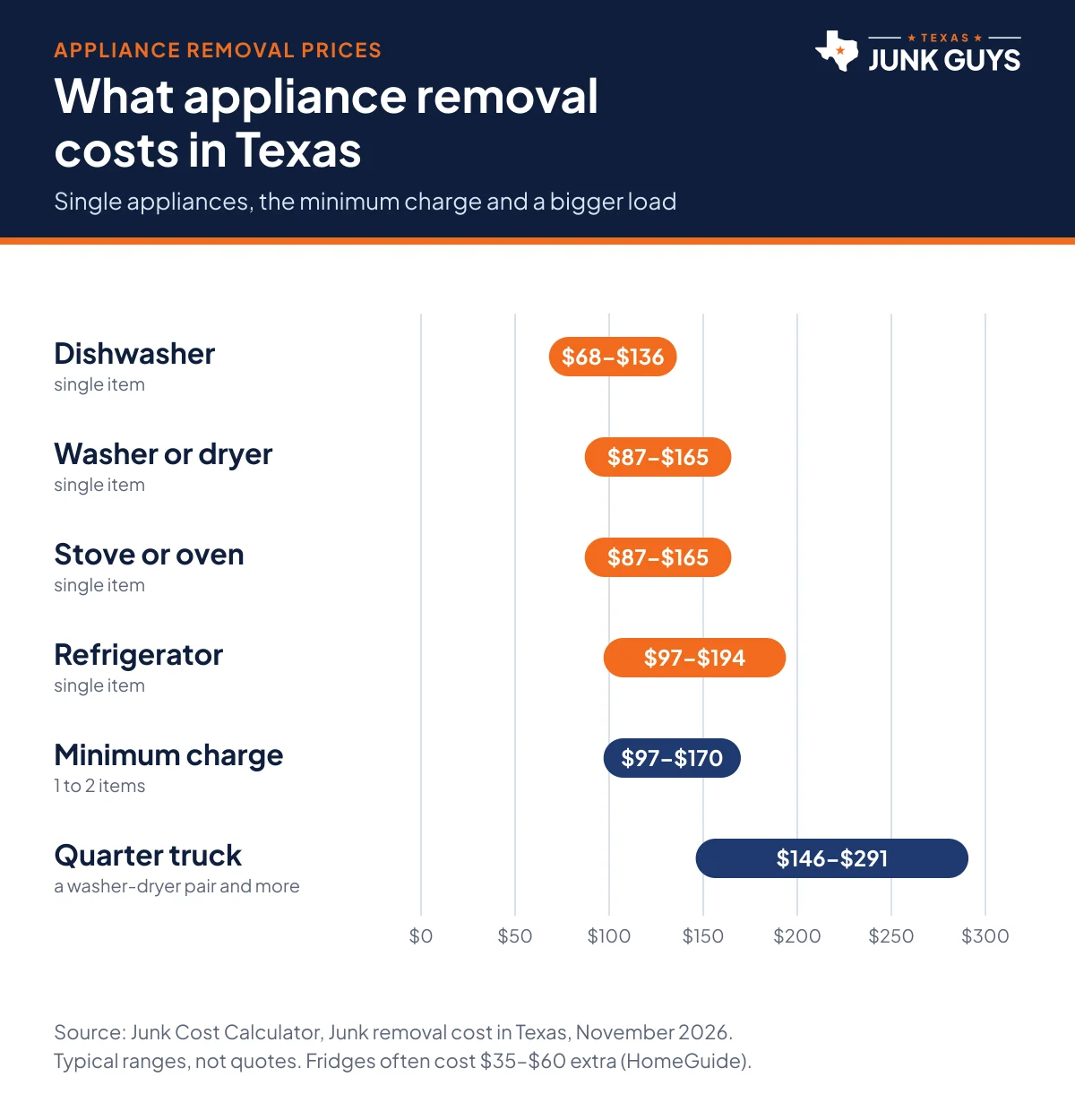
HomeGuide's national figures are close. It puts washer or dryer removal at about $70 to $205, and lists a surcharge of $35 to $60 each for refrigerators, freezers and AC units, because of the extra work and the refrigerant. Junk Cost Calculator doesn't say whether its refrigerator range includes a surcharge like that, so ask when you get a quote. For prices across every kind of junk and each big Texas metro, see our guide to junk removal costs in Texas.
What pushes the price up
- The minimum charge. Most companies won't come out for less than their minimum, about $97 to $170 in Texas. One appliance on its own often costs the minimum, so it's worth adding anything else you've been meaning to get rid of.
- Refrigerant. Fridges, freezers, window AC units and dehumidifiers often carry an extra charge, since the refrigerant has to be recovered before the appliance can be scrapped.
- Weight and stairs. A full-size refrigerator or a chest freezer from a second-floor apartment with no elevator takes more work than a washer in the garage. Ask whether the quote includes stairs.
- Disconnecting it. Many crews only carry. If the appliance is still hooked up to water or gas, you may need to have it disconnected first, or pay extra if the company does it.
- Built-ins. Wall ovens, cooktops and built-in dishwashers have to be taken out of the cabinets before they can be hauled. Ask whether removal is included or whether you need a plumber or electrician first.
Ways to pay less
- Have it ready at the curb or in the garage. Some companies charge less when they don't have to carry anything through the house.
- Book it with other items. If the appliance is one of several things going, ask for a load price rather than per-item prices.
- Try the free options first. A washer or stove in working order often goes quickly if you list it for free, and the city will usually take one that doesn't work.
- Get two or three quotes. Prices for a single item vary a lot between companies.
Why refrigerators, freezers and AC units are different
Refrigerators, freezers, window air conditioners and dehumidifiers hold refrigerant. Under federal rules from the U.S. Environmental Protection Agency (40 CFR §82.155), that refrigerant has to be recovered before the appliance is scrapped or landfilled.
The rule puts the duty on the last business in the disposal chain, usually the scrap recycler or the landfill. It has to recover the refrigerant itself, or get a signed statement giving the name and address of whoever recovered it and the date. The EPA says it doesn't accept a sticker as proof on its own. If the refrigerant has already leaked out, the recycler or landfill needs a signed statement saying so.
For a homeowner, that means:
- Many cities won't take them at the curb. Dallas and Fort Worth don't. Houston takes them only with a certified technician's tag showing the refrigerant has been removed.
- Scrap yards and landfills may ask questions. Expect to sign a statement, show who recovered the refrigerant, or pay a fee for the yard to do it.
- Junk removal companies take them, often with a surcharge, and handle the paperwork with the recycler.
- Never cut the lines yourself. Federal rules ban knowingly releasing refrigerant, and cutting lines doesn't count as a leak under the disposal rule.
Washers, dryers, stoves, ovens, dishwashers and water heaters have no refrigerant, so none of this applies to them. Small items like a wine cooler or a mini fridge still do, even though they're small.
What are your options for getting rid of an appliance?
| Option | Typical cost | How fast | Best for |
|---|---|---|---|
| Junk removal pickup | $68–$194 for one | Often same or next day | Heavy, upstairs or refrigerant appliances |
| Store haul-away with a new one | Free to a fee | On delivery day | Replacing the appliance anyway |
| City bulk trash pickup | Usually included in your bill | Your next collection day | Washers, dryers, stoves and water heaters |
| Drop-off at a city site or landfill | Free to a gate fee | Whenever you can haul it | Anyone with a pickup or trailer |
| Scrap metal recycler | Free, or a little cash | Whenever you can haul it | Non-refrigerant appliances, if you can lift |
| Sell, give away or donate | Free | Days to weeks | Appliances that still work and look clean |
Junk removal price: Junk Cost Calculator, Texas, November 2026. Other costs vary by city, store and recycler, so check before you rely on them.
Hire a junk removal company
It's the easiest option, and often the only practical one for a refrigerator. A crew of two carries the appliance out from wherever it is, loads it and takes it away, usually in one short visit. You don't need a truck or a dolly, and you don't have to get a refrigerator down the stairs yourself.
Ask what happens to it afterward. Depending on the company, working appliances may be resold or donated, and the rest usually go to a scrap metal recycler. Most companies can tell you which, and whether they handle refrigerant recovery or pass it to the recycler.
Let the store take the old one
If you're buying a new appliance, ask about haul-away when you order. Many retailers offer to take the old one when they deliver the new one, sometimes free and sometimes for a fee. It's usually the simplest option, since the delivery crew is already in your kitchen or laundry room with a dolly.
A few things to check when you buy:
- Is haul-away included, or is there a charge?
- Does the old appliance need to be disconnected and empty before they arrive?
- Will they take it from the basement, garage or upstairs?
- Will they take an appliance that isn't the same type as the one you bought?
Use your city's bulk trash pickup
Most big Texas cities pick up washers, dryers, stoves and water heaters at the curb with bulk or heavy trash, at no extra charge to residents on city service. Refrigerators and AC units are where the rules split:
| City | Washers, dryers, stoves, water heaters | Refrigerators, freezers, AC units at the curb |
|---|---|---|
| Dallas | Accepted | Not accepted |
| Fort Worth | Accepted | Not accepted |
| Houston | Accepted | Only with a technician's tag (refrigerant removed) |
| San Antonio | Accepted ("large appliances") | Not singled out; check with 3-1-1 |
| Austin | Accepted (doors removed) | Appliances accepted, no refrigerant rule listed |
Sources: each city's bulk or heavy trash page, checked November 2026. Rules change, so check your city's page before you set anything out.
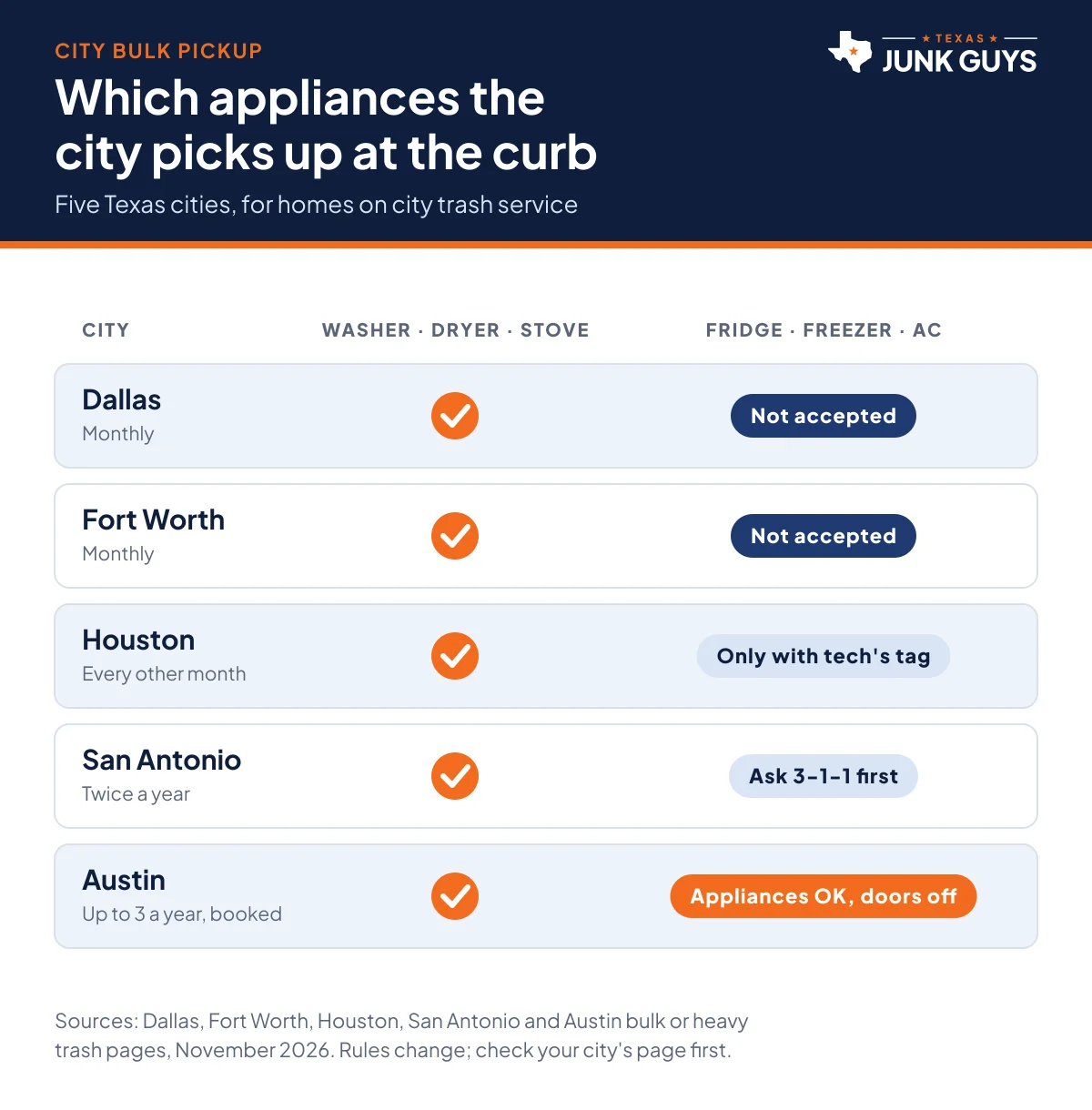
The details for each city:
- Dallas picks up brush and bulky items once a month. Stoves, washers, dryers and water heaters are fine. Appliances that contain coolant, gas or other chemicals are not, which rules out refrigerators, freezers, air conditioners, dehumidifiers and lawnmowers. Microwaves count as electronics in Dallas and aren't taken either. Our guide to bulk trash pickup in Dallas covers the schedule, the 10 cubic yard limit and where to put the pile.
- Fort Worth collects bulk waste monthly, up to 10 cubic yards, but doesn't take appliances with coolant or gas at the curb, such as refrigerators and AC units. Its drop-off stations do take refrigerators and AC units with the refrigerant still in.
- Houston collects heavy trash every other month, up to six times a year. Stoves, washers, dryers and water heaters are accepted. Refrigerators and freezers go only with a certified technician's tag showing the refrigerant has been removed, and the city won't take appliances containing gas, chemicals or coolant otherwise. If allowed and banned items are mixed, the city can refuse the whole pile.
- San Antonio collects bulky items at the curb twice a year, and its accepted list includes large appliances and water heaters. Its curbside page doesn't single out refrigerators, so call 3-1-1 before you set one out.
- Austin moved to on-demand bulk collection: you book one of up to three bulk pickups a year through the Austin Recycles app, online or by calling 3-1-1. Appliances are accepted with the doors removed, and go in a separate pile with other metal items, electronics and rigid plastics. The city says it recycles every appliance it collects.
Two things go for every city. Don't put an appliance out early, because many cities tag or fine piles set out before the allowed window. And expect scrappers: metal appliances often disappear from the curb before the city truck comes, which is normal.
For bulk pickup rules in more cities, and every other way to clear things out, see our guide to getting rid of junk in Texas.
Drop it off yourself
If you have a pickup truck or trailer and help lifting, you can take an appliance to a city drop-off site, transfer station or landfill. Some cities let residents drop off appliances free. Dallas accepts appliances at its landfill and transfer stations once the refrigerant has been removed. Houston's residential drop-off centers want the same technician's tag for refrigerators as its curbside program. Fort Worth's drop-off stations take refrigerators and AC units with the refrigerant still in, unlike its curb. Austin's Recycle and Reuse Center takes appliances by appointment.
Elsewhere, expect a gate fee, and call ahead to ask whether the site takes appliances with refrigerant and what paperwork it wants.
Use a proper appliance dolly and straps. Keep refrigerators and freezers upright if you can, and tie everything down well. An appliance that slides out of a truck bed onto the highway is a hazard and a littering problem.
Take it to a scrap metal recycler
Washers, dryers, stoves, water heaters and dishwashers are mostly steel, so scrap yards take them, and some pay a little by weight. The payout for one appliance is usually small, and the main benefit is that it's free. Call first to ask whether they take appliances, what they pay, and whether they want ID. Many yards ask for a photo ID from anyone selling scrap.
Refrigerators, freezers and AC units are different. Under the federal rule above, the yard has to recover the refrigerant or get a signed statement that it's been done, so many yards charge a fee, ask for proof, or won't take them at all.
Sell it, give it away or donate it
A working washer, dryer, stove or refrigerator that's clean often goes quickly when listed online, even free. Be honest in the listing about its age and any problems, and ask the buyer to bring help and a dolly.
Some charity thrift stores and reuse centers accept working appliances, and a few pick them up. Many have rules about age, condition and refrigerant appliances, so call before you load one up. Ask for a donation receipt if you plan to claim a tax deduction.
It's also worth asking your electric utility whether it runs an appliance recycling or rebate program for old refrigerators and freezers. Programs come and go, and they aren't offered everywhere in Texas.
Where does each appliance go?
| Appliance | Refrigerant? | Easiest free option | Watch out for |
|---|---|---|---|
| Refrigerator or freezer | Yes | Store haul-away when you buy a new one | Not taken at the curb in Dallas or Fort Worth |
| Window AC unit or dehumidifier | Yes | Store haul-away, or a drop-off that takes them | Same refrigerant rules as a fridge |
| Washer or dryer | No | City bulk pickup or scrap | Drain the washer and cap the dryer gas line |
| Stove or oven | No | City bulk pickup or scrap | Gas stoves need a qualified person to disconnect |
| Dishwasher | No | City bulk pickup or scrap | Built-in: has to come out of the cabinet first |
| Water heater | No | City bulk pickup or scrap | Drain it fully, and shut off the gas or power |
| Microwave | No | Electronics drop-off | Dallas treats it as electronics, not bulk trash |
City rules: Dallas, Houston, Fort Worth, San Antonio and Austin bulk trash pages, November 2026. Refrigerant rule: U.S. EPA, 40 CFR §82.155.
How to get an appliance ready for removal
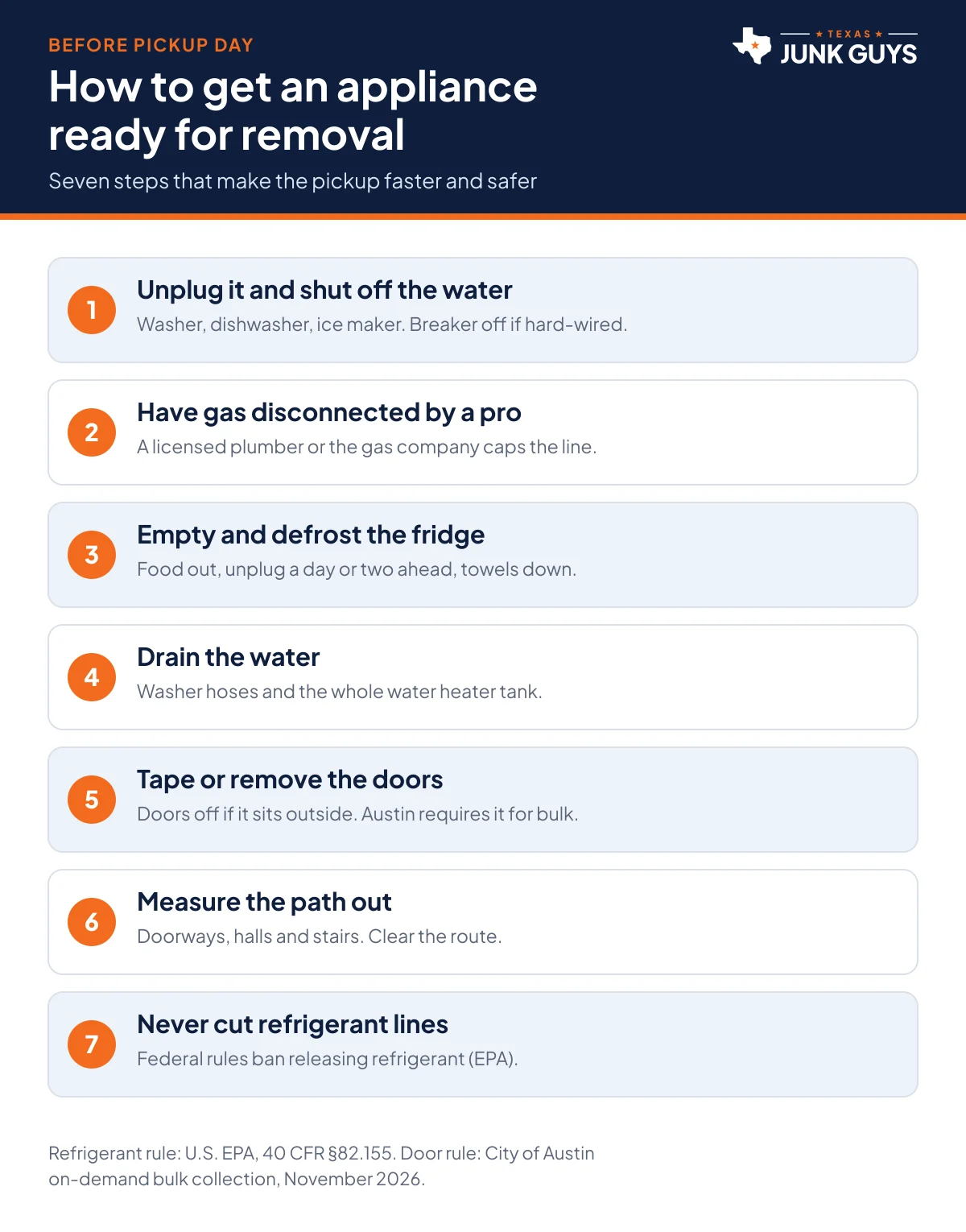
Whichever way it's going, a little prep makes the pickup faster, cheaper and safer.
- Unplug it and shut off the supply. Turn off the water valves for a washer, dishwasher or fridge with an ice maker, and turn off the breaker for anything hard-wired.
- Have gas appliances disconnected by someone qualified. A gas stove, dryer or water heater should be disconnected and the line capped by a licensed plumber or your gas company, not pulled loose by a hauling crew.
- Empty and defrost the fridge or freezer. Take out all the food, unplug it a day or two ahead, and leave the door open with towels down so it can drain.
- Drain water. Run a washer's drain cycle and empty the hoses. Drain a water heater fully, since a full 40-gallon tank holds hundreds of pounds of water.
- Secure or remove the doors. Tape fridge and freezer doors shut for the move. If one has to sit outside, take the doors off, as Austin requires for bulk pickup. A child can get trapped inside an old refrigerator.
- Measure the path. Check doorways, halls and stairs, and clear a route from the appliance to the door or curb.
- Mention anything unusual when you book: stairs, a long carry, a built-in, a gas line or a refrigerant appliance. It keeps the price you're quoted close to the final one.
Appliance removal or a dumpster?
For one or two appliances, junk removal or the city's bulk pickup is almost always simpler and cheaper than a dumpster. Many dumpster companies also restrict refrigerators, freezers and AC units, or charge extra for them, because of the refrigerant.
A dumpster makes more sense when appliances are a small part of a kitchen remodel or a whole-house cleanout and you're doing the loading yourself. Even then, ask the dumpster company which appliances it accepts, and plan to send refrigerant appliances another way.
Questions to ask before you book appliance removal
- Is the price for one appliance, or is there a minimum charge?
- Do you charge extra for a refrigerator, freezer or AC unit?
- Do you disconnect water lines, or does it need to be done before you arrive? What about gas?
- Does the price include stairs or a long carry?
- Where does it go: resale, donation, a scrap recycler or a landfill? Who recovers the refrigerant?
- Can you come today or tomorrow, and is there a charge for same-day pickup?
To compare companies in your area, pick your city on our junk removal page. You can call a company directly or send one free quote request.
Sources
Prices in this guide come from third-party cost guides. They are typical ranges, not quotes from any company. City rules come from the cities' own websites and can change, so check yours before you set anything out.
- Junk Cost Calculator, Junk removal cost in Texas (2026 figures), checked November 11, 2026. Texas prices for a refrigerator, washer or dryer, stove or oven and dishwasher, the minimum charge and prices by load size.
- HomeGuide, How Much Does Junk & Trash Removal Cost?, checked November 11, 2026. National washer and dryer removal price and the surcharge for refrigerators, freezers and AC units.
- U.S. Environmental Protection Agency, Stationary Refrigeration Safe Disposal Requirements (last updated March 23, 2026), and 40 CFR §82.155, Safe disposal of appliances, checked November 11, 2026. Who has to recover refrigerant, signed statements, stickers, leaked refrigerant and the venting ban.
- City of Dallas Sanitation, Brush and Bulky Item Collection (dallascityhall.com), as published in 2026, checked November 11, 2026, and its Landfill and Transfer Stations page, checked November 7, 2026. Accepted and banned appliances, electronics, and drop-off of appliances with the refrigerant removed.
- City of Houston Solid Waste Management Department, Heavy Trash Collection (houstontx.gov), as published in 2026, checked November 11, 2026, and its Residential Drop-Off Centers pages (2026). Accepted appliances and the technician's tag rule.
- City of Fort Worth Environmental Services, Bulk Trash Collection and Drop-Off Stations (fortworthtexas.gov), checked November 8, 2026. Banned coolant and gas appliances at the curb, and refrigerators and AC units at drop-off stations.
- City of San Antonio Solid Waste Management Department, Curbside Brush and Bulky Item Collection (sa.gov), as published in 2026, checked November 11, 2026. Twice-yearly collection and accepted items.
- City of Austin, Austin Resource Recovery, On-Demand Bulk, Brush and Household Hazardous Waste Collection (austintexas.gov/ondemand), checked November 11, 2026. Appointments, accepted appliances with doors removed, the metal pile and the city's recycling of collected appliances. Recycle and Reuse Center as checked for our guide to getting rid of junk, November 2026.
Frequently asked questions
- How much does appliance removal cost in Texas?
- About $97 to $194 for a refrigerator, $87 to $165 for a washer, dryer, stove or oven, and $68 to $136 for a dishwasher, according to Junk Cost Calculator's Texas page (November 2026). Most companies have a minimum charge of about $97 to $170, and many add $35 to $60 for refrigerators, freezers and AC units (HomeGuide).
- How do I get rid of an old appliance for free in Texas?
- Put washers, dryers, stoves and water heaters out with your city's bulk trash pickup, take them to a free resident drop-off site, or haul them to a scrap metal recycler. If you're buying a new appliance, ask the store whether haul-away is free. A working appliance can often be given away or sold.
- Will the city pick up a refrigerator in Texas?
- It depends on the city. Dallas and Fort Worth don't take refrigerators, freezers or AC units at the curb. Houston takes them only with a certified technician's tag showing the refrigerant has been removed. Austin's on-demand bulk pickup takes appliances with the doors removed, and San Antonio takes large appliances but doesn't single out refrigerators, so check with 3-1-1.
- Why do refrigerators cost extra to get rid of?
- Refrigerators, freezers and AC units hold refrigerant, and federal EPA rules require it to be recovered before the appliance is scrapped or landfilled. The recycler or landfill has to recover it or get a signed statement saying who did. That extra step is why many haulers charge a surcharge and many city curbside programs won't take them.
- Can I take an appliance to a scrap yard in Texas?
- Yes, most scrap metal recyclers take washers, dryers, stoves, water heaters and dishwashers, and some pay a little by weight. Call ahead and bring a photo ID. For refrigerators, freezers and AC units, expect the yard to charge a fee, ask for proof the refrigerant was recovered, or refuse them.
- Will stores haul away my old appliance?
- Many retailers will take your old appliance when they deliver a new one, sometimes free and sometimes for a fee. Ask when you order, and check whether it needs to be disconnected and emptied before the delivery crew arrives.
- How do I prepare a refrigerator for removal?
- Take out all the food, unplug it a day or two ahead and let it defrost with the door open and towels down. Turn off the water to the ice maker, then tape the doors shut for the move. If it has to sit outside, remove the doors so a child can't get trapped. Never cut the refrigerant lines.
This guide is general information, not advice about any particular company. Prices, sizes and rules vary by company and city, so confirm the details with the company you hire. How we list companies.