Junk Removal in Texas: The Complete Guide (2026)
Everything a Texas homeowner needs to know before booking junk removal: how it works, what it costs, what crews will and won't haul, how to get ready, and the questions to ask before you hire.
By the Texas Junk Guys team · Updated October 28, 2026

Junk removal in Texas works like this: you book a time, a two-person crew shows up with a box truck, looks at what you want gone and quotes a price based on how much of the truck it will fill. If you agree, they carry everything out, load it and haul it to a landfill, recycler or donation center. A half truckload costs about $291 to $504 in Texas, according to Junk Cost Calculator's Texas page (checked October 2026).
The details that catch people out are what the crew won't take, the extra fees for heavy or special items, and how much prep is worth doing before the truck arrives. This guide covers the whole process, with the Texas details that matter: state landfill rules, big-metro prices, city bulk trash, HOAs, summer heat and storm cleanup.
Quick answer: Most Texas junk removal companies price by volume. Expect roughly $97–$170 for a minimum pickup of one or two items, $291–$504 for a half truck and $534–$970 for a full truck (Junk Cost Calculator, Texas, October 2026), with extra charges for things like refrigerators, pianos, hot tubs and heavy debris. Crews take almost anything non-hazardous: furniture, appliances, mattresses, electronics, yard waste and household clutter. They won't take paint, chemicals, fuel, car batteries or other hazardous waste. These are typical ranges from third-party guides, not quotes.
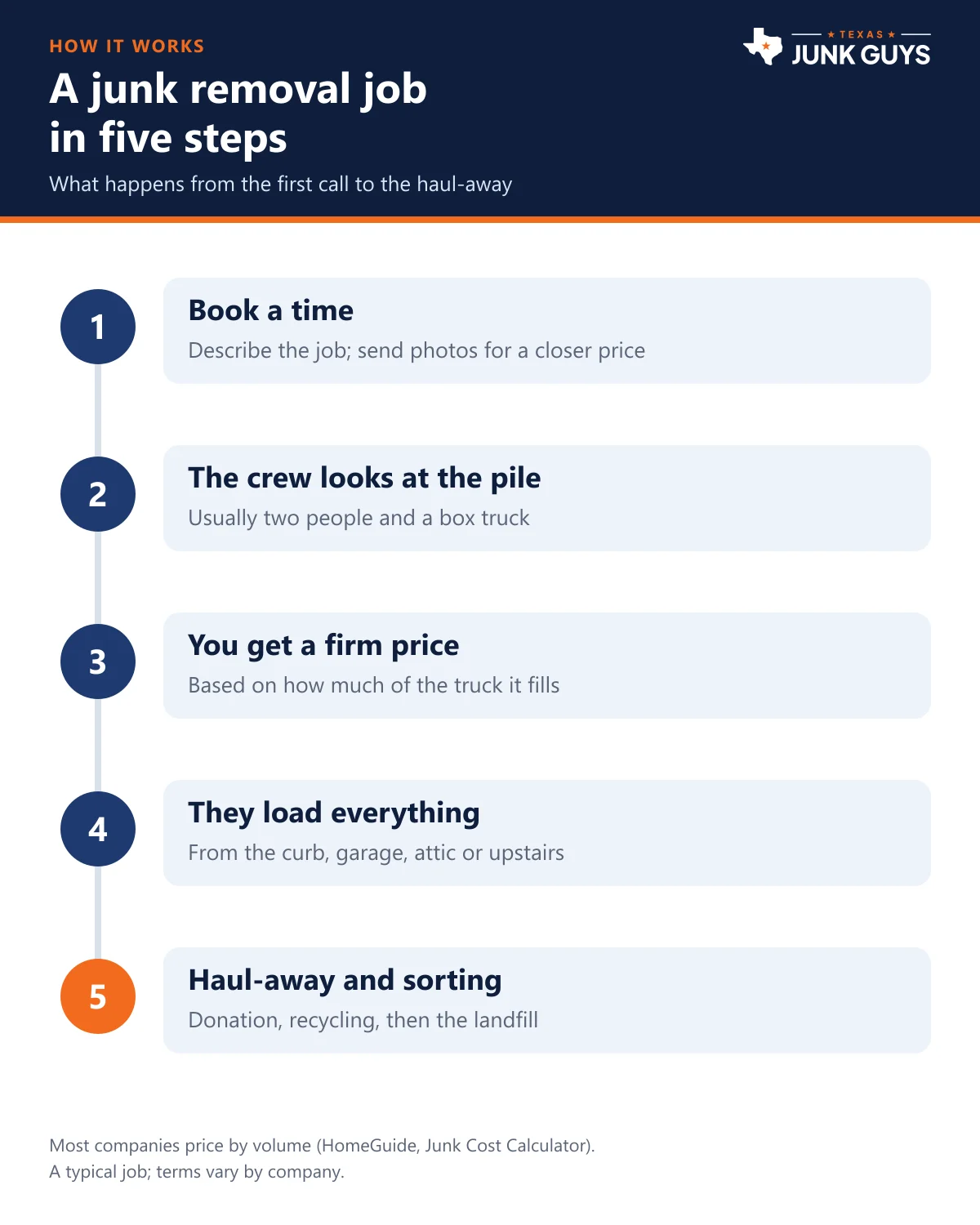
How junk removal works
Nearly every home junk removal job in Texas follows the same five steps.
- You book a time. You call or fill in a form, describe what you're getting rid of and pick a slot. Many companies give a rough price range over the phone or from photos.
- The crew arrives and looks at the pile. Usually two people and a box truck. They see how much space your items will take and check for anything that costs extra or that they can't take.
- You get a firm price. The crew quotes a price for the share of the truck your items will fill. Nothing happens until you agree to it.
- They load everything. The crew carries items out from wherever they are: the curb, the garage, an upstairs bedroom, the attic or the backyard. Most sweep up the spot when they're done.
- They haul it away and sort it. Usable items may go to a charity, metal and electronics to recyclers, and the rest to a landfill or transfer station. You pay, usually on the spot.
The whole visit for a typical household job takes under an hour or two. Big cleanouts can take most of a day, or more than one truckload.
What makes it different from other options
The big difference is who does the work. With junk removal you don't lift anything, rent anything or drive anywhere. That convenience is what you're paying for. With a dumpster, your city's bulk trash pickup or a trip to the landfill, you do the carrying yourself.
Types of junk removal service
"Junk removal" covers a few different kinds of jobs. Knowing which one you need helps you ask for the right quote.
| Service | What it covers | How it's usually priced | Good for |
|---|---|---|---|
| Full-service haul-away | Crew removes items from anywhere on the property | By volume (share of the truck) | Most household jobs |
| Curbside pickup | You put items at the curb or driveway, crew loads them | By volume, often a little less | People who can lift and move items safely |
| Single-item pickup | One or two large items, like a couch or a fridge | Per item, or the minimum load price | A single piece of furniture or one appliance |
| Cleanout | A whole garage, attic, apartment, house or estate | By the number of truckloads | Move-outs, estates, rental turnovers |
| Removal and teardown | Taking something apart first: a hot tub, shed, swing set, deck | Quoted per job | Structures and items too big to carry out whole |
| Light debris removal | Leftover remodeling debris, like drywall, flooring or fencing | By volume, with weight limits | Small projects that don't justify a dumpster |
Sources: pricing methods from HomeGuide's junk removal price list and Junk Cost Calculator's Texas page. Services vary by company, so ask what yours offers.
Full-service and curbside
Full-service is the default. The crew walks into your house, garage or yard and carries everything out. Curbside means you've already moved the items to the curb or driveway. Junk Cost Calculator notes that curbside pickups usually cost less than in-home carry-outs, because the crew spends less time and effort. Only go curbside if you can lift safely, and check your HOA's rules on leaving items out.
Single items
If you just have a couch or an old fridge, many companies quote by the item or charge their minimum load price. Single items cost more per piece than the same item added to a bigger load, because the company still pays for the trip.
Cleanouts
For a whole garage, attic or house, the crew works through the space, often over several hours, and fills one or more trucks. An estate cleanout or a move-out usually goes better when you've already pulled out what you're keeping, donating or selling.
Removal and teardown
Some jobs need the crew to take something apart before it can be hauled: a hot tub cut into sections, a wooden shed or playset taken down, an old deck or fence pulled up. These are priced per job. Ask whether disconnecting power or water is included, or whether you need an electrician or plumber first.
What junk removal companies take
Junk removal crews take almost anything that isn't hazardous and that two people can safely lift. The common categories:
- Furniture: couches, sectionals, recliners, mattresses and box springs, bed frames, dressers, tables, desks, office chairs and entertainment centers.
- Appliances: refrigerators, freezers, washers, dryers, stoves, dishwashers, microwaves, water heaters and window AC units, often with a surcharge for anything with refrigerant.
- Electronics: TVs, computers, monitors, printers and stereo equipment.
- Yard waste: branches, brush, leaves, old fencing, landscaping debris and broken outdoor furniture.
- Household clutter: boxes, clothes, toys, books, holiday decorations, exercise equipment and general garage and attic junk.
- Light construction debris: drywall, flooring, cabinets, doors and lumber from small projects.
- Big outdoor items: hot tubs, swing sets, trampolines, sheds and old grills, usually priced per job.
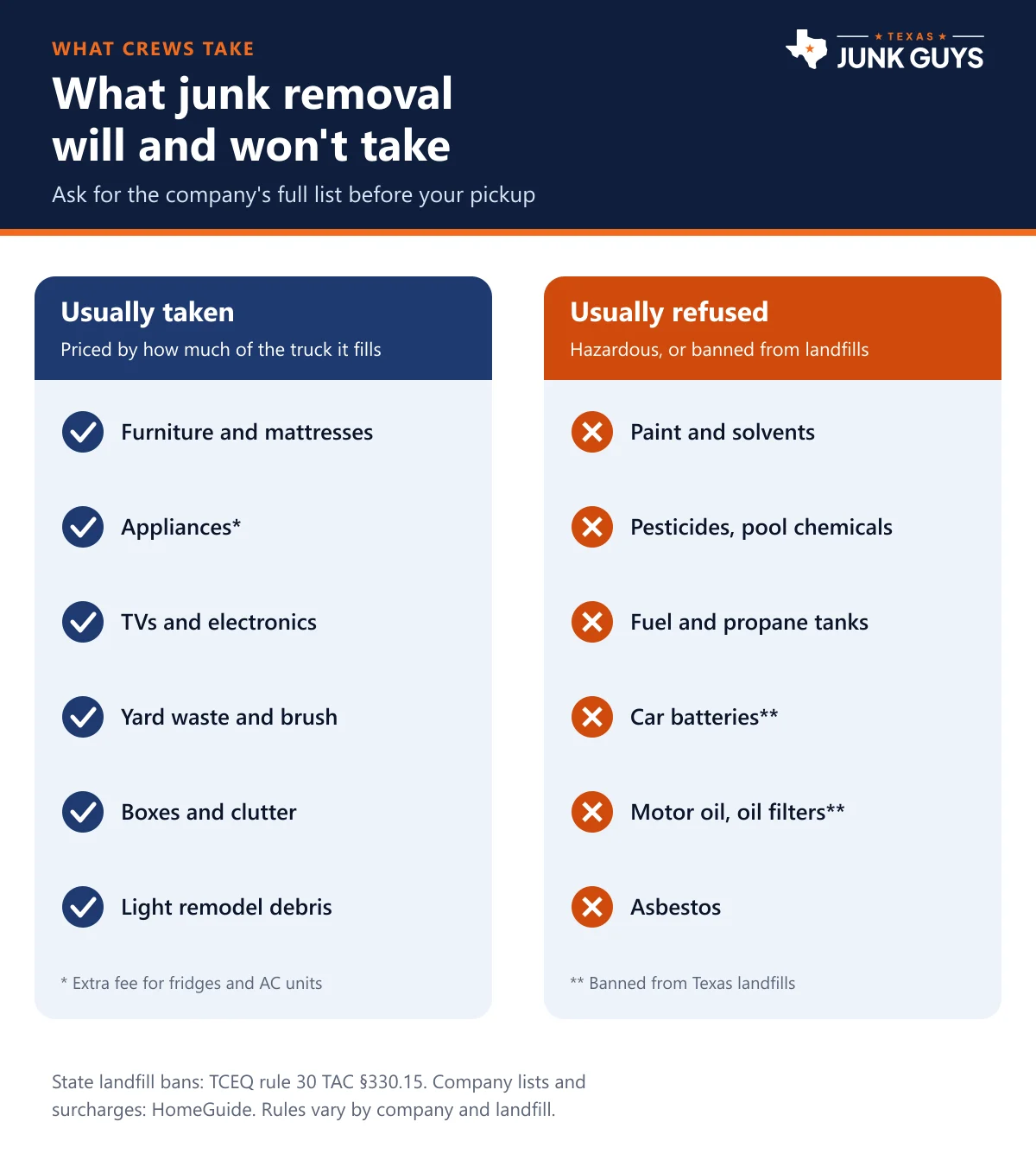
What junk removal companies won't take
Most of what a junk removal company collects ends up at a municipal solid waste landfill or transfer station, so the landfill's rules shape the company's rules. Some items are banned from every Texas landfill by state rule. Others are refused by most companies for safety reasons.
Banned from Texas landfills
The Texas Commission on Environmental Quality's landfill rule (30 Texas Administrative Code §330.15) lists wastes no municipal solid waste facility in Texas may accept. The ones a homeowner is most likely to have:
- Lead-acid batteries: car, truck, boat and motorcycle batteries.
- Used motor oil and used oil filters from do-it-yourself oil changes.
- Whole tires, which can only be landfilled after they've been split or shredded.
- Bulk liquids, and containers holding liquids other than small household ones.
- Regulated hazardous waste.
Some junk removal companies take tires or batteries anyway and send them to a recycler, usually for a fee. HomeGuide lists tires at about $10 each with rims or $5 without, typically once you have more than four.
Usually refused for safety
Most junk removal companies also won't take:
- paint, stains, solvents and adhesives (some take dried-out latex paint)
- pesticides, herbicides, pool chemicals and strong cleaners
- gasoline, fuel cans and propane tanks
- asbestos, including old floor tiles and some insulation
- medical waste and sharps
- ammunition and fireworks
HomeGuide notes that the companies that do handle hazardous waste charge from about $10 per item up to $60 to $125 per item depending on local fees, and about $10 per gallon for latex paint.
Appliances with refrigerant
Refrigerators, freezers, window AC units and dehumidifiers contain refrigerant that federal rules from the U.S. Environmental Protection Agency say must be recovered before the appliance is scrapped or landfilled. Most junk removal companies take them, but HomeGuide says they typically add a $35 to $60 surcharge per fridge, freezer or AC unit to cover it.
Where the refused items go
- Paint, chemicals and pesticides: your city's or county's household hazardous waste program. Most large Texas cities run drop-off sites or collection days for residents, often free.
- Car batteries: a store that sells them, or a recycling facility. Texas law (Health and Safety Code §361.451) directs used lead-acid batteries to a battery retailer or wholesaler, a secondary lead smelter, or an authorized recycling facility.
- Motor oil and filters: many auto parts stores take them for recycling. Call ahead.
- Tires: a tire shop, usually for a small fee, or your city's tire collection if it has one.
- Propane tanks: a propane exchange or refill business.
- Electronics: Texas requires makers of computers and TVs to run recycling programs for their brands. TCEQ's Texas Recycles program lists them, and many cities also take electronics at their drop-off centers.
How much does junk removal cost in Texas?
Almost every company prices by volume: how much of the truck your items take up. A typical junk removal truck holds about 16 to 18 cubic yards, about four pickup-truck loads, according to HomeGuide. The quote usually covers a two-person crew, loading, hauling and disposal of ordinary household junk.
| Load size | What fits | Texas (Junk Cost Calculator) | National (HomeGuide) |
|---|---|---|---|
| Minimum (1–2 items) | A couch, a mattress set or one appliance | $97–$170 | $70–$100 |
| 1/4 truck | A bedroom set, or about one pickup bed | $146–$291 | $100–$150 |
| 1/2 truck | A garage corner or a small apartment | $291–$504 | $200–$300 |
| 3/4 truck | Most of a packed garage or a 1-bedroom move | $437–$728 | $300–$380 |
| Full truck | A whole-house cleanout or garage plus attic | $534–$970 | $400–$450 |
Sources: Junk Cost Calculator's Texas page (checked October 2026) and HomeGuide's junk removal price list (last updated May 2024). Junk Cost Calculator's Texas figures are national ranges adjusted for Texas, which it puts about 3 percent below the national average. Prices vary by company, city and load.
The two guides disagree, mostly at the top end. HomeGuide's figures are national averages from pros' estimates and sit low. Junk Cost Calculator's are deliberately wide. In the big Texas cities, a half truck usually lands somewhere between them.
Our guide to junk removal cost in Texas breaks these prices down in full, with what fits in each load, single-item prices and every extra fee.
Prices in Texas cities
Contractor price reports collected by ProMatcher show the big Texas metros price junk removal almost the same. Its average for a half truckload (about 9 cubic yards) is about $359 in Dallas–Fort Worth, $354 in Austin and San Antonio, and $348 in Houston (checked October 2026). Most of the reports behind those averages are dated 2023, so today's quotes may run somewhat higher. The point stands: what you're throwing away and how much of it matters far more than which big city you live in.
In smaller cities like Lubbock, Amarillo, Tyler, Midland or Corpus Christi, there's little published price data. Prices depend more on how far the nearest company is and which landfill it uses, so get at least two quotes.
Single items
If you only have one or two things, these are Junk Cost Calculator's Texas ranges for common single items (October 2026):
| Item | Texas price range |
|---|---|
| TV | $39–$97 |
| Mattress | $68–$155 |
| Dresser | $68–$146 |
| Washer or dryer | $87–$165 |
| Sofa or couch | $87–$175 |
| Refrigerator | $97–$194 |
| Piano | $243–$485 |
| Hot tub | $340–$582 |
Source: Junk Cost Calculator, Texas page, checked October 2026.
Fees that push the price up
The load price assumes ordinary household junk carried out by a two-person crew. Expect it to go up for:
- Refrigerant appliances: about $35 to $60 each (HomeGuide).
- Pianos: about $50 to $100 extra (HomeGuide), or priced as a single item.
- Heavy debris: HomeGuide puts construction waste removal at about $200 to $250 depending on the type, and says dirt, gravel and concrete are usually priced by the bed load. Some companies won't take concrete at all.
- Stairs, long carries and tight access: Junk Cost Calculator lists these among the things that raise the price.
- Same-day service: usually costs more, according to Junk Cost Calculator.
- Hourly pricing: a few companies charge by the hour per worker. ProMatcher's Texas reports range from about $25 to $30 per worker-hour in Grand Prairie to $80 to $100 in Fort Worth. If you get an hourly quote, ask whether the dump fee is extra.
Why dumping costs less in Texas
Part of every junk removal price is the fee the company pays to unload at the landfill, called the tipping fee. Texas is cheaper than most of the country here. The Environmental Research & Education Foundation (EREF) found the average tipping fee in its South Central region, which includes Texas, was $45.25 per ton in 2023, against $56.80 nationally. That's one reason Texas prices sit near or slightly below the national average.
Junk removal by type of job
Every job is priced the same basic way, but each kind has its own quirks. These are the most common in Texas homes.
Furniture removal
The most common job. Couches, sectionals, recliners, dressers and dining sets are bulky but not heavy, so they're priced by the space they take. A single couch falls in the minimum or quarter-truck range. Furniture in decent shape is worth trying to donate first. Many charities pick up furniture for free, though most turn down stained, torn or broken pieces.
Mattress removal
Mattresses are light but awkward, and some landfills and companies charge extra for them because they're hard to compact. Junk Cost Calculator puts single mattress removal in Texas at about $68 to $155. Box springs often count as a second item. Few charities accept used mattresses, so check before you plan on donating one.
Appliance removal
Washers, dryers, stoves and dishwashers are heavy but straightforward. Fridges, freezers and AC units carry the refrigerant surcharge covered above. Disconnect water and gas lines before the crew arrives, or ask whether they'll do it. Gas appliances in particular should be disconnected by someone qualified. Many appliances end up at scrap metal recyclers, so some companies charge less for them.
Hot tub removal
One of the most expensive single items, because hot tubs weigh hundreds of pounds empty and usually have to be cut apart to get out of a backyard. The two guides disagree sharply: Junk Cost Calculator puts it at $340 to $582 in Texas, while HomeGuide lists $100 to $150 as an add-on. Your price depends on the size, where it sits and whether it's built into a deck. Drain it and have the power disconnected first.
Yard waste removal
Branches, brush, stumps, old fencing and landscaping debris. Yard waste is usually light and bulky. Many Texas cities collect brush and yard trimmings at the curb on a schedule, which is cheaper if you can wait. Junk removal makes sense for a big pile, debris in the backyard that's hard to drag out, or storm cleanup when city crews are backed up.
Estate cleanouts
Clearing a house after someone dies or moves into care is often the biggest job a family takes on, and the most emotional one. It usually means several truckloads. The family normally goes through the house first to set aside papers, photos, valuables and anything to keep, sell or donate. Some junk removal companies offer full estate cleanouts that include sorting and donation runs. Ask what's included and whether the price is per load or per job.
Shed removal
A wooden or metal shed has to be taken apart before it can be hauled. Most companies quote per job, based on size and materials. A concrete slab or footings are a separate, heavier job, and some companies don't do them at all. Empty the shed first, and check that no power line runs to it.
Garage cleanouts
Texas garages fill up fast, often because they double as storage when there's no basement. A garage cleanout runs from a quarter truck to a full truck or more. Sort out paint, chemicals, fuel and car batteries first, since most companies won't take them, and send them to your household hazardous waste program.
Construction and remodeling debris
Junk removal can handle small amounts of drywall, flooring, cabinets and lumber. Heavy debris like tile, shingles, concrete, brick and dirt is a different story. It's priced by weight or bed load, and some companies won't take it. For a remodel that produces debris over several days, a dumpster is usually the better tool.
Storm and flood cleanup
After a hurricane, flood or hailstorm, demand for junk removal jumps across the affected area. Expect to wait longer and book early. Water-damaged carpet, drywall, furniture and mattresses are much heavier than dry. Ask whether wet debris costs more before the crew starts loading. Many Texas cities also run special storm debris collections at the curb after major storms, so check your city's announcements before paying.
We're writing detailed guides to furniture removal, mattress removal, appliance removal, hot tub removal, yard waste removal, estate cleanouts, shed removal and garage cleanouts. They'll be listed on our blog as they go live.
How to prepare for a junk removal pickup
A little prep makes the job faster, the price lower and the quote more accurate.
Before you book:
- Decide what's going. Walk through the space and mark what stays. Crews work fast and can't read your mind.
- Pull out what you'll donate or sell. Less junk means a smaller load and a lower bill.
- Take photos. Send them when you ask for a quote. A price from photos is closer to the final one than a price from a description.
- List anything special. Pianos, hot tubs, fridges, tires, paint, chemicals, or anything on an upper floor or behind a locked gate.
The day before:
- Group everything in one place if you can. A single pile in the garage is quicker to load than items spread through the house. Don't carry anything you can't lift safely; that's the crew's job.
- Separate hazardous items. Paint, chemicals and batteries go to a hazardous waste site, not the truck.
- Disconnect appliances and drain hot tubs. Unplug, empty and defrost fridges and freezers, and turn off water lines to washers.
- Empty drawers and cabinets. Check furniture for papers, jewelry, cash or photos.
- Clear a path. Move cars from the driveway and make sure the truck can park near the house.
On the day:
- Be there, or have someone there. The crew will want to confirm what goes and agree the price before loading.
- Walk through with the crew. Point out every item, and anything that stays.
- Confirm the price before they load. Ask if the quote is all-in.
- Check the area after. Make sure nothing that should stay went on the truck.
How to choose a junk removal company
Prices for the same job can differ by hundreds of dollars between companies, so it's worth comparing. Here's how.
Get at least three quotes
Ask each company for a price in writing, or by text or email at least. Give every company the same description and photos, so the quotes compare like for like.
Ask every company the same questions
- Is the price all-in, including labor, hauling, disposal and tax?
- How much of the truck does the price cover, and what happens if my items need more?
- Are there extra charges for appliances, mattresses, tires, stairs or heavy debris?
- Is there a charge for same-day service?
- Is the price confirmed on site before you load anything?
- What won't you take?
- Do you donate or recycle usable items?
- Are you insured if something in my house gets damaged during the job?
HomeGuide also suggests confirming that the quote covers pickup, loading, taxes, dump fees and mileage, and asking about any hazardous waste or electronics surcharges.
Watch for these warning signs
- A phone price that's far below everyone else's. It may jump once the crew sees the pile.
- No firm price before loading. A reputable crew agrees the price first.
- Cash only, with no receipt.
- No clear answer about where the junk goes. Junk left on a roadside or empty lot can still be traced back to you. Use a company that takes it to a proper landfill, transfer station or recycler.
National franchise or local company
Texas has both: national junk removal franchises and small local outfits with one or two trucks. Neither is automatically cheaper or better. Franchises tend to have standard pricing and online booking. Local companies may be more flexible on price and scheduling. Compare the written quotes and the answers to the questions above, not the brand.
Where your junk goes
Once the truck leaves, a responsible company sorts the load:
- Donation. Furniture, appliances and household goods in good shape can go to charities and reuse stores. HomeGuide notes that many nonprofits accept furniture, appliances and household goods.
- Recycling. Metal from appliances and bed frames goes to scrap recyclers. Electronics go to e-waste recyclers. Cardboard and some plastics can be recycled.
- Landfill or transfer station. Whatever is left goes to a municipal solid waste facility, which charges by the ton.
If donation and recycling matter to you, ask how the company handles them before you book. Some can give you a donation receipt for items that went to charity.
Texas-specific things to know
City bulk and heavy trash pickup
Many Texas cities collect large items like furniture and appliances at the curb on a schedule, for free or a small fee, as part of your trash service. It's slower than junk removal and has limits on what and how much you can put out, but for a few large pieces it can save you money. Check your city's solid waste page for the schedule and rules. Guides to bulk trash pickup in Dallas, Austin, San Antonio and Houston are coming later in this series.
HOA rules
Many Texas neighborhoods have a homeowners association with rules on leaving items at the curb, how long they can sit out, and sometimes when work crews can come. If you're putting items out for curbside pickup or city bulk trash, check your deed restrictions first. A full-service junk removal job, where nothing sits outside, usually avoids the issue.
Summer heat
Carrying furniture out of a hot Texas attic or garage in July is hard work, and dangerous if you're not used to it. That's one of the biggest reasons people hire junk removal instead of doing it themselves. If you do any of the carrying yourself, do it early in the morning, drink water and take breaks. Morning appointments also tend to book up first in summer.
Hurricane, flood and storm season
Gulf Coast hurricanes, flash floods and spring hailstorms all create sudden demand for junk removal. If you live in a storm-prone area, save a couple of local companies' numbers before you need them. After a storm, photograph damaged items for your insurance claim before anything is hauled away.
Moving season
Texas cities see a lot of moves, especially in summer. Junk removal companies get busy around the end of each month, when leases turn over. If you can book mid-month, you'll usually have more choice of times.
Cheaper ways to get rid of junk
Junk removal is the easiest option, not always the cheapest. Before you book, consider these:
| Option | What it costs | Who does the lifting | Best for |
|---|---|---|---|
| City bulk trash pickup | Often free or a small fee | You (to the curb) | A few large items, if you can wait |
| Donation pickup | Free | Usually the charity | Furniture and appliances in good shape |
| Selling or giving away online | Free, sometimes you earn money | Usually the buyer | Anything usable, if you have time |
| Hauling it yourself | Landfill or transfer fee | You | People with a truck or trailer |
| Dumpster rental | About $225–$375 for a 10-yard | You | Multi-day projects and big cleanouts |
| Junk removal | About $97–$970 by load | The crew | Speed, convenience and heavy lifting |
Sources: junk removal prices from Junk Cost Calculator's Texas page (October 2026); 10-yard dumpster price from Dumpster Rental Finder's April 2026 Texas city guides. City and landfill fees vary, so check your city's solid waste page.
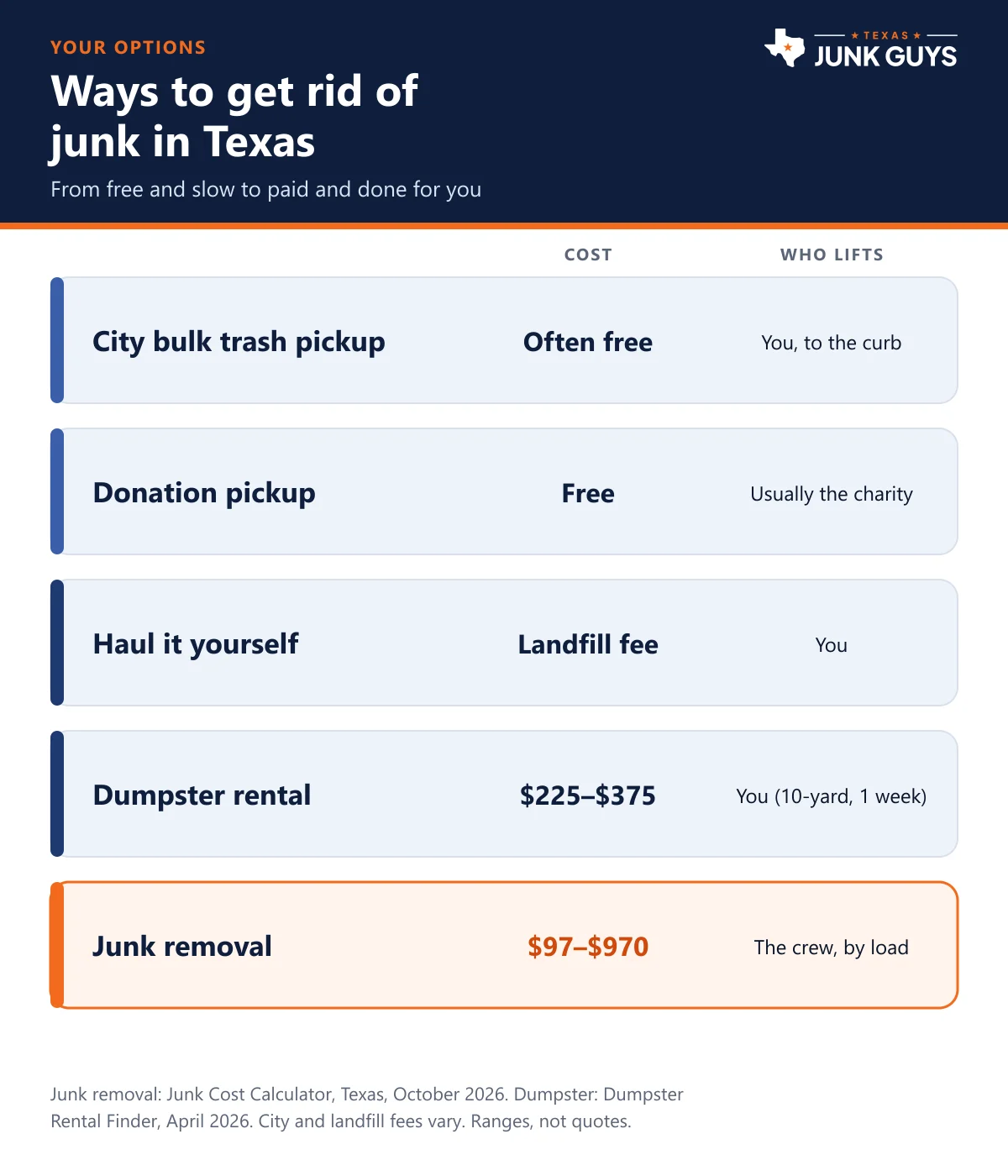
A good order to try them in: donate or sell what's usable, put a few large items out for city bulk pickup, and hire junk removal for the rest, especially anything heavy, upstairs or that you need gone quickly.
Junk removal or a dumpster?
This is the most common question once a job gets big. Junk removal usually wins when:
- you have a few large items or a single room's worth of stuff
- you can't or don't want to do the lifting
- you want it gone today or tomorrow, with nothing in your driveway
A dumpster usually wins when:
- debris comes out over several days, as during a remodel or a roof replacement
- you're happy to load it yourself and have room in the driveway
- the debris is heavy, like shingles, tile or concrete, and fits the weight allowance
A full junk removal truck holds about 16 to 18 cubic yards, and a 20-yard dumpster rents for about $300 to $550 a week in the biggest Texas cities, according to Dumpster Rental Finder's April 2026 guides. For similar volumes, a dumpster you load yourself is usually cheaper than a full truck of junk removal. The difference is the labor and the time. Our guide to junk removal vs dumpster rental compares Texas prices for both at every job size, and our dumpster rental page lists dumpster companies by city.
Common junk removal mistakes
- Booking without photos. A vague description means a vague price, and a bigger change on the day.
- Leaving hazardous items in the pile. Paint and chemicals get left behind or cost extra.
- Forgetting to check drawers and boxes. Once it's on the truck, it's gone.
- Booking several small pickups. One bigger load costs less than two smaller ones.
- Paying before the job is done. Pay when everything's loaded and the price matches what you agreed.
- Skipping the free options. City bulk pickup and charity pickups can take a lot off the load.
- Choosing on the phone price alone. Compare all-in prices, including surcharges.
Do you tip junk removal crews?
Tipping isn't expected, but it's appreciated when a crew does a hard job well, like a hot attic, several flights of stairs or a job that runs longer than planned. HomeGuide suggests about 10 percent of the bill, or $10 to $20 per crew member, when the crew does a great job and spends more time than expected. A cold drink on a hot day goes a long way too.
Finding a junk removal company in your Texas city
Our directory lists junk removal companies in 777 Texas cities. These are the counts for the biggest cities:
| City | Companies listed |
|---|---|
| Houston | 172 |
| Dallas | 149 |
| Austin | 146 |
| Fort Worth | 116 |
| San Antonio | 69 |
| El Paso | 65 |
Source: the Texas Junk Guys directory, October 26, 2026. A company is counted in every city it serves, so the same company can appear in several cities. Dallas–Fort Worth suburbs such as Irving (186), Euless (175), Grand Prairie (163) and Arlington (154) have the most companies listed, because many metro companies serve the whole area.
In big metros there's plenty of choice, so getting three quotes is easy. San Antonio and El Paso have fewer companies for their size, so book early for big jobs. In smaller cities, call early and expect prices to depend on how far the company has to drive.
To compare companies, pick your city on our junk removal page. You'll see the companies that serve it, and you can call one directly or send one free quote request.
Sources
All figures in this guide come from third-party cost guides, contractor reports and Texas state rules. Prices are typical ranges, not quotes from any company. Sources checked October 26, 2026.
- Junk Cost Calculator, Junk removal cost in Texas (2026 figures). Texas prices by load size and single item, and what raises the price.
- HomeGuide, How Much Does Junk & Trash Removal Cost?, last updated May 2024. National prices, truck volume, surcharges for appliances, pianos and tires, hazardous waste and construction debris costs, donation, questions to ask and tipping.
- ProMatcher, Houston junk removal costs and prices, plus its Dallas, Fort Worth, Austin and San Antonio reports on the same site. Half-truck averages and hourly rates. Most reports dated February 2023.
- Texas Commission on Environmental Quality rule 30 Texas Administrative Code §330.15, General Prohibitions. Wastes banned from Texas landfills.
- Texas Health and Safety Code §361.451, on where used lead-acid batteries must go.
- Texas Commission on Environmental Quality, Texas Recycles Computers and Texas Recycles TVs programs.
- U.S. Environmental Protection Agency, refrigerant recovery rules for appliance disposal (Clean Air Act Section 608).
- Environmental Research & Education Foundation (EREF), Analyzing Municipal Solid Waste Landfill Tipping Fees (2023 data).
- Dumpster Rental Finder, Texas city price guides for Houston, Dallas, Austin, San Antonio and Fort Worth, April 2026. Dumpster prices used for comparison.
- Company counts: the Texas Junk Guys directory, October 26, 2026.
Frequently asked questions
- How does junk removal work?
- You book a time, a two-person crew arrives with a truck, looks at what you want gone and gives you a price based on how much of the truck it will fill. If you agree, they carry everything out, load it and haul it to a landfill, recycler or donation center. You don't lift anything or rent anything.
- How much does junk removal cost in Texas?
- A minimum pickup of one or two items runs about $97 to $170, a half truckload about $291 to $504, and a full truckload about $534 to $970, according to Junk Cost Calculator's Texas page (October 2026). HomeGuide's national figures are lower. Prices vary by company, load and access, so get a written quote.
- What will junk removal companies not take?
- Most won't take hazardous waste: paint, solvents, pesticides, pool chemicals, fuel, propane tanks and asbestos. Texas landfill rules also ban car batteries, used motor oil and oil filters, whole tires and bulk liquids, so many companies refuse those or charge extra to recycle them. Ask for the company's list before your pickup.
- Do junk removal companies take appliances?
- Yes. Most take washers, dryers, stoves, dishwashers and water heaters. Refrigerators, freezers and AC units contain refrigerant that must be recovered under federal rules, so HomeGuide says companies typically add a $35 to $60 surcharge for each one.
- Is it cheaper to rent a dumpster or hire junk removal?
- For a few large items or one room's worth of stuff, junk removal is usually cheaper and the crew does the lifting. For a multi-day remodel or a big cleanout you'll load yourself, a dumpster usually costs less. A 20-yard dumpster rents for about $300 to $550 a week in Texas's biggest cities.
- Do I need to be home for junk removal?
- It's best to be there, or have someone there, so you can point out exactly what goes, agree the price before loading and check nothing that should stay ends up on the truck. Some companies will do curbside pickups without you present if the items are clearly set out and the price is agreed in advance.
- How can I get rid of junk for free in Texas?
- Many Texas cities collect bulky items at the curb on a schedule as part of trash service, often for free. Charities pick up furniture and appliances in good shape, and you can give items away online. Check your city's solid waste page for bulk trash rules before you put anything out.
- Should you tip junk removal workers?
- Tipping isn't expected, but it's appreciated for a hard job done well. HomeGuide suggests about 10 percent, or $10 to $20 per crew member, when the crew does a great job and spends more time than expected.
This guide is general information, not advice about any particular company. Prices, sizes and rules vary by company and city, so confirm the details with the company you hire. How we list companies.