How to Get Rid of Junk in Texas: Every Option (2026)
From free city bulk pickup and donation to drop-off sites, dumpsters and full-service junk removal, here's every way to get rid of junk in Texas, what each costs, and where the items nobody wants have to go.
By the Texas Junk Guys team · Updated November 10, 2026
The cheapest way to get rid of junk in Texas is usually a mix: sell or donate what still works, put big items out for your city's bulk trash pickup, and drop off or pay to remove the rest. Most big Texas cities collect furniture, mattresses and most appliances at the curb at no extra charge, a few times a year or monthly. Paint, chemicals, car batteries, tires, electronics and refrigerators need special handling, because the curb, the landfill or both won't take them.
This guide is the overview. It covers every option a Texas homeowner has, from free to full service, with the rules in Dallas, Houston, San Antonio, Austin and Fort Worth, what the state says about the items nobody wants, and when paying someone is worth it.
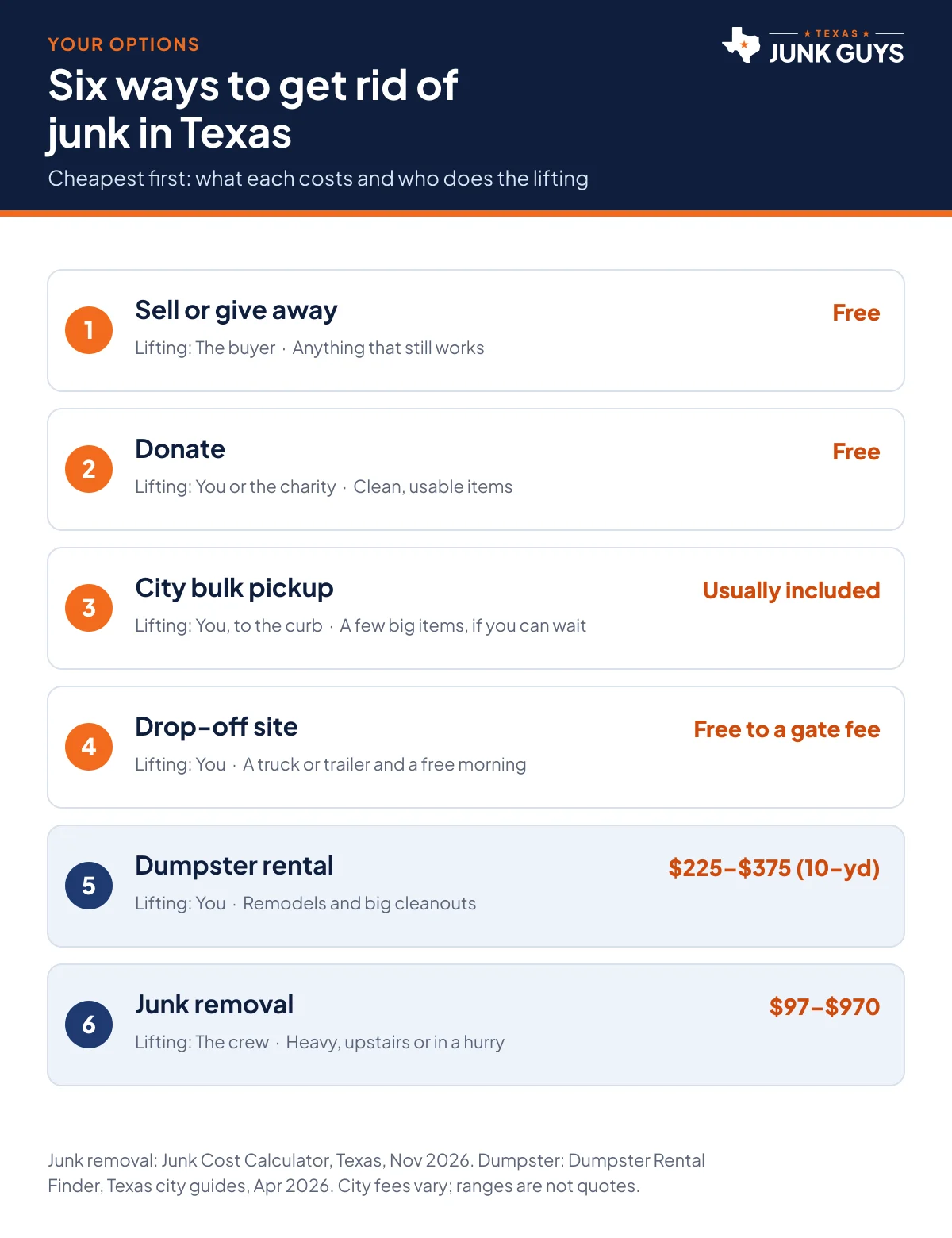
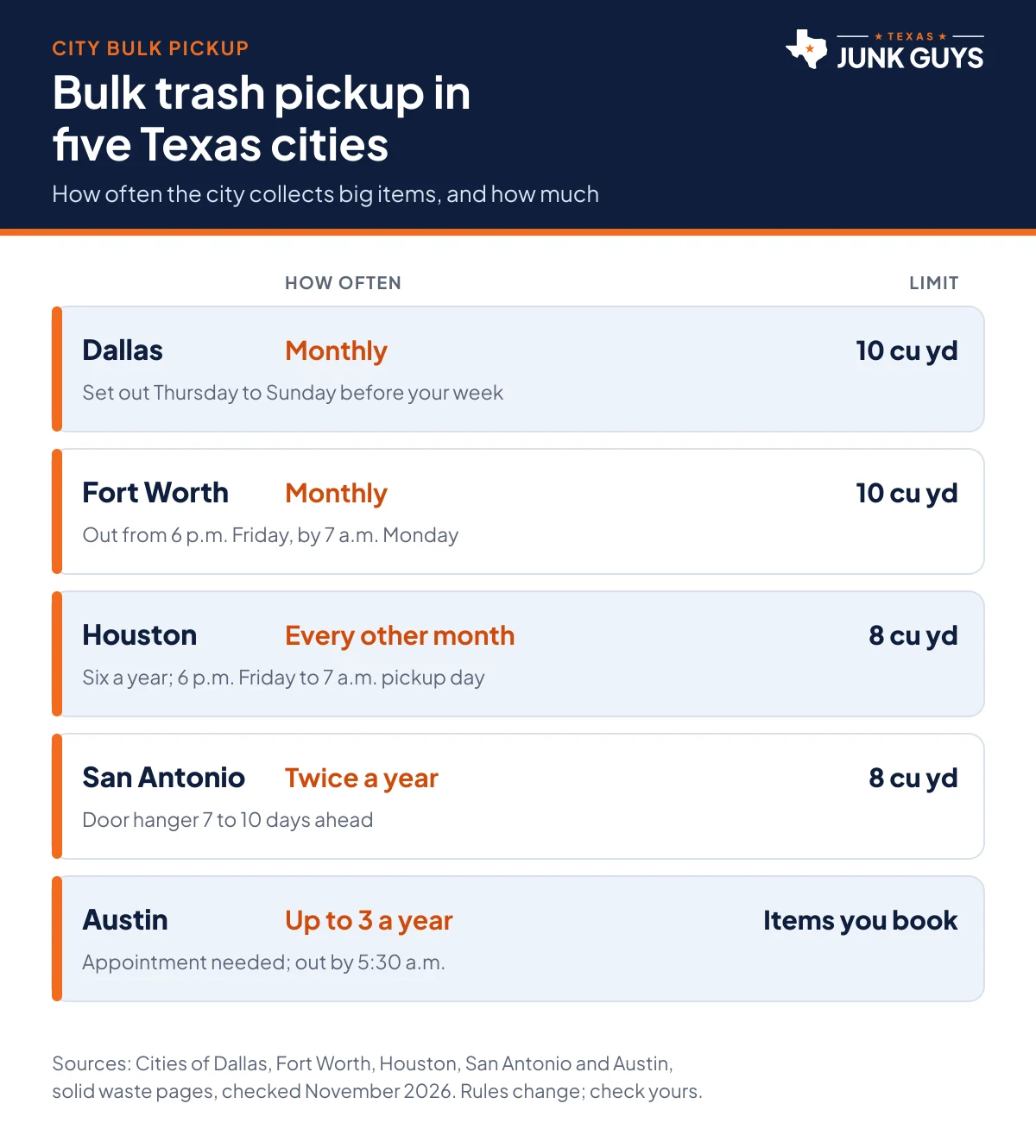
Quick answer: Sell, give away or donate usable items first. Then use your city's bulk trash pickup for furniture, mattresses and large appliances: monthly in Dallas and Fort Worth, every other month in Houston, twice a year in San Antonio, and by appointment up to three times a year in Austin. Haul overflow to a city drop-off site, many of which are free for residents with ID and a utility bill. Take paint and chemicals to household hazardous waste collection, car batteries back to a battery store, and computers to the maker's free take-back program. For heavy, upstairs or urgent jobs, junk removal runs about $97 to $970 depending on the load (Junk Cost Calculator, Texas, November 2026).
Which option fits your situation?
Most people don't need every option. Start with what you're getting rid of and how soon it has to go.
| Your situation | Best first option | Backup |
|---|---|---|
| A couch, mattress or appliance, and you can wait | City bulk trash pickup | City drop-off site |
| Furniture or appliances in good shape | Sell, give away or donate | City bulk pickup |
| A truck or trailer and a free Saturday | City drop-off site or landfill | Junk removal for what's left |
| Paint, chemicals, pool supplies or old fuel | Household hazardous waste collection | A city drop-off station that takes it |
| Car batteries, motor oil or tires | An auto parts or tire store | City drop-off or collection event |
| Old computers and TVs | Manufacturer take-back or city drop-off | A junk removal company (often a fee) |
| A remodel or a whole-house cleanout you'll load | Dumpster rental | Junk removal by the truckload |
| Heavy items, upstairs rooms, or it has to go this week | Junk removal | None needed |
| Storm debris after a hurricane or hailstorm | Your city's storm debris pickup, if it runs one | Dumpster or junk removal |
The rest of this guide goes through each option in order, from the ones that cost nothing to the ones you pay for.
1. Sell it or give it away
Anything that still works has a good chance of finding a new home, and the person who takes it usually brings the truck and the muscle.
What sells or goes quickly: working appliances, solid wood furniture, dining sets, dressers, patio furniture, grills, tools, exercise equipment, bikes, kids' gear and anything with a known brand. Cheap flat-pack furniture and older electronics are harder to move, even for free.
How to make it go faster:
- List it free if you mainly want it gone. "Free, you haul" listings in Texas cities often go the same day.
- Post clear photos and measurements. People need to know whether it fits through their door and in their truck.
- Say where it is. "In the garage, ground floor" gets more replies than "upstairs, narrow stairs."
- Put a deadline in the listing. If no one has taken it by then, it goes to the curb.
- Stay safe. Have someone with you when strangers come to the house, or move the item to the garage or driveway so no one needs to come inside.
Leaving something at the curb with a "free" sign is fine in many neighborhoods for a day or so, but check your HOA rules and your city's set-out rules first. In some cities a pile at the curb outside the allowed days can bring a code violation, even if you meant it as a giveaway.
2. Donate it
Charity thrift stores, furniture banks, reuse centers, shelters and church groups all take donations, and many will pick up larger items free. It's a good fit for furniture, appliances, housewares, clothing, books and tools in good shape.
What charities usually take and turn down
Charities are pickier than most people expect. They have to sell or use what they take, and they pay to throw away what they can't. Expect them to turn down:
- stained, torn, broken or very worn furniture
- anything with pet hair, smoke smell or signs of bed bugs
- used mattresses and box springs, which many don't accept at all
- large old entertainment centers and wall units they can't sell
- old TVs and appliances that don't work
Texas has no state law today on donating or reselling used mattresses and bedding. The old used-bedding licensing rules in the Health and Safety Code (Chapter 345) were repealed in 2015. That leaves it to each charity's own policy, and many simply say no. Call before you load anything.
Pickup or drop-off
Many larger charities pick up furniture and appliances free, but pickups are often booked days or weeks out, and drivers can refuse items on the spot if they don't meet the charity's standards. Dropping off yourself is faster if you can lift and haul the item.
If you plan to claim a tax deduction, ask for a donation receipt and keep a list of what you gave.
For a closer look at what to do with old couches, dressers and tables, including what charities accept, see our guide to furniture removal.
3. Recycle it
A surprising amount of household junk can be recycled instead of landfilled, and some of it is free or even pays.
- Your recycling cart. Cardboard, paper, metal cans and most plastic bottles go in your curbside recycling cart. Break down boxes from a move so they fit.
- Scrap metal. Bed frames, metal shelving, old grills, lawn furniture, water heaters and appliances are mostly steel. Scrap yards buy metal by weight. Appliances that hold refrigerant, like refrigerators, freezers and AC units, are the exception: federal rules require the refrigerant to be recovered first (more on that below), so many yards want proof it's been done or charge to do it.
- City drop-off centers. Several big Texas cities run recycling or reuse centers that take scrap metal, electronics and other recyclables free from residents. They're covered under drop-off sites below.
- Electronics. Texas law requires computer and TV makers to offer recycling to consumers. See the electronics section below.
- Mattresses. Most of a mattress can be recycled, but Texas has no statewide mattress recycling program. The Mattress Recycling Council lists only California, Connecticut, Oregon and Rhode Island as states with mattress recycling laws. In Texas, mattress recycling depends on private recyclers, where they exist.
4. Use your city's bulk trash pickup
For a few big items, city bulk pickup is usually the cheapest option, because you've already paid for it through your trash bill. Most Texas cities with their own trash service run some version of it. The names differ (bulk, bulky, heavy trash, brush and bulky), and so do the schedules, limits and rules.
How it works in the big Texas cities
| City | What it's called | How often | Limit per pickup | Main way to find your date |
|---|---|---|---|---|
| Dallas | Brush and bulky item collection | Monthly | 10 cubic yards | Dallas.gov/sanitation, Dallas Sanitation app, 3-1-1 |
| Fort Worth | Bulk waste collection | Monthly | 10 cubic yards | 2026 bulk schedule map, city garbage app, 3-1-1 |
| Houston | Heavy trash collection | Every other month (6 a year) | 8 cubic yards | City service lookup, HTX Collects app |
| San Antonio | Curbside brush and bulky | Twice a year (bulky) | 8 cubic yards | Door hanger 7–10 days ahead; Find My Collection Day |
| Austin | On-demand bulk collection | By appointment, up to 3 a year | Items listed when you book | Austin Recycles app, online or 3-1-1 |
Sources: City of Dallas Sanitation (checked November 2026); City of Fort Worth Environmental Services (bulk page as published August 2026); City of Houston Solid Waste Management (heavy trash page as published October 2026); City of San Antonio Solid Waste Management (curbside page as published August 2026); City of Austin Resource Recovery (on-demand page as published August 2026). Rules change, so check your city's page before you set anything out.
Dallas
Dallas picks up brush and bulky items once a month for homes on city trash service. Set items behind the curb in front of your home between the Thursday and Sunday before your collection week, up to 10 cubic yards. Once a year you can request a bigger 20-yard pickup. Piles over the limit are still picked up but billed at $60 per 5 cubic yards on your utility bill. Refrigerators, electronics, tires and construction debris aren't accepted. Our guide to bulk trash pickup in Dallas covers the schedule, the limits and the placement rules in detail.
Fort Worth
Fort Worth collects bulk waste monthly for homes with city curbside garbage and recycling service. Each area has a collection week that starts on the 1st, 2nd, 3rd or 4th Monday of the month, shown on the city's 2026 bulk schedule map.
- When: items can go out from 6 p.m. the Friday before your week and must be at the curb by 7 a.m. Monday. Crews have until Saturday at 5 p.m.
- How much: up to 10 cubic yards, which the city describes as about 8 feet long, 6 feet wide and 6 feet tall, at no extra charge. Bigger piles cost extra, and only one pile per household is allowed.
- Where: at least 2 feet from trees, mailboxes, water meters, fences and other obstructions, and not under low branches.
- Not accepted: anything in plastic bags (including leaves and grass), tires, car parts, batteries, contractor remodeling debris, computers and other electronics, and appliances with coolant or gas, such as refrigerators, AC units and lawnmowers.
- Out-of-cycle or non-compliant piles are charged $123.52 for the first 5 cubic yards and $107.40 for each 5 after that, up to 30 cubic yards.
Houston
Houston collects heavy trash every other month for occupied homes that get city curbside service, up to six collections a year. Buildings with more than eight units aren't eligible.
- When: between 6 p.m. the Friday before and 7 a.m. on your collection day.
- How much: up to 8 cubic yards, which the city compares to a minivan. That can include up to 4 cubic yards of building material you produced yourself, but not shingles, brick, plaster or concrete.
- Accepted: furniture, carpet (bundled), mattresses and box springs, toilets, bikes and toys, stoves, washers, dryers and water heaters, and tree limbs up to 8 inches across and 10 feet long. Up to four passenger tires can go out too, though they may take up to a week to be picked up.
- Refrigerators and freezers only with a certified technician's tag showing the refrigerant has been removed.
- Not accepted: household garbage, electronics, paint and chemicals, dirt, roofing, and contractor or demolition debris. If allowed and banned items are mixed, the city can refuse the whole pile.
- Where: just behind the curb in front of your home, not in the street or on the sidewalk, and not under wires or on meters or hydrants.
Look up your day with the city's service lookup tool or the HTX Collects app.
San Antonio
San Antonio collects bulky items at the curb twice a year, separately from brush. Keep the two in separate piles.
- When: a door hanger arrives 7 to 10 days before your collection week. Don't set anything out until it does. The pile has to be out by 7 a.m. on the Monday of your collection week, and the city says trucks drive through only once.
- How much: up to 8 cubic yards, within 8 feet of the curb, in front of your house even if your garbage goes in the alley.
- Accepted: furniture, mattresses, large appliances, water heaters, grills, fencing, small pieces of carpet, up to six car tires without rims, and up to three TVs.
- Not accepted: brush and yard waste, concrete, construction and demolition material, glass and mirrors, roofing, soil and rocks, and household hazardous waste.
- Penalties: the city warns that a pile with the wrong materials, a blocked pile or one set out after crews have passed can bring a fine of up to $2,000 a day plus a collection and disposal fee.
- Can't wait? You can request an out-of-cycle pickup through 3-1-1. The city's fee schedule lists $50 for one item or up to 4 cubic yards, plus $25 for each additional 4 cubic yards.
Austin
Austin switched from scheduled bulk collection to on-demand appointments in January 2025. Single-family homes and buildings up to fourplexes can book up to three bulk collections a year (and, separately, up to three brush collections) through the Austin Recycles app, online or by calling 3-1-1. Items aren't picked up without an appointment.
- When: at the curb by 5:30 a.m. on your appointment day.
- Accepted: appliances (doors removed), furniture, household carpet, doors, lawnmowers with the gas and oil drained, nail-free lumber, pallets, rolled fencing, electronics, and up to 8 passenger tires per household with the rims removed.
- Not accepted: brush (book it separately), construction and remodeling debris, sheet glass, tile, mirrors, hazardous materials, household trash, and tires still on rims.
- How to set out: sort into three piles (metal and rigid plastics including appliances and electronics; everything else like carpet and lumber; tires), at least 5 feet from carts, mailboxes, fences, meters, hydrants and parked cars. Don't bag or box anything. Items in an alley or in front of a vacant lot aren't collected.
Suburbs, small towns and unincorporated areas
Outside the big cities, bulk pickup varies a lot. Many suburbs contract trash service to a private hauler, and bulk pickup comes with that contract, sometimes monthly, sometimes on request, sometimes for a fee. Some small towns have one or two cleanup days a year. In unincorporated parts of a county, there's often no curbside bulk service at all; the county may run citizen collection stations or cleanup events instead.
Your city's website, your trash bill or a call to your hauler will tell you what you have. If you're in an apartment complex, the complex's private trash service usually isn't the city's, so ask the office before you put anything by the dumpster.
Rules that apply almost everywhere
- Don't set out early. Every city above has a set-out window, and piles outside it can be tagged or fined.
- Keep it out of the street, sidewalk and alley unless your city says otherwise.
- Keep banned items out of the pile. One can of paint or a stack of shingles can get the whole pile skipped.
- Stay under the volume limit, or expect to pay for the extra.
- Expect pickers. Metal and usable furniture often disappear before the city truck arrives. That's normal.
5. Drop it off yourself
If you have a pickup truck or trailer, you don't have to wait for your collection day. Many Texas cities run drop-off sites for residents, and landfills and transfer stations take loads from anyone, usually for a fee.
City drop-off sites in the big Texas cities
| City | Sites | Cost for residents | What to bring |
|---|---|---|---|
| Dallas | McCommas Bluff Landfill and three transfer stations | Free (car, pickup or trailer under 15 ft) | Driver's license plus proof of Dallas residency |
| Fort Worth | Four drop-off stations | Free | Current water utility bill showing sanitation charges, matching driver's license |
| Houston | Six residential drop-off centers | Free, up to four visits a month | Texas ID plus a current City of Houston utility bill or lease, same address |
| San Antonio | Four bulky waste collection centers | Free if you pay the city's environmental fee | Recent CPS Energy bill and photo ID |
| Austin | Recycle and Reuse Center (by appointment) | Free for Austin and Travis County residents | Appointment through the app or online |
Sources: each city's drop-off or landfill page, as listed under the table above for bulk pickup, plus Dallas Landfill and Transfer Stations (November 2026), Fort Worth Drop-Off Stations (October 2026), Houston Residential Drop-Off Centers (October 2026 and June 2026), San Antonio Bulky Waste Collection Centers (October 2026) and Austin Recycle and Reuse Center (August 2026).
Each city has its own limits, and they're worth checking before you load up:
- Fort Worth allows single-axle trailers up to 8 by 6 feet with loads up to 3 feet high (about 5 cubic yards). It takes refrigerators and AC units at drop-off stations without the Freon removed, unlike at the curb. Tires are limited to four per household every six months, and computers and TVs to two every six months.
- Houston allows pickups and trailers up to 10 feet, but not box trucks, rental trucks or dump trailers. Large items like couches are limited to two per visit, and refrigerators need a tag showing the Freon was removed. TVs, paint, chemicals, dirt and bricks aren't accepted.
- San Antonio limits bulky items to 4 cubic yards and construction debris to 1 cubic yard per visit, and loads can't be piled above the truck bed's wheel wells. Mattresses with blood stains or bed bugs aren't accepted.
- Austin's Recycle and Reuse Center takes appliances, electronics, scrap metal and household hazardous waste, but not furniture, mattresses or toilets. Tires cost $6 each.
Landfills and transfer stations
Public and private landfills and transfer stations across Texas take household junk from anyone, usually for a gate fee based on weight or vehicle size. Call or check the site's page before you go for the fee, hours, what they accept and whether they take cash or cards.
Two state rules apply at every municipal landfill in Texas: whole tires can't be landfilled (they have to be split, quartered or shredded first), and car batteries, used motor oil and oil filters aren't allowed at all. The full list is in the next section.
Cover your load
Texas law requires loose loads, including trash and discarded items, to be covered and secured on public roads unless nothing can blow or spill out (Texas Transportation Code, Chapter 725). The tailgate has to be closed, and the fine runs from $25 to $500. A mattress, a sheet of plywood or a bag of trash that blows out on the highway can also count as illegal dumping. Strap everything down, put a tarp over loose items and drive slowly.
6. Hazardous and special items: where they go
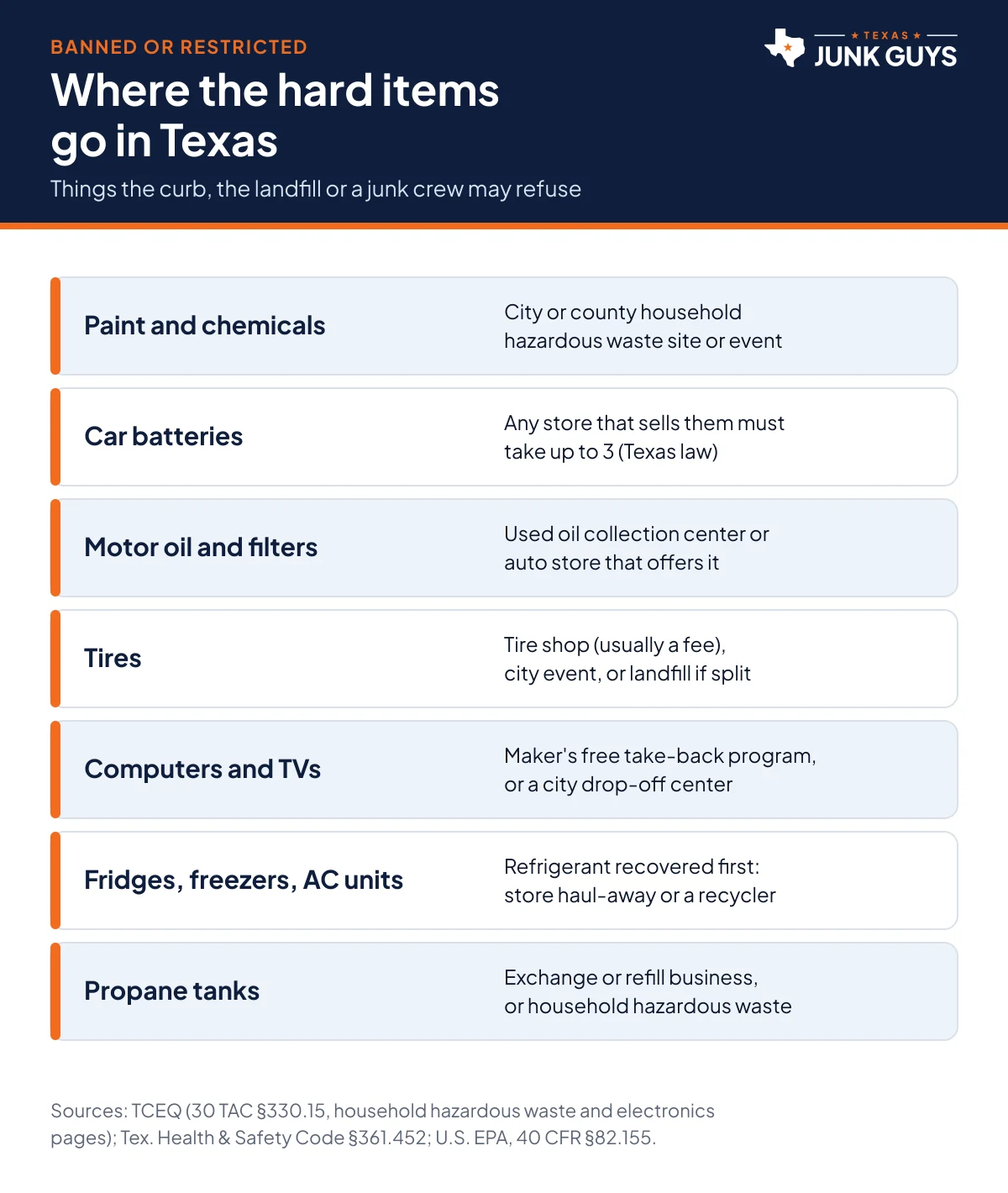
Some things can't go in your trash cart, at the curb with bulk trash, or in a Texas landfill. Others are allowed in small amounts but have better places to go. These are the items most likely to be left over after everything else is gone.
What Texas landfills can't take
The Texas Commission on Environmental Quality's landfill rule (30 Texas Administrative Code §330.15) bans these from every municipal solid waste landfill in Texas:
- Lead-acid batteries from cars, trucks, boats and motorcycles
- Used motor oil from do-it-yourself oil changes, and used oil filters
- Whole tires, unless they've been split, quartered or shredded
- Bulk liquids, and containers of liquid bigger than normal household sizes
- Regulated hazardous waste, PCB waste and radioactive materials
The same rule says refrigerators, freezers, air conditioners and other appliances with refrigerant must be handled under the federal refrigerant rules.
Paint, chemicals and other household hazardous waste
Household hazardous waste (HHW) is leftover paint, stains, solvents, cleaners, pesticides, pool chemicals, fuels, fluorescent bulbs and anything with mercury. The TCEQ notes that many Texas communities run HHW drop-off facilities or hold collection events, and keeps a list of programs by county on its household hazardous waste page (linked in the sources below).
In the big cities:
- Dallas: the Dallas County Home Chemical Collection Center, plus mobile collection events.
- Fort Worth: the Environmental Collection Center on Bridge Street, and the four drop-off stations (up to 20 gallons of household chemicals every three months).
- Houston: two Environmental Service Centers. ESC South is open four days a week; ESC North opens the second Thursday of each month. Limits include 25 gallons of paint and 100 pounds of chemicals per visit.
- San Antonio: the permanent HHW site on Culebra Road, with a CPS Energy bill showing the environmental fee and a photo ID.
- Austin: the Recycle and Reuse Center by appointment, or curbside HHW collection booked like bulk pickup (up to 30 gallons, and never left at the curb).
Latex paint shortcut: the TCEQ says that if a can is less than a quarter full, you can take the lid off and let it dry for a few days, then put the dry can in your trash. Oil-based paint still goes to HHW collection.
Car batteries
Car, truck and boat batteries can't go in the trash or the landfill. Texas law (Health and Safety Code §361.452) requires stores that sell lead-acid batteries to accept up to three used ones from a customer and to post a sign saying so. Auto parts stores are the easy answer. City drop-off stations and HHW sites take them too.
Motor oil and filters
Used motor oil and oil filters are banned from Texas landfills. Many HHW programs and used oil collection centers take them, and some auto parts stores and service centers accept small amounts, but Texas law doesn't require stores to. Call ahead. Houston's drop-off centers take up to 5 quarts.
Tires
Whole tires can't go in a Texas landfill, and most city curbside programs limit or refuse them. Your options:
- The tire shop. When you buy new tires, ask the shop to keep the old ones. The TCEQ says most dealers will take them for a fee.
- City bulk pickup or drop-off, where allowed: Houston takes up to four passenger tires at the curb, San Antonio up to six without rims, Austin up to eight without rims, and Fort Worth four per household every six months at its drop-off stations. Dallas takes up to six a year at its landfill and transfer stations. Truck and tractor tires are usually refused.
- A landfill that charges for them, which will split or shred them first.
Don't stockpile them. Old tires collect water and breed mosquitoes, and Texas requires anyone storing more than 500 to register the site with the state.
Computers and TVs
Texas law requires companies that make computers and TVs to give consumers a way to recycle their brand, free at the time of recycling, through mail-back, drop-off sites or collection events. The TCEQ's electronics recycling page (linked in the sources below) links to the Texas Recycles Computers and Texas Recycles TVs lookups, where you find your brand's program.
- Computers: desktops, laptops, monitors, and a matching keyboard and mouse, no matter how old. The TCEQ points out that you're responsible for any personal data left on the device, so wipe or remove the drive first.
- TVs: 9-inch screens and up. Makers only have to collect a set share by weight each year, so availability varies more than for computers.
City options: Dallas transfer stations take electronics from residents, Houston's Environmental Service Centers take up to five large items per visit, San Antonio takes up to three TVs with bulky pickup, Austin takes electronics with on-demand bulk and at its Recycle and Reuse Center, and Fort Worth's drop-off stations take two computers or TVs every six months.
Refrigerators, freezers and AC units
These hold refrigerant, which federal rules (U.S. EPA, 40 CFR §82.155) say must be recovered before the appliance is scrapped or landfilled. The last business in the chain, usually the scrap recycler or landfill, has to recover it or get a signed statement saying who did and when. EPA doesn't accept a sticker as proof.
For a homeowner, that means:
- Store haul-away is often the easiest option when you're buying a new one. Ask whether there's a fee.
- City rules differ. Dallas and Fort Worth don't take them at the curb. Houston takes them at the curb and at drop-off centers only with a technician's tag showing the refrigerant was removed. Fort Worth's drop-off stations take them with the refrigerant still in.
- Junk removal companies take them, often with a surcharge of about $35 to $60 per unit, according to HomeGuide.
- Never cut the lines yourself. Federal rules ban knowingly releasing refrigerant.
Propane tanks and fuel
Gasoline, propane and other fuels count as household hazardous waste. Grill-size propane tanks can often be traded in at a tank exchange or taken to a propane refill business. Austin's Recycle and Reuse Center takes propane cylinders; Fort Worth's drop-off stations and its Environmental Collection Center don't. Never put a propane tank in your trash cart or a bulk pile.
Construction debris, dirt and roofing
Nearly every city bulk program refuses remodeling and construction debris, roofing, concrete, brick, dirt and rocks, or allows only a small amount. Houston takes up to 4 cubic yards of building material you produced yourself at the curb (not shingles, brick, plaster or concrete), San Antonio's centers take 1 cubic yard per visit, and Fort Worth's drop-off stations take one load of small home repair waste a month, up to 5 cubic yards. For anything bigger, use a dumpster or have the contractor haul it.
7. Rent a dumpster
A roll-off dumpster makes sense when debris comes out over several days, like a remodel, a roof replacement, a big yard project or a whole-house cleanout, and you're happy to load it yourself. A company drops it in your driveway, you fill it, and they haul it away when you call.
In the biggest Texas cities, a 10-yard dumpster rents for about $225 to $375 and a 20-yard for about $300 to $550, according to Dumpster Rental Finder's April 2026 Texas city guides. Prices vary by company, city, rental length and weight. Most rentals include a weight allowance, and the same items banned from landfills (batteries, tires, liquids, hazardous waste) are banned from dumpsters too.
Things to check first:
- Space. You need room in the driveway, and the truck needs room to back in.
- Permits. If it has to sit on the street, many Texas cities require a permit.
- HOA rules. Many Texas HOAs limit how long a dumpster can stay.
Our complete guide to dumpster rental in Texas covers sizes, prices, what can go in, permits and how to choose a company.
8. Hire a junk removal company
Junk removal is the easiest option and usually the most expensive. A two-person crew comes to your home, carries out whatever you point at, from anywhere on the property, loads it and hauls it to a landfill, recycler or donation center. You don't lift anything.
Most companies price by how much of their truck your load fills:
| Load size | What fits | Texas price range |
|---|---|---|
| Minimum (1–2 items) | A couch, a mattress set or one appliance | $97–$170 |
| 1/4 truck | A bedroom set, or about one pickup bed | $146–$291 |
| 1/2 truck | A garage corner or a small apartment | $291–$504 |
| 3/4 truck | Most of a packed garage or a 1-bedroom move | $437–$728 |
| Full truck | A whole-house cleanout or garage plus attic | $534–$970 |
Source: Junk Cost Calculator, Junk removal cost in Texas, checked November 2026. Typical ranges, not quotes. Prices vary by company, city, load and access, and appliances with refrigerant, pianos, hot tubs and heavy debris usually cost extra.
Junk removal is usually worth paying for when:
- The items are heavy or hard to reach, like a sleeper sofa upstairs, a piano or a garage full of junk.
- Your city's pickup is weeks away, and you're moving out this week.
- The city won't take it, like remodeling debris, electronics or a refrigerator, which most junk removal companies take, some for a fee.
- It's more than the city's limit and the overage fees would add up.
- It's July and the junk is in the attic.
One Texas-specific point: the state's illegal dumping law covers anyone who "allows or permits" junk to be dumped illegally, not just the person who dumps it. For the most serious charge, a state jail felony, the law presumes you didn't mean for it to happen if, before handing over the junk, you got a signed statement from the hauler, including the hauler's Texas driver's license number, saying it will be disposed of legally (Health and Safety Code §365.012). That's a good reason to hire an established company and keep the paperwork, and to be careful with very cheap cash offers to haul junk away.
Our complete guide to junk removal in Texas covers how it works, what crews take and won't, every fee, and how to pick a company. To compare companies near you, pick your city on our junk removal page.
Don't dump it: what illegal dumping costs in Texas
Leaving junk on an empty lot, a roadside, behind a store or next to a dumpster you aren't allowed to use is illegal dumping under the Texas Litter Abatement Act (Health and Safety Code, Chapter 365). The penalty depends on how much is dumped:
| Amount dumped (not for business) | Offense under §365.012 |
|---|---|
| 5 pounds or less (or 5 gallons or less) | Class C misdemeanor |
| More than 5 pounds but less than 500 pounds | Class B misdemeanor |
| 500 pounds or more but less than 1,000 pounds | Class A misdemeanor |
| 1,000 pounds or more, or waste in a closed barrel or drum | State jail felony |
Source: Texas Health and Safety Code §365.012, current through the 2025 legislative sessions. Dumping for a commercial purpose moves up a level at lower weights, a repeat conviction moves up one level, and a conviction carries required community service.
A couch or a mattress weighs well over 5 pounds, so dumping one is at least a Class B misdemeanor. Under the Texas Penal Code, that carries a fine of up to $2,000, up to 180 days in jail, or both. The law also covers putting waste in a dumpster you're not authorized to use, such as a business's or an apartment complex you don't live in.
There's one narrow exception: the law doesn't apply when waste that was produced on land you own, not from a business, is disposed of on that same land. Even then, burning or burying some materials is regulated separately, so check with your county before you do it.
Texas things to know before you start
HOA rules
Many Texas neighborhoods have deed restrictions on how long items can sit at the curb, where a dumpster can go and how long it can stay, and sometimes when work crews can come. Check before you put out a bulk pile or book a dumpster.
Apartments and rentals
If you rent in a complex, city bulk pickup and drop-off sites may not be open to you. Houston's heavy trash isn't available to buildings with more than eight units, and Fort Worth's drop-off stations take only recycling and household chemicals from apartment residents. Ask the office how residents are supposed to get rid of furniture. Many complexes charge a fee for bulky items left by the dumpster.
Summer heat
Hauling furniture out of an attic or garage in a Texas summer is hard and can be dangerous. If you're doing the work yourself, start early in the morning, drink water and take breaks. Drop-off sites are often busiest on Saturday mornings, so a weekday visit can save time in line.
Storms and hurricanes
After a hurricane, flood or big hailstorm, cities often run special storm debris collections with their own rules, and normal bulk limits may not apply. Watch your city's website or app before you pile anything at the curb. Photograph damaged items for your insurance claim before they leave your property. Junk removal and dumpster companies book up fast after a storm, so call early.
Moving season
Lease turnovers at the end of each month, and the summer moving season, are when drop-off lines are longest and junk removal companies are busiest. Plan your cleanout mid-month if you can.
A good order to work in
- Sort into four piles: keep, sell or give away, donate, and throw away.
- List the sell-or-give-away pile with a deadline.
- Call charities about the donate pile and book a pickup or drop off.
- Pull out the special items: paint, chemicals, batteries, oil, tires, electronics and refrigerant appliances. Plan where each one goes.
- Check your city's bulk pickup date and rules, and set out the big items in the allowed window.
- Drop off the overflow at a city site if you have a truck.
- Hire junk removal or rent a dumpster for whatever's left, especially anything heavy, upstairs or too much for the city limit.
Sources
City rules come from the cities' own websites. State rules come from Texas statutes, TCEQ rules and EPA rules. Prices come from third-party cost guides and are typical ranges, not quotes. Checked November 8, 2026, unless noted. Rules and schedules change, so check your city's site or call 3-1-1 before you set anything out.
- Junk Cost Calculator, Junk removal cost in Texas (2026 figures), checked November 2026. Junk removal prices by load size.
- Texas Commission on Environmental Quality, Household Hazardous Waste (page last modified April 2026). What counts as HHW, collection programs by county, and the latex paint advice. Also the TCEQ's HHW collection programs page and its publication GI-288, "What Do I Do With It Now?" (revised August 2022), on tires, oil and refrigerant appliances, and its tire disposal pages (2026).
- Texas Commission on Environmental Quality, Electronics recycling (page last modified March 2026), and its computer and TV recycling program pages. Manufacturer take-back programs, free at the time of recycling.
- Texas Administrative Code, 30 TAC §330.15, General Prohibitions (TCEQ landfill rule). Wastes banned from Texas landfills.
- Texas Health and Safety Code §361.112 (tire storage and disposal), §361.451 and §361.452 (lead-acid batteries), Chapter 361 Subchapters Y and Z (computer and TV recycling), Chapter 365 including §365.012 (illegal dumping), and Chapter 371 (used oil). Texas Penal Code §12.22 (Class B misdemeanor penalties). Texas Transportation Code Chapter 725 (covered loads). Senate Bill 202, 84th Legislature (2015), which repealed Chapter 345 (used bedding).
- U.S. Environmental Protection Agency, 40 CFR §82.155 (safe disposal of appliances) and its Section 608 safe disposal guidance (updated March 2026).
- City of Dallas Sanitation, Brush and Bulky Item Collection; Landfill and Transfer Stations; Household Hazardous Waste (dallascityhall.com), checked November 7, 2026.
- City of Fort Worth Environmental Services, Bulk Waste Collection (as published August 2026), 2026 bulk collection schedule map, Drop-Off Stations (October 2026) and Environmental Collection Center (January 2026) (fortworthtexas.gov).
- City of Houston Solid Waste Management Department, Heavy Trash Collection (October 2026), Residential Drop-Off Centers (October and June 2026), Recycling Centers (June 2026) and Environmental Service Centers (October 2026) (houstontx.gov).
- City of San Antonio Solid Waste Management Department, Curbside Brush and Bulky Item Collection (August 2026), Rates and Fees (September 2026), Bulky Waste Collection Centers (October 2026) and Household Hazardous Waste (September 2026) (sa.gov).
- City of Austin, Austin Resource Recovery, On-Demand Bulk, Brush, Household Hazardous Waste and Clothing and Textiles Collection, and Recycle and Reuse Center (August 2026) (austintexas.gov).
- Mattress Recycling Council, state programs page, checked November 2026. States with mattress recycling laws.
- Dumpster Rental Finder, Texas city price guides, April 2026. Dumpster prices.
- HomeGuide, How Much Does Junk & Trash Removal Cost? (last updated May 2024). Refrigerant appliance surcharge.
Frequently asked questions
- How do I get rid of junk for free in Texas?
- Sell or give away anything usable, donate what charities will take, and use your city's bulk trash pickup, which most big Texas cities include with your trash service. Many cities also run free drop-off sites for residents with ID and a utility bill, including Dallas, Fort Worth, Houston and San Antonio (for residents who pay its environmental fee).
- How often is bulk trash pickup in Texas cities?
- It depends on the city. Dallas and Fort Worth collect monthly, Houston every other month (six times a year), San Antonio twice a year, and Austin by appointment, up to three times a year. Check your city's solid waste page or call 3-1-1 for your date.
- What can't go in the trash or a landfill in Texas?
- Texas landfill rules ban car and other lead-acid batteries, used motor oil and oil filters, whole tires, bulk liquids and regulated hazardous waste. Refrigerators, freezers and AC units can be disposed of only after the refrigerant is recovered. Paint, chemicals and pesticides should go to household hazardous waste collection.
- Where can I take old paint and chemicals in Texas?
- To your city's or county's household hazardous waste program, which may be a permanent drop-off center or a collection event. The TCEQ lists programs by county. If a can of latex paint is less than a quarter full, the TCEQ says you can let it dry out with the lid off and put the dry can in your trash.
- Where do I take old tires in Texas?
- The easiest option is the tire shop when you buy new ones, usually for a small fee. Many cities also take a few passenger tires: Houston, San Antonio and Austin at the curb with bulk pickup, Fort Worth at its drop-off stations, and Dallas at its landfill and transfer stations. Whole tires can't be landfilled in Texas unless they're split or shredded.
- How do I get rid of an old computer or TV in Texas?
- Texas requires computer and TV makers to offer free recycling for their brands. Find your brand's program through the TCEQ's Texas Recycles Computers and Texas Recycles TVs lookups. Many cities also take electronics at drop-off centers or with bulk pickup. Wipe or remove the hard drive first.
- Will a store take my old car battery in Texas?
- Yes. Texas law requires stores that sell lead-acid batteries to accept up to three used ones from a customer. Car batteries can't go in your trash or a Texas landfill.
- Is it illegal to dump junk in Texas?
- Yes. Under the Texas Litter Abatement Act, dumping more than 5 pounds is at least a Class B misdemeanor, with a fine of up to $2,000, up to 180 days in jail, or both. Larger amounts can be a Class A misdemeanor or a state jail felony. Leaving junk in a dumpster you're not allowed to use counts too.
This guide is general information, not advice about any particular company. Prices, sizes and rules vary by company and city, so confirm the details with the company you hire. How we list companies.