30-Yard Dumpster: Size, What Fits and Cost in Texas (2026)
A 30-yard dumpster is about 22 feet long, 8 feet wide and 6 feet high, holds 9 to 12 pickup loads and rents for about $375 to $650 a week in Texas's big cities.
By the Texas Junk Guys team · Updated November 11, 2026
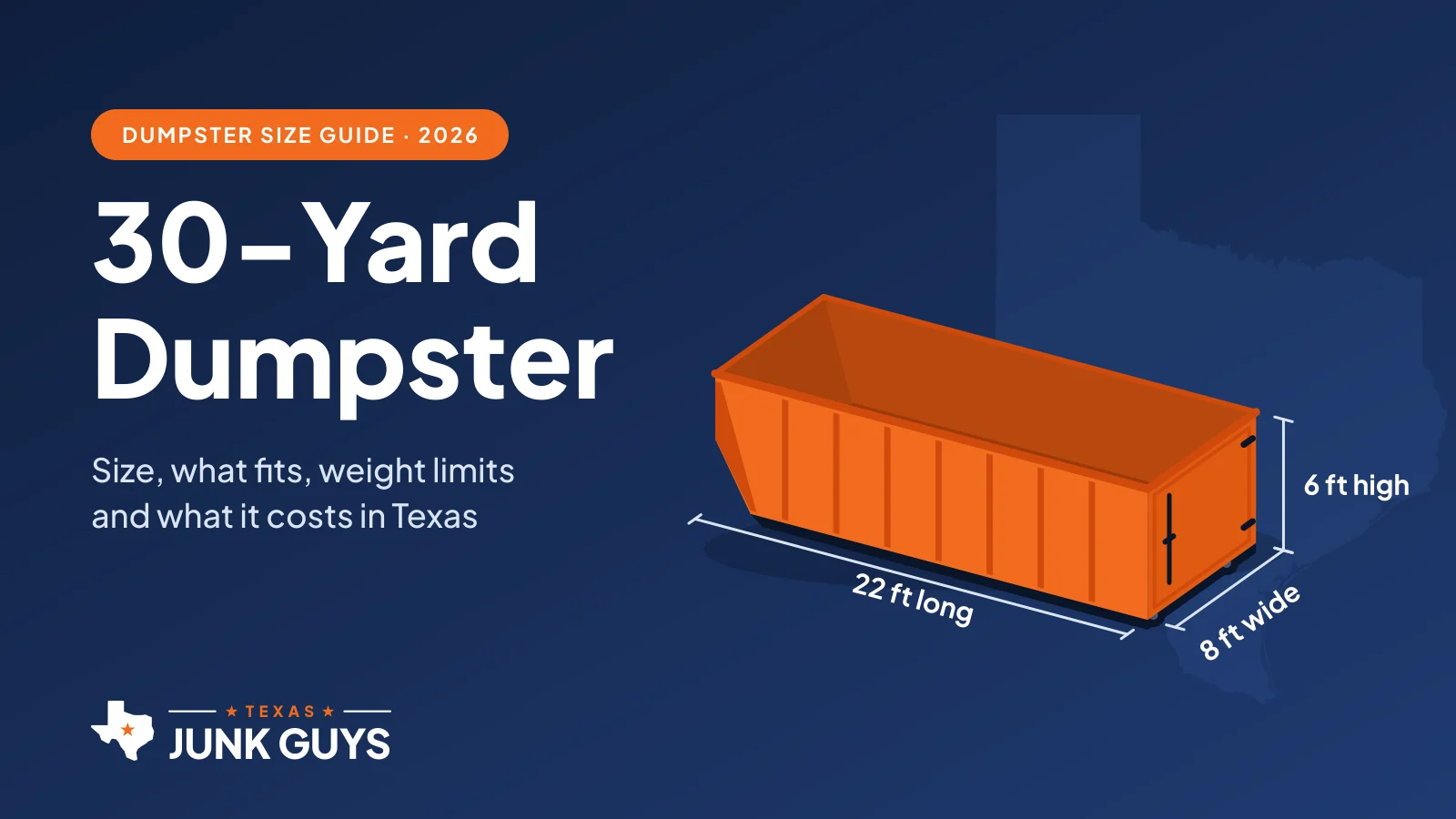
A 30-yard dumpster is about 22 feet long, 8 feet wide and 6 feet high. It holds 30 cubic yards of debris, which is roughly 9 to 12 pickup-truck loads, and usually comes with a 4 to 5 ton weight allowance. In Houston, Dallas, Austin, San Antonio and Fort Worth a 7-day rental costs about $375 to $650, according to Dumpster Rental Finder's April 2026 Texas price guides.
It's the size people step up to when a 20-yard won't be enough: a whole-house renovation, a big estate or hoarding cleanout, a multi-layer roof or new construction waste. This guide covers how big it is, what fits, how fast heavy debris reaches its weight limit, and what it costs in each big Texas metro.
Quick answer: A 30-yard roll-off is about 22 × 8 × 6 feet, holds 9 to 12 pickup loads and takes 4 to 5 tons. Expect $450–$600 for a week in Houston and San Antonio, $500–$650 in Dallas and Austin, and $375–$500 in Fort Worth. It costs about $75 to $125 more than a 20-yard and takes the same driveway space. It suits big cleanouts and renovations with bulky, light debris. For concrete, dirt or brick it's the wrong size. These are typical ranges from third-party guides, not quotes.
This post is part of our complete guide to dumpster rental in Texas, which covers how renting works from start to finish.
30-yard dumpster at a glance
| What | Typical figure |
|---|---|
| Dimensions (L × W × H) | 22 ft × 8 ft × 6 ft |
| Volume | 30 cubic yards (810 cubic feet) |
| Pickup-truck loads | about 9 (HomeGuide) to 12 (Dumpster Rental Finder) |
| Weight allowance | 4–5 tons (8,000–10,000 lb); HomeGuide says 3–5 tons |
| 7-day price, Texas metros | $375–$650 |
| Step up from a 20-yard | about $75–$125 more |
| Extra days | $5–$15 per day |
| Overage | $40–$75 per extra ton |
| Best for | Whole-house renovation, large cleanout, multi-layer roof, new building |
Sources: Dumpster Rental Finder's Texas city, price and 30-yard pages, last updated April 2026 and checked November 10, 2026 (dimensions, 12 pickup loads, 4–5 tons, prices, extra days, overage). HomeGuide's dumpster rental price guide, April 2023 (9 pickup loads, 3–5 tons). Cubic feet is 30 × 27.
How big is a 30-yard dumpster?
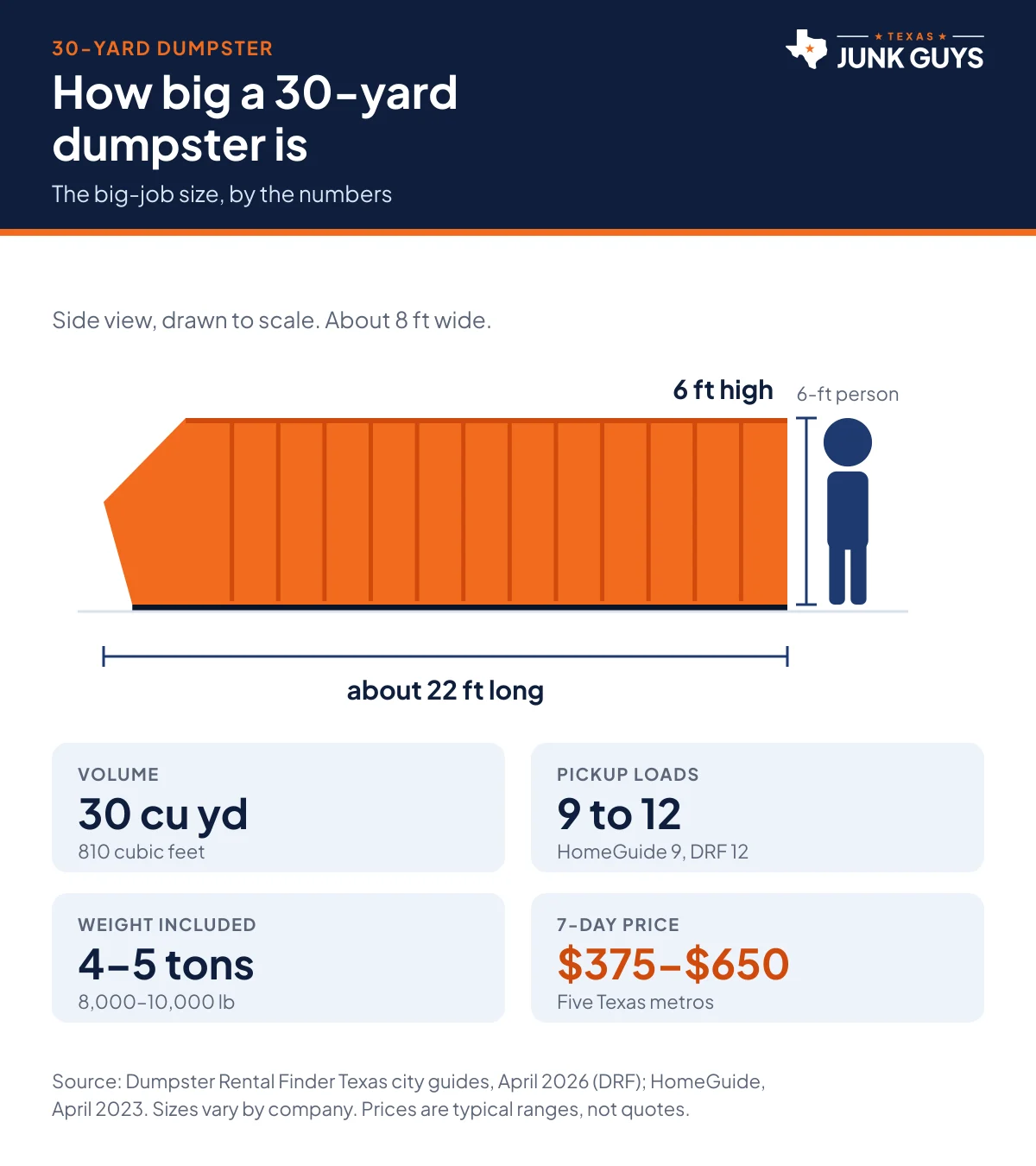
All five of Dumpster Rental Finder's Texas city guides list a 30-yard at 22 feet long, 8 feet wide and 6 feet high. HomeGuide's national guide also gives 22 feet long and 6 feet high, but notes that most roll-offs are about 7.5 feet wide rather than 8. Containers aren't built to one standard, so if space is tight, ask the company for the exact size of the one it will deliver.
Some ways to picture it:
- Footprint. About 22 by 8 feet, which Dumpster Rental Finder describes as roughly one parking space.
- Height. The walls are about 6 feet high, at or above eye level for most adults. You can't drop bags in over the side the way you can with a 4.5-foot 20-yard. Dumpster Rental Finder says most 30-yard containers have a swing-open door at one end, so you can walk debris in.
- Volume. One cubic yard is a cube 3 feet on each side. Thirty of them is 810 cubic feet.
Don't use the listed measurements to work out the volume. Multiply 22 × 8 × 6 and you get 1,056 cubic feet, about 39 cubic yards, not 30. The measurements are rounded and vary by manufacturer. What you're renting is the rated capacity: 30 cubic yards.
Same footprint as a 20-yard, just taller
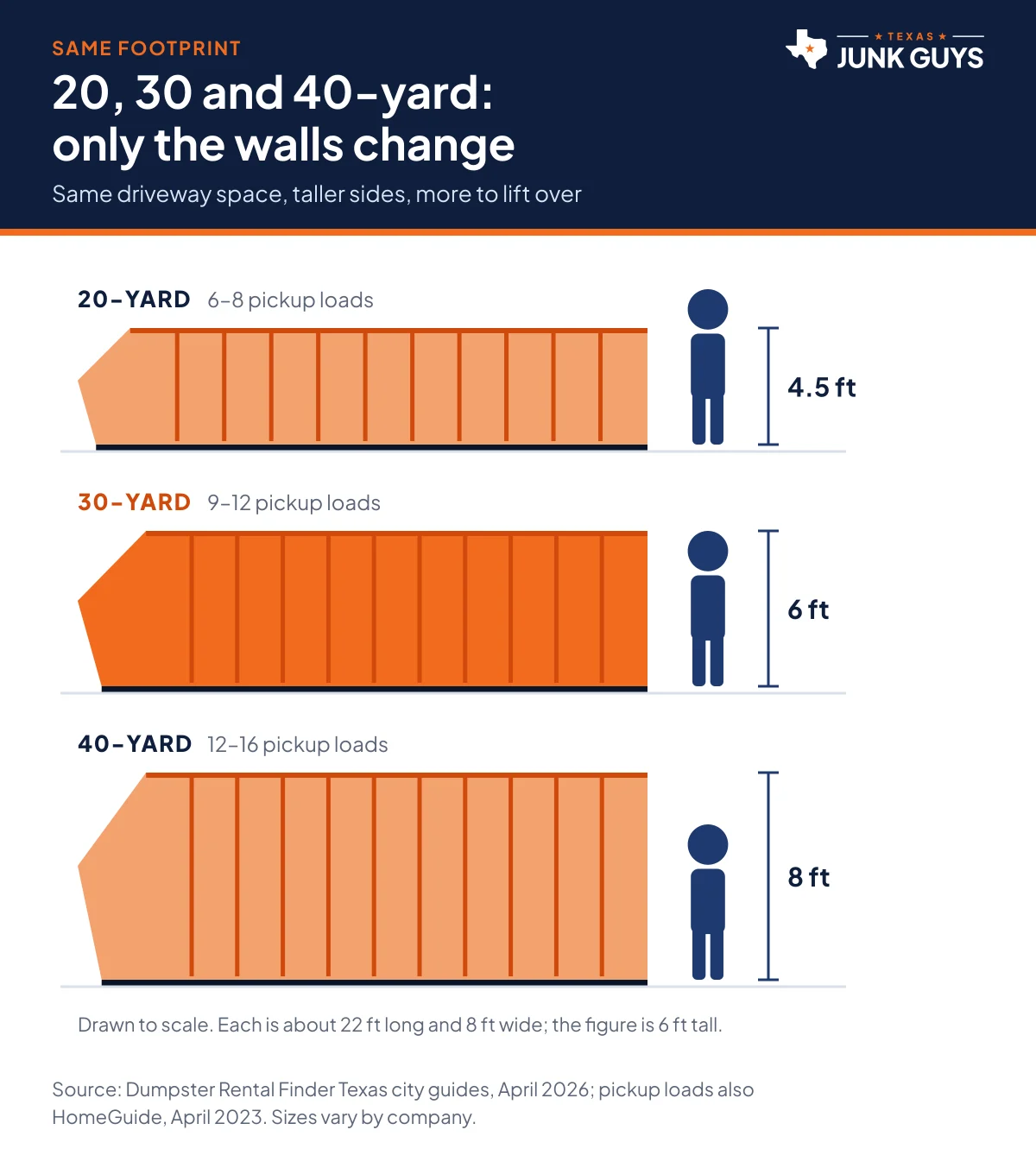
This is the most useful thing to know about the 30-yard. In Dumpster Rental Finder's figures, the 20-, 30- and 40-yard all share the same 22-by-8-foot footprint. The extra space comes from the walls: 4.5 feet on a 20-yard, 6 feet on a 30-yard and 8 feet on a 40-yard.
| Size | Dimensions (L × W × H) | Pickup loads | Weight allowance |
|---|---|---|---|
| 10-yard | 12 × 8 × 3.5 ft | about 3 | 2–3 tons |
| 15-yard | 14 × 8 × 4 ft | about 5 | 3–4 tons |
| 20-yard | 22 × 8 × 4.5 ft | 6–8 | 3–4 tons |
| 30-yard | 22 × 8 × 6 ft | 9–12 | 4–5 tons |
| 40-yard | 22 × 8 × 8 ft | 12–16 | varies; ask |
Sources: Dumpster Rental Finder Texas city guides, April 2026 (dimensions, weight allowances and the higher pickup-load figures). HomeGuide, April 2023 (the lower pickup-load figures). For the 40-yard, Dumpster Rental Finder says weight limits vary a lot and to confirm with the company; HomeGuide gives 5 to 6 tons.
So if a 20-yard fits on your driveway, a 30-yard usually does too. The trade-off is loading: the higher walls make it harder to toss things in by hand, which is why the swing door matters.
What fits in a 30-yard dumpster?
Projects it suits
Dumpster Rental Finder's Texas guides list these jobs for a 30-yard:
- Whole-house or multi-room renovation
- Large cleanouts, including estate cleanups, hoarding situations and office moves
- New construction waste and commercial buildouts
- Multi-room demolition
- Roofing on bigger jobs. Its city guides suggest a 20-yard for a single-layer tear-off and a 30-yard for whole-house renovation or roofing.
HomeGuide's list is similar: full cleanouts of a medium-size house, major remodels, and large amounts of landscaping debris. It suggests a 20-yard for a small house and a 40-yard for a large one.
If the 30-yard is for a building job, our guide to construction dumpster rental in Texas covers swaps, long rentals and whether you or your contractor should rent it.
How to check your pile will fit
- Measure the pile in feet, or the part of the rooms it fills: length, width and height.
- Multiply to get cubic feet.
- Divide by 27 to get cubic yards.
- Leave room. Furniture, branches and boxes don't pack tight. Break things down, or allow extra space.
If you get somewhere between about 20 and 30 cubic yards, a 30-yard is likely the right size. Under 20, a 20-yard will usually do, and our 20-yard dumpster guide covers it in the same detail as this one. Over 30, look at a 40-yard or plan a swap.
If you'd rather count truckloads: HomeGuide puts a typical pickup bed at about 2.4 cubic yards, so 9 to 12 loads is roughly what a 30-yard holds. For every size side by side, with a project-by-project table, see our guide to what size dumpster you need.
How much weight can a 30-yard dumpster hold?
Dumpster Rental Finder's Texas guides put a 30-yard's standard weight allowance at 4 to 5 tons, or 8,000 to 10,000 pounds. HomeGuide's range is a little wider, at 3 to 5 tons. Go over and you pay for each extra ton: $40 to $75 in the five big Texas metros, according to Dumpster Rental Finder.
A bigger container doesn't come with a matching jump in weight. A 30-yard holds 50 percent more than a 20-yard by volume, but its allowance is only about a ton higher. That makes weight a bigger risk in a 30-yard than in any smaller size.
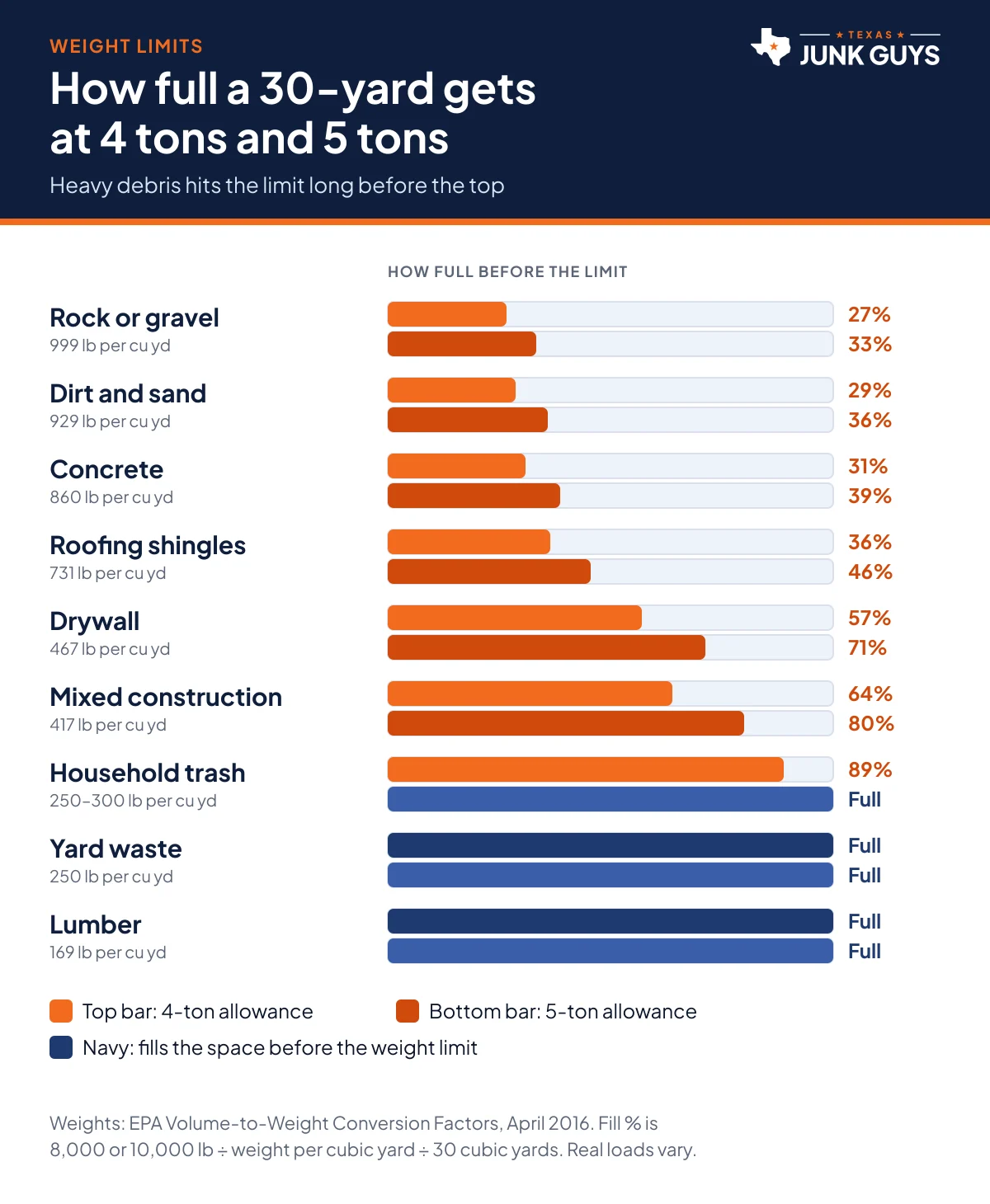
The U.S. Environmental Protection Agency publishes average weights per cubic yard for common materials. Using those figures, here's how full a 30-yard gets before it reaches 4 tons and 5 tons:
| Material | Weight per cubic yard (EPA) | How full at 4 tons | How full at 5 tons |
|---|---|---|---|
| Rock or gravel | 999 lb | about 27% | about 33% |
| Dirt and sand | 929 lb | about 29% | about 36% |
| Concrete | 860 lb | about 31% | about 39% |
| Asphalt roofing (shingles) | 731 lb | about 36% | about 46% |
| Drywall | 467 lb | about 57% | about 71% |
| Mixed construction debris | 417 lb | about 64% | about 80% |
| Mixed household trash, uncompacted | 250–300 lb | about 89% to full | full |
| Yard waste, uncompacted | 250 lb | full | full |
| Lumber | 169 lb | full | full |
Source: EPA, Volume-to-Weight Conversion Factors, April 2016. The "how full" columns are our arithmetic: 8,000 or 10,000 pounds divided by the EPA weight per cubic yard, compared with the container's 30 cubic yards. Real loads vary with moisture, how tightly they're packed and the size of the pieces.
What this means in practice:
- Furniture, yard waste, lumber and light household junk fill the space before the weight limit. This is what a 30-yard is good at.
- Packed household trash can go over a 4-ton allowance. At the EPA's upper figure of 300 pounds per cubic yard, a 30-yard filled to the top weighs about 9,000 pounds, or 4.5 tons. On a big cleanout, ask for the 5-ton option.
- Drywall and mixed remodeling debris reach the limit with the container two-thirds to four-fifths full. Plan for some overage, or ask about a higher allowance before you book.
- Concrete, dirt, rock and brick hit the limit with a 30-yard only about a quarter to two-fifths full. You'd be paying for space you can't use. Dumpster Rental Finder says heavy materials may need a dedicated heavy-debris container, at a 10 to 20 percent premium, and HomeGuide warns a container filled entirely with them can be too heavy for the truck to lift.
Roofing in a 30-yard
Shingles weigh about 731 pounds per cubic yard in the EPA's table. That means a 30-yard reaches 4 tons at about 11 cubic yards of shingles and 5 tons at about 14, well under half full either way. A 30-yard gives you room for the shingles plus the underlayment, flashing and any rotten decking, but on a heavy tear-off the weight will run out first. Ask about the allowance, the overage rate and whether the company has roofing-specific pricing before you book.
Wet debris after a storm
Water adds weight. The EPA's table shows wet sawdust at about 530 pounds per cubic yard against 275 pounds dry, almost double. Flood-soaked carpet, drywall, insulation and furniture after a Texas hurricane or flash flood will weigh far more than the dry figures above, so a 30-yard full of flood debris can go well past 5 tons. Plan for overage, or rent two smaller containers rather than overfilling one big one. Dumpster Rental Finder lists the 40-yard for major storm cleanup, but the same weight warning applies to it.
How much does a 30-yard dumpster cost in Texas?
Dumpster Rental Finder publishes a price guide for each of the five biggest Texas metros, all last updated April 2026. For a standard 7-day rental:
| City | 20-yard | 30-yard | 40-yard |
|---|---|---|---|
| Houston | $350–$500 | $450–$600 | $550–$750 |
| Dallas | $375–$550 | $500–$650 | $600–$825 |
| Austin | $375–$550 | $500–$650 | $600–$825 |
| San Antonio | $350–$500 | $450–$600 | $550–$750 |
| Fort Worth | $300–$425 | $375–$500 | $475–$650 |
Source: Dumpster Rental Finder price guides for each city, last updated April 2026, checked November 10, 2026. The guides describe these as estimates based on market data and regional cost adjustments, not quotes.
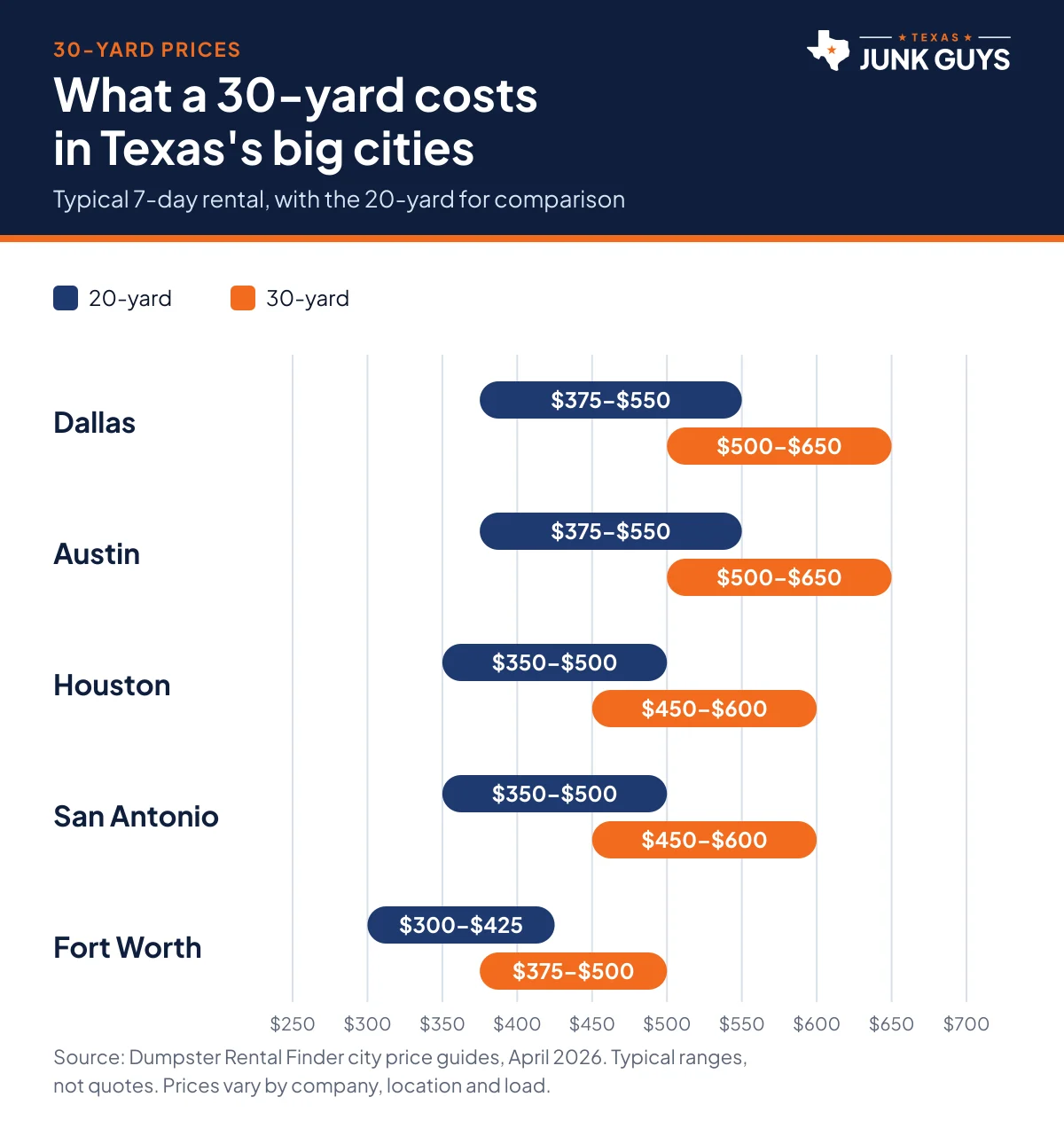
What stands out:
- Dallas and Austin are the priciest, at up to $650.
- Houston and San Antonio match, at $450 to $600.
- Fort Worth is the cheapest, at $375 to $500, even though it shares a metro area with Dallas. Near the county line, it can pay to ask companies on both sides.
The same site's separate 30-yard pages give one range for all five cities: $425 to $550 for 7 days with a 4-to-5-ton allowance. That's lower at the top end than the city price guides above, so treat the whole spread, roughly $375 to $650, as the realistic range, and get a written quote.
For every size and city, plus permits and the fees that push the bill up, see our guide to dumpster rental prices in Texas, linked from the hub guide above.
The step up from a 20-yard
Going from a 20-yard to a 30-yard adds about $75 to $125 for the week, depending on the city, comparing the price-guide ranges above. Dumpster Rental Finder's 30-yard pages give the same figure.
That matters because the alternative costs more. Dumpster Rental Finder's Texas guides put the cost of a second delivery and pickup, when a container fills too soon, at $150 to $250. If you're unsure whether a 20-yard will hold everything and the debris is light, the 30-yard is the cheaper bet.
Is a 30-yard good value?
By volume, yes. Using the Houston prices above:
| Size | Houston, 7 days | Price per cubic yard |
|---|---|---|
| 20-yard | $350–$500 | $17.50–$25 |
| 30-yard | $450–$600 | $15–$20 |
| 40-yard | $550–$750 | $13.75–$18.75 |
Price per cubic yard is our arithmetic: the price range divided by the size.
But that only holds if you can use the space. Because a 30-yard's weight allowance is only a ton or so higher than a 20-yard's, heavy debris makes it poor value. For concrete, dirt or shingles, a smaller container (or a heavy-debris one) is usually cheaper.
What the price includes
Dumpster Rental Finder's Texas guides describe a standard rental the same way in all five cities. The price usually covers delivery, pickup, 7 days on site and a base weight allowance with disposal of that weight.
What it usually doesn't cover:
- Extra days, at about $5 to $15 a day in the city price guides, or $10 to $15 on the 30-yard pages
- Overage, at about $40 to $75 per ton over the allowance
- Heavy-debris containers, at 10 to 20 percent more
- A delivery fee if the company's yard is far away, which the Houston cost guide puts at about $25 to $75
- A permit, if the dumpster goes on the street
- Surcharges for items like mattresses and tires, which the Houston cost guide puts at $15 to $50 each
30-yard vs 20-yard vs 40-yard: which do you need?
Choose a 20-yard if you're clearing out an average-size house, doing a kitchen or flooring remodel, or tearing off a single layer of roofing. Its 4.5-foot walls are much easier to load by hand.
Choose a 30-yard if it's a whole-house renovation, a large house with a full attic and garage, a hoarding or estate cleanout, a multi-layer roof, or new construction waste. It takes the same driveway space as a 20-yard and costs about $75 to $125 more.
Choose a 40-yard if it's commercial demolition, a large construction site or major storm cleanup, the jobs Dumpster Rental Finder lists for it. At 8 feet high, Dumpster Rental Finder notes, it needs equipment or a walk-in door for loading.
If you're stuck between two sizes and the debris is light, pick the bigger one. If the debris is heavy, pick the smaller one and ask about a heavy-debris container. On a long renovation, a 30-yard that's swapped when full is often easier to manage than one oversized container.
Will a 30-yard dumpster fit at your house?
The container needs about 22 by 8 feet, but the truck that delivers it needs far more. Dumpster Rental Finder's Texas buyer guides give these numbers:
- 60 feet or more of straight access for the truck to line up and set the container down.
- 23 to 25 feet of clearance overhead. Look for power lines, tree branches and roof eaves.
- Protect the surface. Its guides suggest plywood under the container on concrete or asphalt. Its 30-yard pages say a loaded 30-yard weighs 8,000 to 12,000 pounds, and that's sitting on your driveway for a week.
Also check the access itself: a narrow gate, a steep driveway or a tight cul-de-sac can rule out the spot you want. If your driveway slopes or is narrow, talk about placement when you book.
A dumpster on your own driveway usually needs no permit. Dumpster Rental Finder's Texas guides say street placement usually needs a temporary permit from the city. Many Texas HOAs also have their own rules about dumpsters in driveways and how long they can stay. Check both before delivery day; the hub guide linked above covers permits and HOAs in more detail.
Book a few days ahead
The 30-yard isn't carried by every company. In Dumpster Rental Finder's Texas listings, about a third to two-fifths of dumpster companies in each city offer one: 15 of 41 in Houston, 13 of 38 in Dallas, 13 of 31 in Austin, 12 of 33 in Fort Worth and 6 of 14 in San Antonio. Its guides call spring and fall peak renovation season and suggest planning 2 to 3 days ahead then. If your project has a fixed start date, book early.
What can't go in a 30-yard dumpster?
Size doesn't change what's allowed. Texas keeps some wastes out of landfills altogether. Under the Texas Commission on Environmental Quality's landfill rule (30 Texas Administrative Code §330.15), that includes lead-acid batteries, used motor oil, used oil filters, whole used tires and regulated hazardous waste. None of those can go in a dumpster bound for a Texas landfill.
Beyond that, each company has its own list. Dumpster Rental Finder's Houston guides say most companies there don't take paint, chemicals, batteries, asbestos, motor oil, medical waste or appliances with refrigerant, and some restrict mattresses, electronics and tires or charge extra for them. HomeGuide warns that prohibited items found at the dump can be sent back to you, with a fine of up to $500. Ask for the company's list before you start loading.
Tips for loading a 30-yard dumpster
- Use the door. With 6-foot walls, walk heavy and awkward items in through the swing door rather than lifting them over the side. Close and latch it before the truck comes.
- Load heavy and flat items first, then stack lighter, bulkier things on top.
- Spread the weight evenly. A container loaded heavily at one end is harder for the truck to lift.
- Break things down. Take furniture apart, cut branches short and flatten boxes. A 30-yard full of air is still a 30-yard you paid for.
- Keep heavy debris separate. If the job includes concrete, tile or dirt, ask whether it should go in its own container.
- Don't fill above the top edge. HomeGuide notes that drivers can't legally haul an overloaded container with debris sticking up over the top, so you may be charged or asked to unload.
- Cover it if rain is forecast, where the company allows it. Rain adds weight you pay for.
Questions to ask before you book a 30-yard dumpster
Tell the company what you're throwing away and roughly how much, then ask:
- What are the exact dimensions, and does the container have a swing door?
- How many tons are included, and what does each extra ton cost? Is there a 5-ton option?
- How many days are included, and what does each extra day cost?
- Do you require a separate container for concrete, dirt or roofing?
- What items aren't allowed, and are there fees for any of them?
- How much room and overhead clearance does your truck need?
- Is the price all-in, or are there delivery, fuel or disposal fees on top?
To compare companies, pick your city on our dumpster rental page. You'll see the companies that serve it, and you can call one directly or send one free quote request.
Sources
All figures in this guide come from third-party cost guides, a federal data table and a Texas state rule. They are typical figures, not quotes from any company.
- Dumpster Rental Finder, 30 Yard Dumpster Rental in Houston, TX, plus the site's matching 30-yard pages and its city, price, cost and buyer guides for Houston, Dallas, Austin, San Antonio and Fort Worth, last updated April 2026 and checked November 10, 2026. Dimensions, pickup loads, weight limits, prices, extra-day and overage rates, heavy-debris premium, second-haul cost, truck access, projects, provider counts and booking season.
- HomeGuide, Dumpster Rental Prices, April 2023, checked November 10, 2026. Width, lower pickup-load and weight figures, pickup-bed volume, best uses by house size, overflow and prohibited-item warnings.
- U.S. Environmental Protection Agency, Volume-to-Weight Conversion Factors, April 2016, checked November 10, 2026. Weights per cubic yard by material.
- Texas Commission on Environmental Quality, 30 Texas Administrative Code §330.15, General Prohibitions. Wastes banned from Texas landfills.
Frequently asked questions
- How big is a 30-yard dumpster?
- A 30-yard dumpster is typically about 22 feet long, 8 feet wide and 6 feet high, according to Dumpster Rental Finder's April 2026 Texas guides. It holds 30 cubic yards, or 810 cubic feet, and takes up about one parking space. Exact dimensions vary by manufacturer, so ask the company if space is tight.
- How much does a 30-yard dumpster cost in Texas?
- About $375 to $650 for a 7-day rental in the big metros: $450–$600 in Houston and San Antonio, $500–$650 in Dallas and Austin, and $375–$500 in Fort Worth (Dumpster Rental Finder, April 2026). The price usually includes delivery, pickup and a 4 to 5 ton weight allowance. Get a written quote, because prices vary by company and load.
- How many pickup-truck loads fit in a 30-yard dumpster?
- About 9 to 12. HomeGuide counts about 9 and Dumpster Rental Finder about 12. A typical pickup bed holds about 2.4 cubic yards, according to HomeGuide.
- How much weight can a 30-yard dumpster hold?
- Most Texas rentals include 4 to 5 tons (8,000 to 10,000 pounds), according to Dumpster Rental Finder; HomeGuide gives 3 to 5 tons. Over that, expect about $40 to $75 per extra ton. Concrete or dirt reaches 4 tons with the container less than a third full.
- What's the difference between a 20-yard and a 30-yard dumpster?
- Height and capacity. Both are about 22 by 8 feet, so they take the same driveway space, but a 20-yard's walls are about 4.5 feet high and a 30-yard's about 6 feet. The 30-yard holds 50 percent more and costs about $75 to $125 more for a week in Texas's big metros.
- Is a 30-yard dumpster big enough for a whole-house cleanout?
- For a medium-size house, usually yes. HomeGuide suggests a 30-yard for a medium-size house and a 40-yard for a large one, and Dumpster Rental Finder lists it for estate and hoarding cleanouts. Packed household trash can weigh about 4.5 tons in a full 30-yard, so ask for a 5-ton allowance.
- Will a 30-yard dumpster fit in my driveway?
- Usually, if a 20-yard would: it has the same 22-by-8-foot footprint. The truck needs about 60 feet of straight access and 23 to 25 feet of overhead clearance, according to Dumpster Rental Finder's Texas guides. Check for low branches, power lines and narrow gates.
- Can I put concrete in a 30-yard dumpster?
- You can, but it's usually the wrong size for it. Concrete weighs about 860 pounds per cubic yard (EPA), so a 30-yard reaches 4 tons with only about 9 cubic yards in it. Some companies want concrete, dirt and brick in a separate heavy-debris container. Ask before you load.
This guide is general information, not advice about any particular company. Prices, sizes and rules vary by company and city, so confirm the details with the company you hire. How we list companies.