What Size Dumpster Do I Need? A Texas Guide to 10- to 40-Yard Sizes
Most Texas home projects fit a 10- to 20-yard dumpster. Here's how big each size is, which one suits your project, and why heavy debris changes the answer.
By the Texas Junk Guys team · Updated October 21, 2026
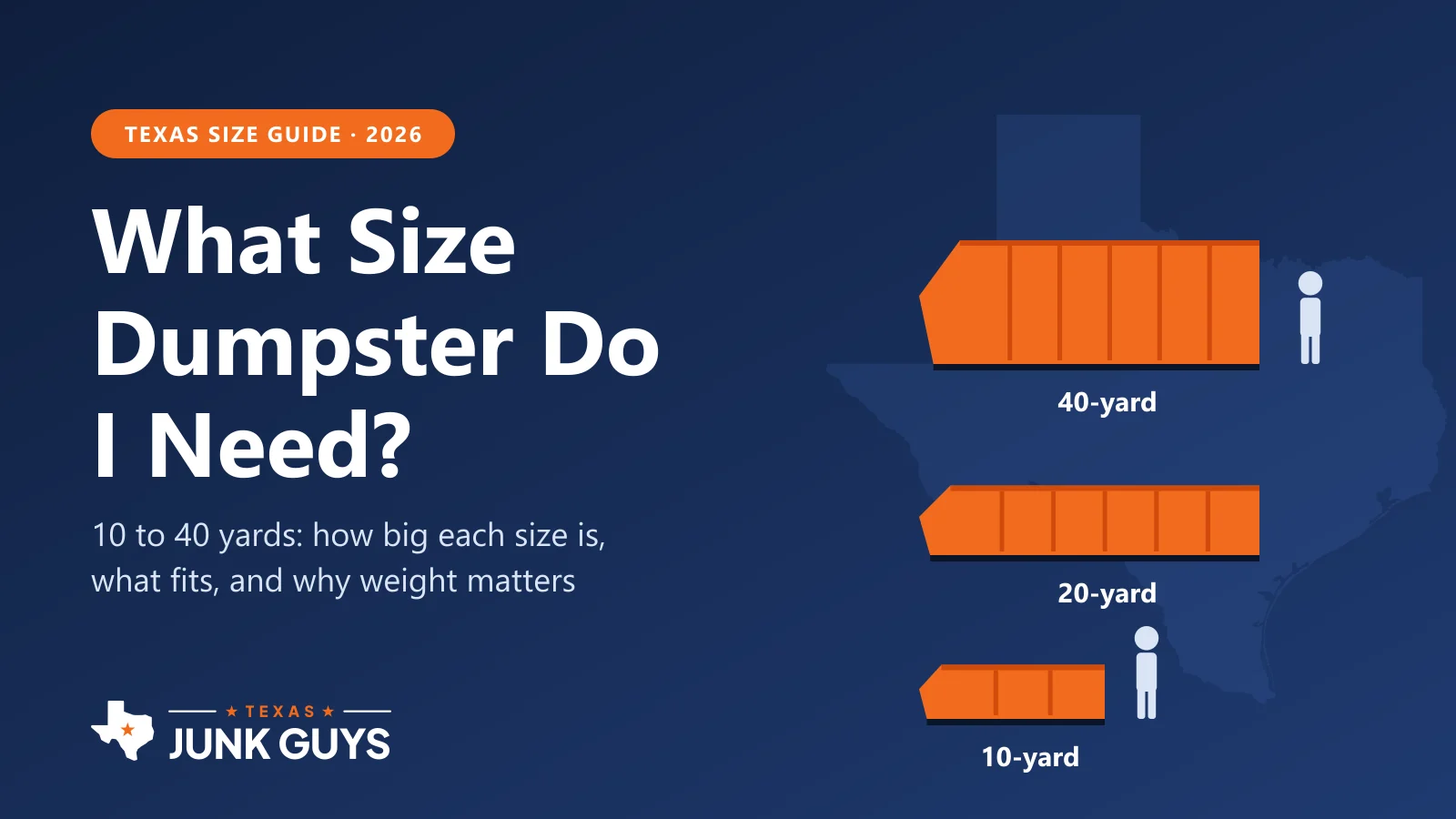
For most home projects in Texas, a 20-yard dumpster is the right size. It holds about 6 to 8 pickup-truck loads and suits a whole-house cleanout, flooring removal or a large remodel. Go down to a 10-yard for a garage cleanout or a small bathroom remodel. Go up to a 30- or 40-yard for a major renovation, new construction or a big cleanup.
Volume is only half the answer, though. Every dumpster also has a weight limit, and heavy debris like concrete, dirt or roofing shingles reaches it long before the container is full. This guide covers how big each size really is, what fits in it, how to measure your own pile, and how to pick a size when the debris is heavy.
Quick answer: 10-yard for a garage or one-room cleanout, 15-yard for a kitchen remodel, 20-yard for a whole-house cleanout or large remodel, 30-yard for a major renovation, 40-yard for construction or large-scale cleanups. For concrete, dirt or brick, rent a small container and fill it only part way. If you're between two sizes, the bigger one usually costs less than a second haul.
For what each size costs in Houston, Dallas, Austin, San Antonio and Fort Worth, see our dumpster rental prices in Texas guide. This post is about picking the size.
Dumpster sizes at a glance
Roll-off dumpsters are sold by volume, in cubic yards. One cubic yard is a cube 3 feet on each side, or 27 cubic feet. A "20-yard" dumpster holds about 20 cubic yards of debris.
Dumpster Rental Finder's April 2026 guides for Houston, Dallas, Austin, San Antonio and Fort Worth list the same typical dimensions for all five cities:
| Size | Typical dimensions (L × W × H) | About how many pickup loads | Typical weight limit | Good for |
|---|---|---|---|---|
| 10-yard | 12 ft × 8 ft × 3.5 ft | 3 | 2–3 tons | Garage cleanout, small bathroom remodel, small deck |
| 15-yard | 14 ft × 8 ft × 4 ft | 5 | 3–4 tons | Kitchen remodel, flooring in several rooms |
| 20-yard | 22 ft × 8 ft × 4.5 ft | 8 | 3–4 tons | Whole-house cleanout, large remodel, single-layer roof |
| 30-yard | 22 ft × 8 ft × 6 ft | 12 | 4–5 tons | Whole-house renovation, new construction waste |
| 40-yard | 22 ft × 8 ft × 8 ft | 16 | Varies | Commercial demolition, large construction sites |
Source: Dumpster Rental Finder city guides for the five largest Texas metros, updated April 2026.
Two things to know about these numbers:
- Dimensions vary by manufacturer. HomeGuide's national guide gives slightly different ones: a 10-yard about 14 feet long and 3.5 feet high, a 15-yard 16 feet long and 4.5 feet high, and most dumpsters about 7.5 feet wide. Ask the company for the exact size of the container it will deliver if space is tight.
- Pickup-load counts are rough. HomeGuide counts about 3 loads for a 10-yard, 4.5 for a 15-yard, 6 for a 20-yard, 9 for a 30-yard and 12 for a 40-yard. Dumpster Rental Finder counts more for the bigger sizes, because it assumes a fuller truck bed. Use the range, not an exact number.
Notice that the 20-, 30- and 40-yard sizes share the same footprint in Dumpster Rental Finder's list. They take up the same driveway space and differ only in height. The 10- and 15-yard are the ones that are actually shorter.
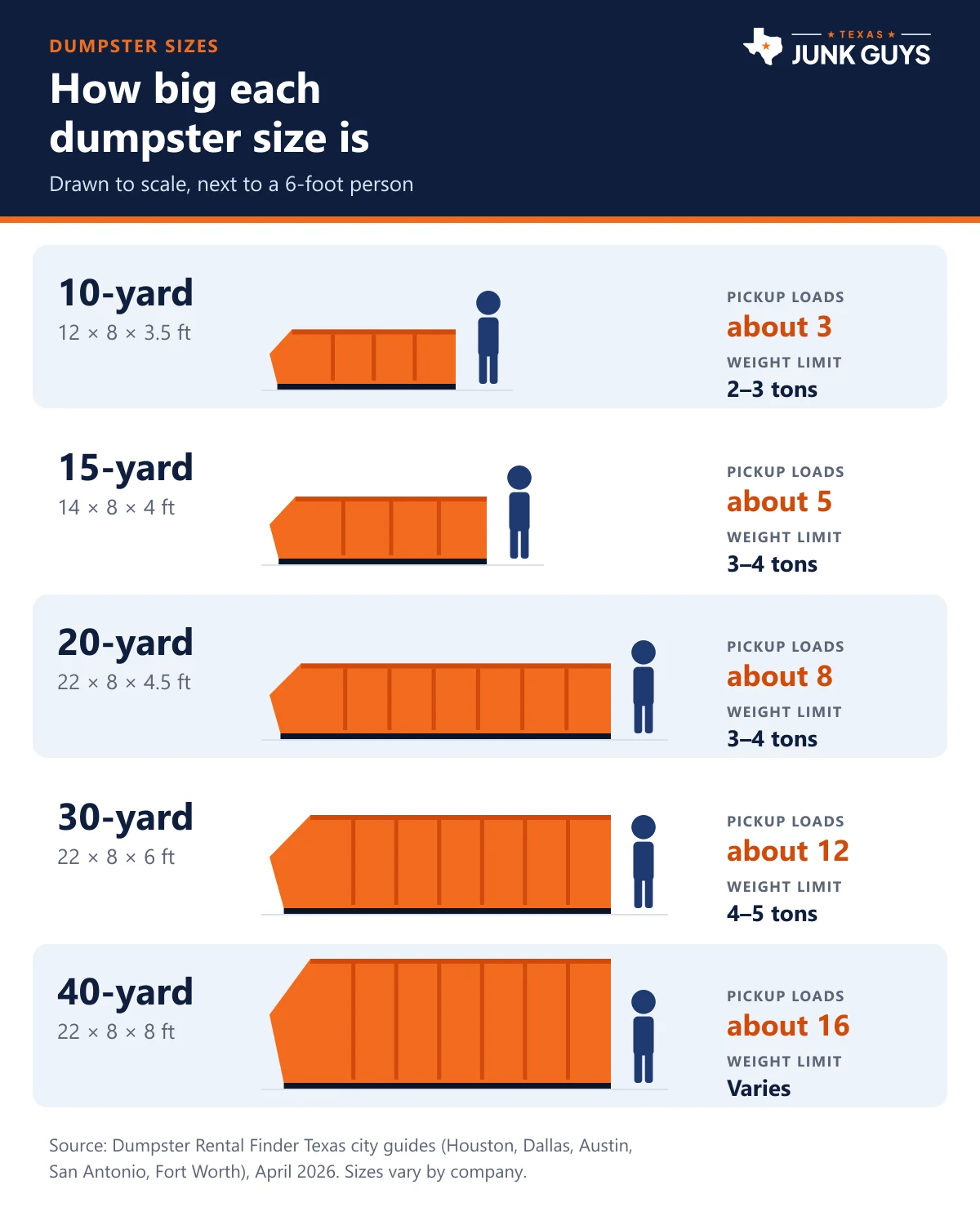
How big is each dumpster size?
How big is a 10-yard dumpster?
A 10-yard dumpster is about 12 feet long, 8 feet wide and 3.5 feet high, and holds about 3 pickup-truck loads. It's the smallest roll-off most Texas companies carry. Dumpster Rental Finder says it fits comfortably in a standard driveway.
It suits a single-room cleanout, a garage or closet cleanout, a small bathroom remodel or a small deck removal. Its weight limit is usually 2 to 3 tons. It's also the usual size for heavy material like concrete, dirt and brick (more on that below).
How big is a 15-yard dumpster?
A 15-yard dumpster is about 14 feet long, 8 feet wide and 4 feet high in Dumpster Rental Finder's figures, and holds about 4.5 to 5 pickup loads. It sits between a light cleanout and a full renovation: a kitchen remodel, flooring removal across several rooms, or a small porch or deck demolition. HomeGuide also lists siding removal. Weight limits run 2 to 4 tons, depending on the company.
How big is a 20-yard dumpster?
A 20-yard dumpster is about 22 feet long, 8 feet wide and 4.5 feet high, and holds about 6 to 8 pickup loads. Dumpster Rental Finder calls it the most commonly rented size in Houston and nationally. It handles whole-house cleanouts, flooring removal, larger remodels and, according to Dumpster Rental Finder, single-layer roof replacements. Its weight limit is usually 3 to 4 tons.
How big is a 30-yard dumpster?
A 30-yard dumpster has the same 22-by-8-foot footprint as a 20-yard but is about 6 feet high, and holds about 9 to 12 pickup loads. It's for big jobs: a whole-house renovation, a major remodel, new construction waste or large landscaping debris. Dumpster Rental Finder says it needs a clear area about the size of a parking space. Typical weight limits are 3 to 5 tons.
How big is a 40-yard dumpster?
A 40-yard dumpster is about 22 feet long, 8 feet wide and 8 feet high, and holds about 12 to 16 pickup loads. It's the largest standard size. At 8 feet tall, Dumpster Rental Finder notes, it needs equipment or a walk-in door to load. It's used for commercial demolition, large construction sites and large-scale cleanups, including major storm cleanup. HomeGuide lists large house cleanouts, very large remodels and roofing jobs. Weight limits vary a lot between companies, with HomeGuide giving 5 to 6 tons as typical.
How to work out how much debris you have
You don't need to be exact. A rough estimate is enough to choose between two sizes.
- Measure the pile, or the space it fills. If the junk is already in a pile, measure its length, width and height in feet. If it's still in a room, measure the part of the room it fills.
- Multiply to get cubic feet. Length × width × height.
- Divide by 27 to get cubic yards. A pile 9 feet long, 6 feet wide and 3 feet high is 162 cubic feet, or 6 cubic yards.
- Add some room. Debris doesn't pack perfectly. Furniture, branches and boxes leave gaps, so a pile takes up more space in a dumpster than its measurements suggest unless you break things down.
If it's easier to think in truckloads: HomeGuide puts a typical pickup bed at about 2.4 cubic yards, and our own calculator uses about 2 cubic yards for an 8-foot bed loaded level. Count how many pickup loads you'd need, multiply by 2 to 2.4, and you have a rough volume.
Our free dumpster size calculator does the math for you. Enter your pile's measurements, or pick a common project, and it gives the volume in cubic yards and the smallest standard size that fits.
What size for common projects?
The two third-party guides mostly agree. Where they differ, both are shown.
| Project | HomeGuide | Dumpster Rental Finder (Texas guides) |
|---|---|---|
| Garage or small cleanout | 10-yard | 10-yard |
| Small bathroom remodel | 15-yard | 10-yard |
| Kitchen remodel | 15-yard | 15- to 20-yard |
| Flooring removal | 20-yard | 15- to 20-yard |
| Small deck or porch removal | 15-yard | 10-yard |
| Whole-house cleanout | 20- to 40-yard, by house size | 20-yard |
| Roof replacement | 40-yard | 20-yard (single layer) or 30-yard |
| Major remodel or whole-house renovation | 30-yard | 30-yard |
| Large landscaping or yard cleanup | 20- or 30-yard | not listed |
| New construction or demolition | not listed | 30- or 40-yard |
Sources: HomeGuide's dumpster rental price guide (April 2023) and Dumpster Rental Finder's Texas city guides (April 2026).
The size of the house and the depth of the job change the answer. A cleanout of a two-bedroom house is a different job from a four-bedroom house with a full attic. Roofing depends on the size of the roof and how many layers come off. Use the table as a starting point, then check your estimate with the calculator.
Why weight matters as much as size
A dumpster's rating tells you how much space it has. Its weight limit tells you how much you can actually put in it before you pay extra. For light household junk, you'll fill the space first. For heavy debris, you'll hit the weight limit first, sometimes with the container less than half full.
The U.S. Environmental Protection Agency publishes average weights per cubic yard for common materials, drawn from waste studies. Using those figures, here's roughly how much of each material fits in a 20-yard dumpster before you reach a 3-ton (6,000-pound) allowance, the low end of the 3-to-4-ton range above:
| Material | Weight per cubic yard (EPA) | Cubic yards to reach 3 tons | How full a 20-yard gets |
|---|---|---|---|
| Rock or gravel | 999 lb | about 6 | about 30% |
| Dirt and sand | 929 lb | about 6.5 | about 32% |
| Concrete | 860 lb | about 7 | about 35% |
| Asphalt roofing (shingles) | 731 lb | about 8 | about 41% |
| Drywall | 467 lb | about 13 | about 64% |
| Mixed construction debris | 417 lb | about 14 | about 72% |
| Mixed household trash, uncompacted | 250–300 lb | 20 or more | full, near the limit |
| Yard waste, uncompacted | 250 lb | 24 | full, under the limit |
| Lumber | 169 lb | 35 | full, well under |
Source: EPA, Volume-to-Weight Conversion Factors, April 2016. The "cubic yards" and "how full" columns are our arithmetic: 6,000 pounds divided by the EPA weight per cubic yard, compared with a 20-yard's 20 cubic yards. Real loads vary with moisture, how tightly they're packed and how big the pieces are.
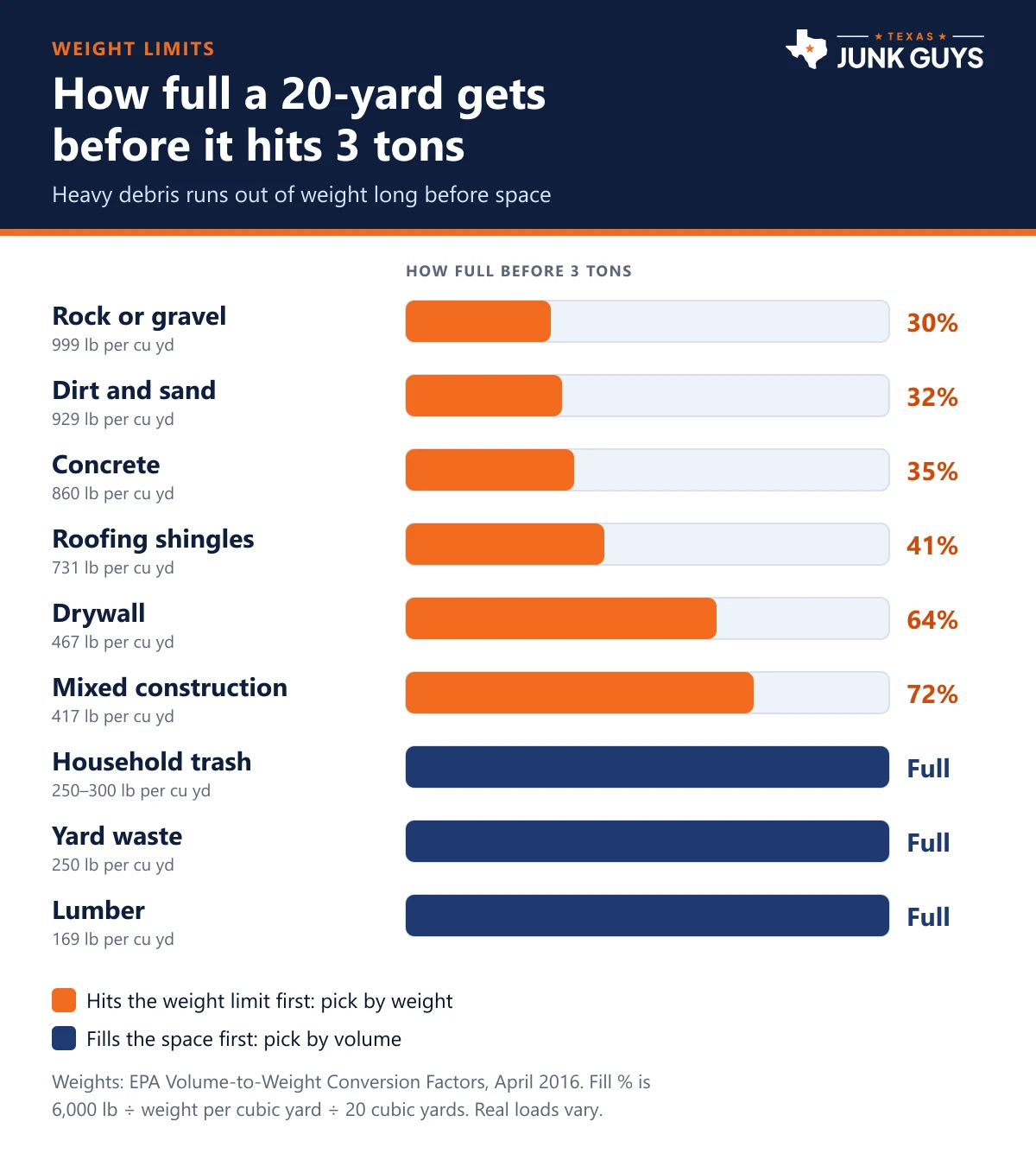
The lesson is simple:
- Light debris (household junk, furniture, lumber, yard waste, cardboard) fills the space before the weight limit. Pick by volume.
- Medium debris (drywall, mixed remodeling waste) gets close to the limit in a full 20-yard. Ask about the allowance and the rate per extra ton.
- Heavy debris (concrete, dirt, rock, brick, shingles) hits the limit with the container one-third to two-fifths full. Pick by weight.
Heavy debris: go smaller, not bigger
It sounds backwards, but for concrete, dirt, brick and rock, a smaller container is usually the right choice. Our size calculator recommends a 10-yard filled about halfway for these materials, because the weight limit runs out long before the space does. Many companies require heavy material to go in a dedicated heavy-debris container. HomeGuide warns that a dumpster filled entirely with concrete, brick, block or dirt can be too heavy for the truck to lift at all.
If your project mixes heavy and light debris, such as a remodel with a tiled floor, ask whether it's cheaper to rent a small heavy-debris container for the tile and concrete and a larger one for everything else.
Wet debris weighs more
Water adds weight, and that matters in Texas, where hurricanes, storms and flooding leave a lot of wet debris behind. The EPA's own table shows the effect: wet sawdust weighs about 530 pounds per cubic yard against 275 pounds dry, nearly double. Waterlogged drywall, carpet, insulation and furniture from a flooded house will weigh more than the dry figures above.
After a storm or flood, plan on reaching the weight limit sooner than you would with dry debris. Ask the company about the tonnage allowance and the overage rate before you start loading, and keep the container covered if rain is forecast and the company allows it.
Will the dumpster fit at your house?
The right size on paper is no use if it doesn't fit where you want it.
- Measure the spot. A 10-yard needs about 12 to 14 feet of length. A 20-, 30- or 40-yard needs about 22 feet, plus space for the truck to line up and set it down. Ask the company how much straight-line room its truck needs and whether it can reach your spot.
- Look up. Low branches, power lines and roof eaves can block the truck's lift. Tell the company about anything overhead.
- Check the surface. A loaded container is heavy. Ask the company whether it puts boards or pads under the container to protect your driveway.
- Mind the gate and the slope. A narrow gate, a steep driveway or a tight cul-de-sac can limit which sizes can be delivered.
- Think about loading. The 10- and 15-yard have walls about 3.5 to 4 feet high. A 40-yard at 8 feet tall needs a walk-in door or equipment.
If the dumpster has to go on the street, you may need a permit from your city, and many HOAs have their own rules on dumpsters in driveways. Our dumpster prices guide, linked above, covers permit costs and what to check with your city and HOA.
If you're between two sizes
Size up. Dumpster Rental Finder's Texas guides put it plainly: when in doubt, size up, because the $50 to $100 difference between sizes is cheaper than a second delivery. A second haul means paying for another delivery and pickup, and waiting for it.
Bigger dumpsters also cost less per cubic yard. Using Dumpster Rental Finder's April 2026 Houston prices for a 7-day rental:
| Size | Houston price range | Price per cubic yard |
|---|---|---|
| 10-yard | $250–$350 | $25–$35 |
| 20-yard | $350–$500 | $17.50–$25 |
| 40-yard | $550–$750 | $13.75–$18.75 |
Source: Dumpster Rental Finder Houston price guide, April 2026. Price per cubic yard is the range divided by the size. Prices vary by company and location, and these are typical ranges, not quotes.
There are two exceptions to "size up":
- Heavy debris. A bigger container doesn't raise the weight limit much, so you'd pay for space you can't use. Stay small.
- Very small jobs. If your pile is only one or two pickup loads, a dumpster may not be the best option at all.
You can compare dumpster rental companies by city on our dumpster rental page. In Houston, for example, our directory lists 169 companies that rent dumpsters. Compare dumpster rental companies in Houston.
Do you need a dumpster at all?
A dumpster makes sense when debris builds up over days, as in a remodel, a roof replacement or a big cleanout you'll do yourself. You load it on your schedule, and the company hauls it away when you're done.
If you have a few large items and a small pile, such as a sofa, a mattress and some boxes, a junk removal service is often the simpler choice. The crew does the lifting and takes everything in one visit, and nothing sits in your driveway. You pay by how much space your items take in their truck. Compare junk removal companies in Texas.
A rough rule: if you'll fill most of a 10-yard and you're happy to load it yourself, a dumpster usually makes sense. If it's less than two or three pickup loads, or you can't do the lifting, junk removal usually does.
Questions to ask before you book
When you call for a quote, tell the company what you're throwing away and roughly how much. Then ask:
- What are the exact dimensions of the container you'll deliver?
- How much room does your truck need, and can it reach my spot?
- How many tons are included, and what does each extra ton cost?
- Do you require a separate container for concrete, dirt or roofing?
- What can't go in the dumpster?
- How many days are included, and can I swap it for an empty one if I fill it early?
Sources
All figures in this guide come from third-party guides and a federal data table. They are typical figures, not quotes from any company. Sources checked October 21, 2026.
- Dumpster Rental Finder, Dumpster Rental Houston, plus its matching guides for Dallas, Austin, San Antonio and Fort Worth on the same site, all updated April 28, 2026. Dimensions, pickup loads, weight limits, project sizes and Houston prices.
- HomeGuide, Dumpster Rental Prices, April 2023. Alternative dimensions, pickup loads, weight limits and project sizes.
- U.S. Environmental Protection Agency, Volume-to-Weight Conversion Factors, April 2016. Weights per cubic yard for each material.
- Company count: the Texas Junk Guys directory, October 21, 2026.
Frequently asked questions
- What size dumpster do I need for a house cleanout?
- For most whole-house cleanouts, a 20-yard dumpster is the usual choice. It holds about 6 to 8 pickup-truck loads. HomeGuide suggests a 30-yard for a full cleanout of a medium-size house and a 40-yard for a large one, while a single room or garage usually fits in a 10-yard.
- How big is a 10-yard dumpster?
- A 10-yard dumpster is typically about 12 feet long, 8 feet wide and 3.5 feet high, according to Dumpster Rental Finder's April 2026 Texas guides. It holds about 3 pickup-truck loads and usually has a 2 to 3 ton weight limit. Exact dimensions vary by company.
- How big is a 20-yard dumpster?
- A 20-yard dumpster is typically about 22 feet long, 8 feet wide and 4.5 feet high. It holds about 6 to 8 pickup-truck loads and usually comes with a 3 to 4 ton weight allowance. It's the most commonly rented size.
- How many pickup-truck loads fit in a dumpster?
- Roughly 3 in a 10-yard, 5 in a 15-yard, 6 to 8 in a 20-yard, 9 to 12 in a 30-yard and 12 to 16 in a 40-yard. The range depends on how full you load the truck bed. A typical pickup bed holds about 2 to 2.4 cubic yards.
- What size dumpster do I need for concrete or dirt?
- Usually a 10-yard, filled only part way. Concrete and dirt weigh about 860 to 930 pounds per cubic yard (EPA), so a container reaches its weight limit long before it's full. Many companies require these materials to go in a separate heavy-debris container, so ask before you book.
- What size dumpster do I need for a roof?
- It depends on the roof's size and how many layers come off. Dumpster Rental Finder lists a 20-yard for a single-layer roof replacement and a 30-yard for bigger jobs. Shingles are heavy, at about 731 pounds per cubic yard (EPA), so ask about the weight allowance and the overage rate first.
- Is it better to get a bigger dumpster?
- Usually, if you're between two sizes. The step up typically costs about $50 to $100, which is less than a second haul, and bigger dumpsters cost less per cubic yard. The exception is heavy debris like concrete or dirt, where the weight limit, not the space, is what you run out of.
- How do I calculate what size dumpster I need?
- Measure your pile in feet, multiply length × width × height to get cubic feet, and divide by 27 to get cubic yards. Then add some room for gaps and pick the next standard size up. Our free dumpster size calculator does the math for you.
This guide is general information, not advice about any particular company. Prices, sizes and rules vary by company and city, so confirm the details with the company you hire. How we list companies.