Dumpster Rental in Texas: The Complete Guide (2026)
Everything a Texas homeowner needs to rent a dumpster: how it works, which size to get, what it costs in the big metros, what state rules keep out of the landfill, and the questions to ask before you book.
By the Texas Junk Guys team · Updated October 23, 2026
Renting a dumpster in Texas is simple: you pick a size, a company drops a roll-off container on your driveway, you fill it over about a week, and the company hauls it to a landfill and bills you for the rental plus any weight over the allowance. In the big metros a 20-yard dumpster, the most popular size, costs about $300 to $550 for a 7-day rental, according to Dumpster Rental Finder's April 2026 city guides.
The parts that trip people up are the weight limit, the list of things the landfill won't take, and where the container is allowed to sit. This guide covers the whole process from start to finish, with the Texas details that matter: big-metro prices, state landfill rules, storm debris, HOAs and the heat.
Quick answer: Most Texas home projects need a 10- to 20-yard roll-off dumpster. Expect roughly $225–$375 for a 10-yard, $300–$550 for a 20-yard and $475–$825 for a 40-yard for a standard week in Houston, Dallas, Austin, San Antonio and Fort Worth, with 2 to 4 tons of weight included. Texas law keeps car batteries, used motor oil, oil filters, whole tires and hazardous waste out of landfills, so they can't go in the dumpster. A container on your own driveway usually needs no permit; one in the street often does. These are typical ranges from third-party guides, not quotes.
How dumpster rental works
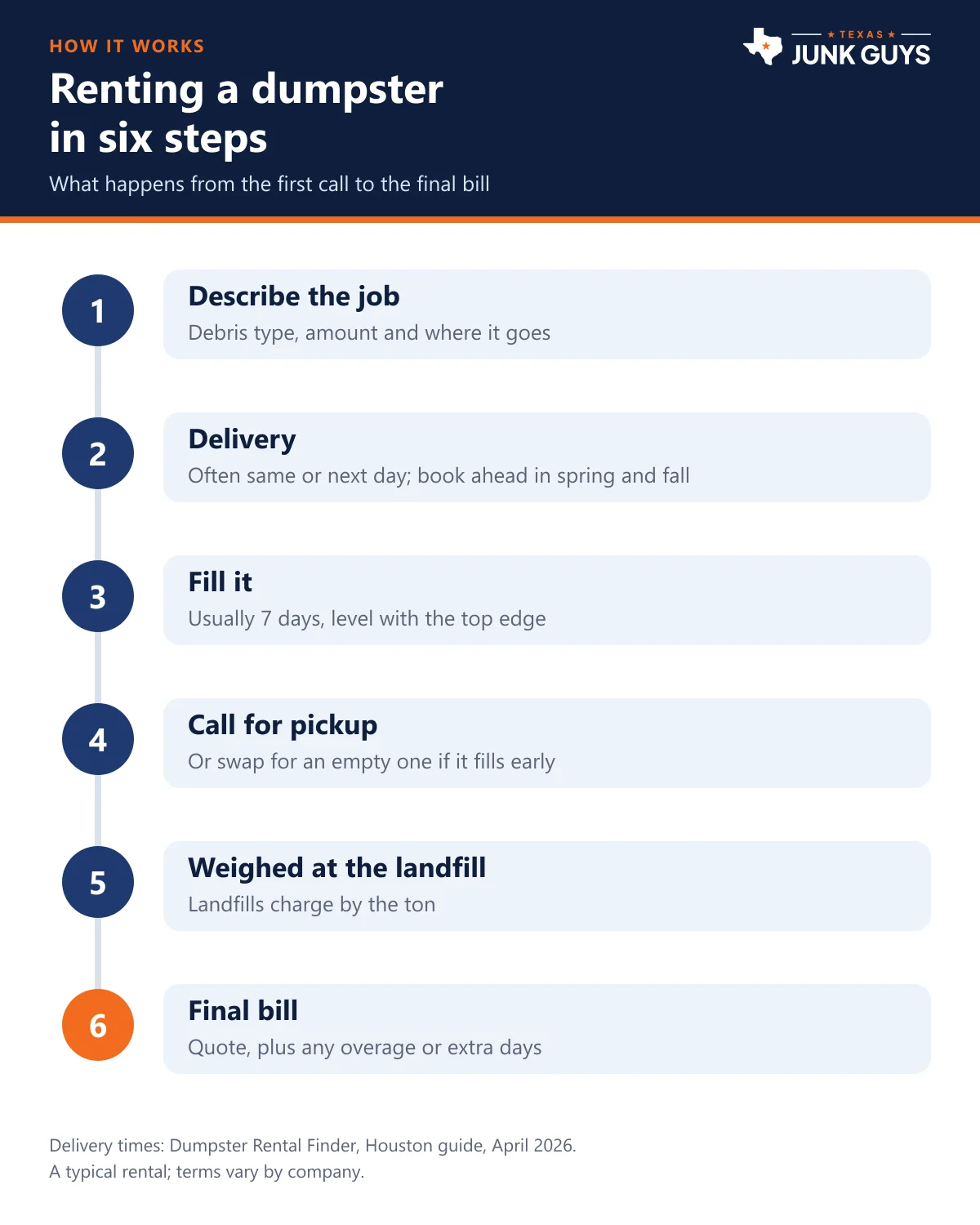
Almost every home dumpster rental in Texas follows the same six steps.
- You describe the job and pick a size. The company asks what you're throwing away, roughly how much, and where the container will go. From that it suggests a size and quotes a price.
- The container is delivered. A roll-off truck tilts its bed and slides the dumpster onto your driveway, yard or job site. Dumpster Rental Finder's April 2026 Houston guide says about 45 percent of the Houston companies it tracks advertise same-day or next-day delivery, and suggests booking 2 to 3 days ahead in the busy spring and fall seasons.
- You fill it. A standard rental gives you 7 days. You load it on your own schedule, keeping the debris level with the top edge.
- You call for pickup. When you're done, or when the rental period ends, the truck comes back and pulls the container onto its bed.
- The load is weighed and dumped. The company takes it to a landfill or transfer station, which charges by the ton.
- You get the final bill. If you stayed under the weight allowance, kept to the rental period and didn't load anything prohibited, the price is what you were quoted. If not, overage, extra-day or prohibited-item fees are added.
If you fill the container before the job is finished, most companies will swap it for an empty one. HomeGuide notes that many companies are happy to swap containers daily or weekly on big jobs. Each swap is billed as another haul, so ask what it costs when you book.
Who rents dumpsters
Homeowners are the biggest group for the sizes in this guide: remodels, roof replacements, move-outs, estate cleanouts and storm cleanup. Contractors rent the same roll-off containers for construction and demolition. Businesses usually need something different, an ongoing container emptied on a schedule, which is covered below under commercial dumpsters.
Types of dumpsters
When people talk about renting a dumpster for a project, they almost always mean a roll-off dumpster: an open-top steel container on rails, delivered and collected by a roll-off truck. But there are three other options worth knowing about.
| Type | Typical sizes | How it works | Best for |
|---|---|---|---|
| Roll-off dumpster | 10 to 40 cubic yards | Dropped off for about a week, then hauled away full | Remodels, roofing, cleanouts, construction |
| Heavy-debris roll-off | Usually 10 yards | A small roll-off filled only part way with heavy material | Concrete, dirt, brick, rock |
| Front-load dumpster | 2 to 8 cubic yards | Stays on site and is emptied on a schedule | Businesses, apartment complexes, long-term sites |
| Dumpster bag | About 3 cubic yards | A heavy-duty bag you fill, then book a collection | Very small projects with little debris |
Sources: sizes and uses from HomeGuide's dumpster rental price guide and Dumpster Rental Finder's Texas city guides.
Roll-off dumpsters
These are what most of this guide is about. They come in standard sizes from 10 to 40 cubic yards, open at the top, and most have a swinging door at one end so you can walk or wheel debris in. They need a flat, clear spot and room for the truck to back up and set them down.
Heavy-debris containers
Concrete, dirt, brick and rock are so heavy that a container fills up by weight long before it fills up by volume. Many companies require these materials to go in a separate heavy-debris container, usually a 10-yard, with a limit on how full you can load it. Dumpster Rental Finder notes these typically cost 10 to 20 percent more than a standard container of the same size.
Front-load dumpsters
These are the smaller containers you see behind restaurants and apartment buildings, emptied by a truck that lifts them over its cab. HomeGuide puts small dumpster rentals of 2 to 8 yards at about $120 to $250 per week, usually with a weekly pickup included. They suit ongoing waste, not a one-time project.
Dumpster bags
A dumpster bag is a heavy-duty fabric bag, about 3 cubic yards, that you fill and then book a collection for. HomeGuide puts collection at about $140 per bag, as long as the bag stays under its weight limit. Bags take up less space and are gentler on a driveway, but each one holds about as much as a single pickup-truck load, so they only make sense for small jobs. Collection isn't available everywhere.
What size dumpster do you need?
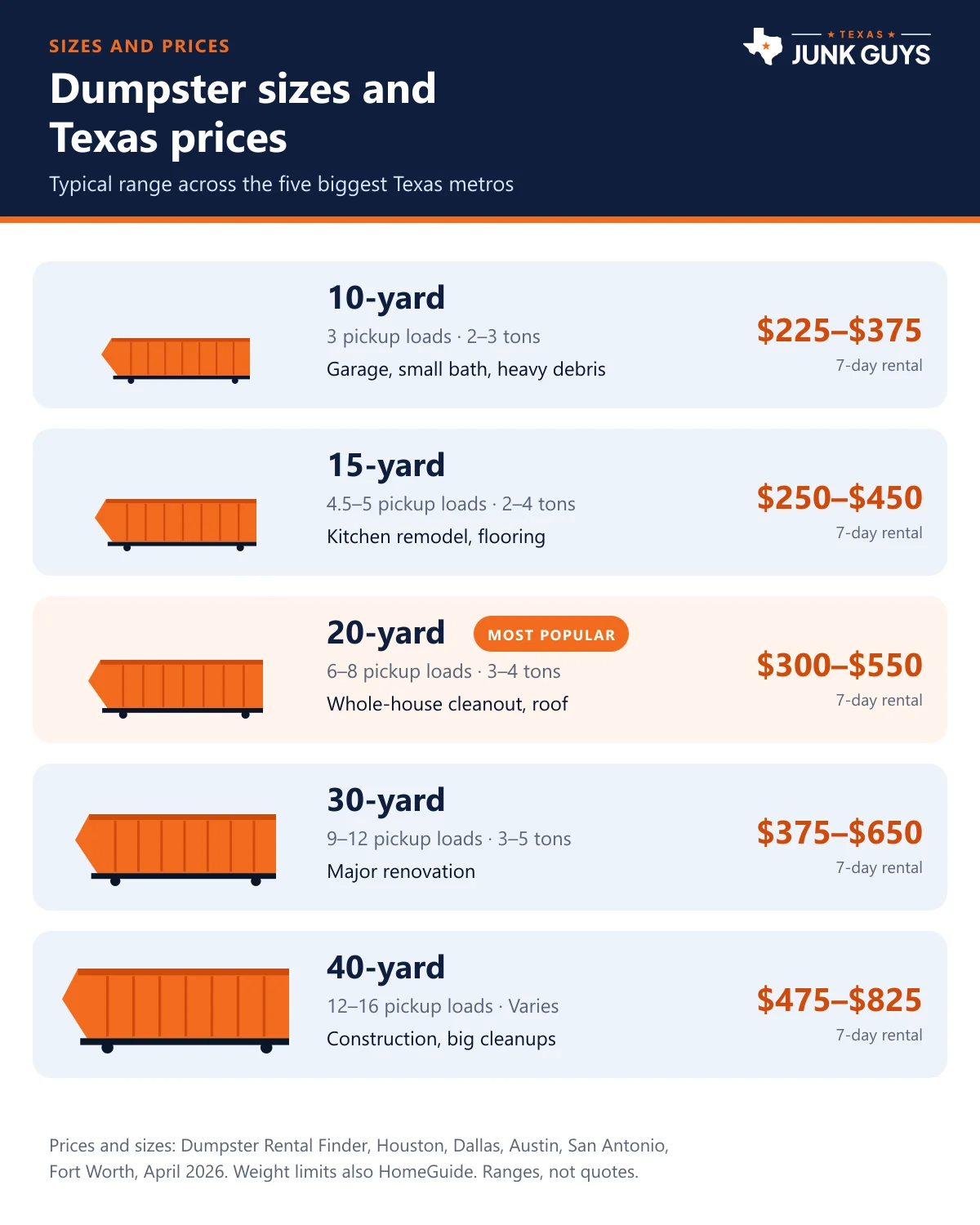
Roll-off dumpsters are measured in cubic yards of space. One cubic yard is a cube 3 feet on each side, or 27 cubic feet. Here are the five standard sizes most Texas companies carry:
| Size | Typical dimensions (L × W × H) | About how many pickup loads | Typical weight limit | Good for |
|---|---|---|---|---|
| 10-yard | 12 ft × 8 ft × 3.5 ft | 3 | 2–3 tons | Garage cleanout, small bathroom remodel, heavy debris |
| 15-yard | 14 ft × 8 ft × 4 ft | 4.5–5 | 2–4 tons | Kitchen remodel, flooring in several rooms |
| 20-yard | 22 ft × 8 ft × 4.5 ft | 6–8 | 3–4 tons | Whole-house cleanout, large remodel, single-layer roof |
| 30-yard | 22 ft × 8 ft × 6 ft | 9–12 | 3–5 tons | Whole-house renovation, new construction waste |
| 40-yard | 22 ft × 8 ft × 8 ft | 12–16 | Varies, often 5–6 | Large construction sites, big storm cleanups |
Sources: dimensions from Dumpster Rental Finder's April 2026 guides for Houston, Dallas, Austin, San Antonio and Fort Worth. Pickup loads and weight limits from those guides and HomeGuide, which counts slightly fewer loads per size. Dimensions vary by manufacturer, so ask for the exact size if space is tight.
The short version: a 10-yard for a garage, a single room or heavy debris, a 15-yard for a kitchen, a 20-yard for most whole-house jobs, a 30-yard for a major renovation, and a 40-yard for construction or a large-scale cleanup. Our guide to what size dumpster you need goes through each size in detail, with a project-by-project table and drawings to scale.
How to estimate your debris
Measure your pile, or the part of the room it fills, in feet. Multiply length by width by height to get cubic feet, then divide by 27 to get cubic yards. A pile 9 feet long, 6 feet wide and 3 feet high is 162 cubic feet, or 6 cubic yards. Add some room for gaps, because furniture and branches never pack perfectly.
If you'd rather think in truckloads, HomeGuide puts a typical pickup bed at about 2.4 cubic yards. Our free dumpster size calculator does the math for you and tells you the smallest standard size that fits.
Weight matters as much as size
Every dumpster has a weight allowance, and you pay per ton for anything over it. Light debris like furniture, household junk, lumber and yard waste fills the space before it reaches the limit. Heavy debris reaches the limit first.
Using the U.S. Environmental Protection Agency's average weights per cubic yard, a 20-yard dumpster reaches a 3-ton allowance when it's only about 30 percent full of rock, about 35 percent full of concrete, about 41 percent full of asphalt shingles and about 64 percent full of drywall. That's why heavy material calls for a small container, not a big one. The what-size guide, linked above, has the full table by material.
If you're between two sizes
Size up. The step to the next size usually costs about $50 to $100, according to Dumpster Rental Finder's Texas guides, which is less than a second delivery. Bigger containers also cost less per cubic yard. The exception is heavy debris, where a bigger container doesn't buy you much more weight allowance.
How much does dumpster rental cost in Texas?
Dumpster Rental Finder publishes price ranges for each of the five largest Texas metros. These are typical 7-day prices with delivery, pickup and a base weight allowance included:
| Size | Houston | Dallas | Austin | San Antonio | Fort Worth |
|---|---|---|---|---|---|
| 10-yard | $250–$350 | $275–$375 | $275–$375 | $250–$350 | $225–$300 |
| 15-yard | $300–$400 | $325–$450 | $325–$450 | $300–$400 | $250–$350 |
| 20-yard | $350–$500 | $375–$550 | $375–$550 | $350–$500 | $300–$425 |
| 30-yard | $450–$600 | $500–$650 | $500–$650 | $450–$600 | $375–$500 |
| 40-yard | $550–$750 | $600–$825 | $600–$825 | $550–$750 | $475–$650 |
Source: Dumpster Rental Finder city price guides, April 2026, checked October 2026. Estimates based on market data, not quotes. Prices vary by company, location and load.
Dallas and Austin price the same and sit a little above the national typical range. Houston and San Antonio match each other at about the national average. Fort Worth is the cheapest of the five, even though it shares a metro with Dallas. HomeGuide's national guide, last updated in 2023, gives a typical weekly range of $280 to $500 across all sizes, so the Texas metros sit around the middle of the country.
Our guide to dumpster rental prices in Texas breaks these numbers down city by city and explains why Texas dumping costs less than the national average.
What the price usually includes
A standard Texas quote bundles:
- Delivery and pickup.
- 7 days on site. Extra days typically cost $5 to $15 each in the big metros (Dumpster Rental Finder).
- A weight allowance, usually 2 to 4 tons depending on size.
- Disposal of that weight at the landfill.
It usually doesn't include weight over the allowance, extra days, permits or fees for prohibited items. HomeGuide notes some companies also ask for a deposit of $200 to $400, credited against the final bill.
Flat-rate and weight-based pricing
Companies price in one of two ways. A flat rate covers everything up to a set weight, so you know the cost up front as long as you stay under the limit. A variable rate has a lower base price and bills disposal by the actual weight after pickup. HomeGuide's guide says the two usually end up costing about the same over a week. With a flat rate, the company carries the risk up to the limit. With a variable rate, you do. Light household junk favors a variable rate. Heavy remodeling debris favors a flat rate with a generous allowance.
The fees that push the price up
- Overage. About $40 to $75 per extra ton in the five big Texas metros (Dumpster Rental Finder). HomeGuide gives $40 to $100 nationally.
- Extra days. About $5 to $15 a day after the first week. For a month-long remodel, ask for a monthly rate. HomeGuide puts those at $500 to $1,200 nationally.
- Prohibited items. If the landfill finds something it won't take, the company charges you to deal with it. HomeGuide says fines can reach $500.
- Overfilling. Drivers can't legally haul debris sticking out over the top, HomeGuide notes, so an overfilled container means an overflow fee or unloading the excess yourself.
- Trip fees. If a parked car, locked gate or low wire stops the driver from dropping or collecting the container, expect a fee for the wasted trip.
- Permits. HomeGuide puts typical city permit costs at $10 to $75 where one is needed (more on permits below).
Brokers and franchises
Some websites that take dumpster bookings don't own any containers. They pass your order to a local hauler and keep a cut. HomeGuide says that when some quotes come in 15 to 20 percent higher than others, a broker, franchise or middleman is often the reason. Ask any company you call whether it owns the containers and trucks itself. If it doesn't, you can usually get a better price by booking directly with the local company that does the work.
What can and can't go in a Texas dumpster
Dumpsters go to municipal solid waste landfills, so the landfill's rules are your rules. Some items are banned from Texas landfills by state law. Others are restricted by the landfill or the rental company.
Usually allowed
HomeGuide's list of debris typically allowed includes asphalt, brick, concrete, drywall, furniture, cabinets, flooring, lumber, siding, most appliances, most electronics, storm debris and general remodeling debris. Heavy items like concrete and brick may need a heavy-debris container, as covered above.
Banned from Texas landfills by state rule
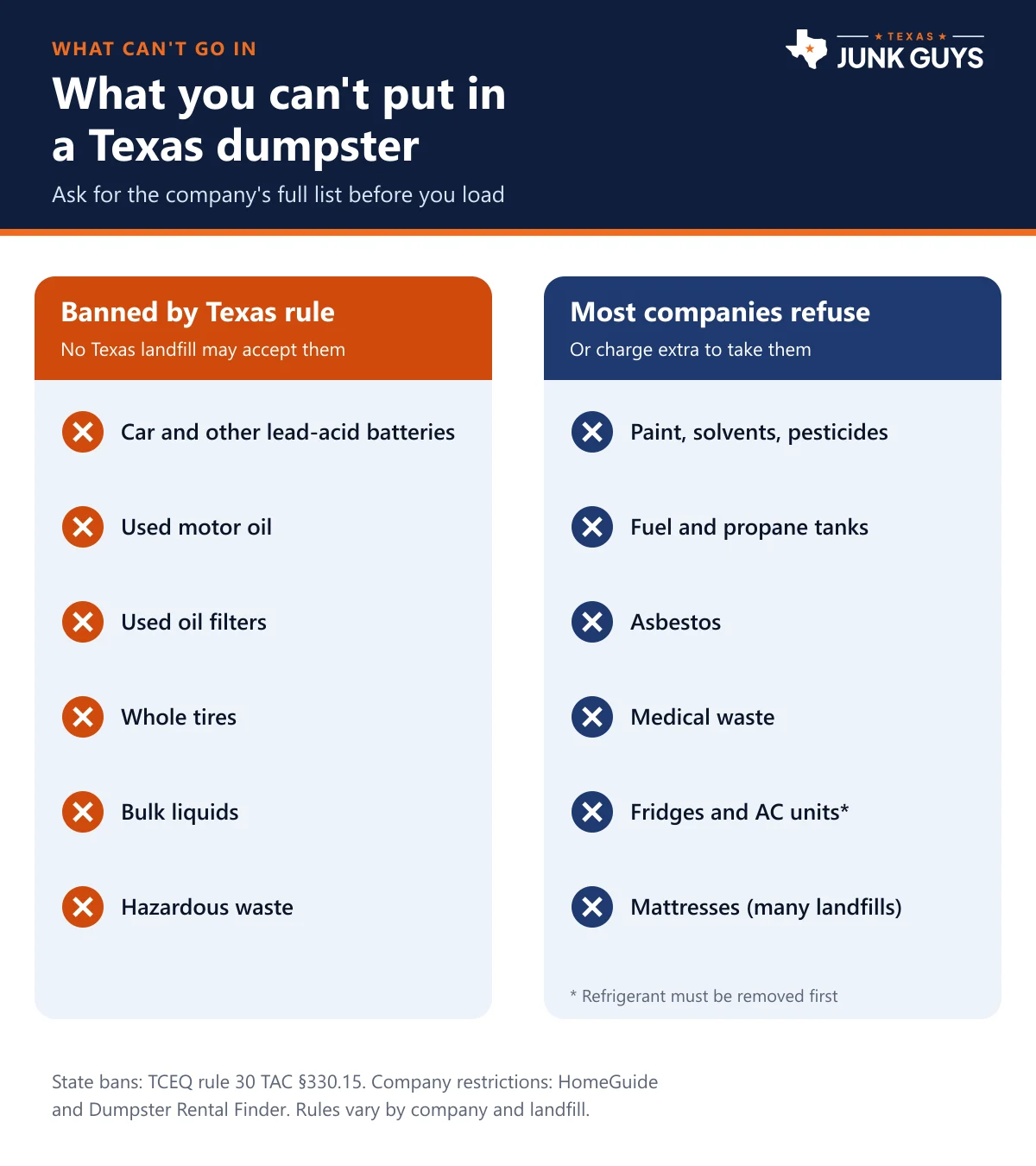
The Texas Commission on Environmental Quality's landfill rules (30 Texas Administrative Code §330.15) list wastes that no municipal solid waste facility in Texas may accept. The ones a homeowner is most likely to have:
- Lead-acid batteries, such as car, truck and boat batteries. Each battery improperly disposed of counts as a separate violation. The Texas Health and Safety Code (§361.451) says used lead-acid batteries must go to a battery retailer or wholesaler, a secondary lead smelter, or an authorized collection or recycling facility.
- Used motor oil from do-it-yourself oil changes, on its own or mixed with other trash.
- Used oil filters from cars, trucks and other engines.
- Whole tires. Tires can only be landfilled after they've been processed, such as split or shredded, so a dumpster company can't take them in a normal load.
- Liquid waste in bulk, and most containers holding liquids other than small household-size ones.
- Regulated hazardous waste, PCB waste and radioactive material.
The same rule says refrigerators, freezers, air conditioners and other appliances containing refrigerant must have it handled under federal rules before disposal. In practice that means many rental companies either refuse these appliances or charge extra for them. Dumpster Rental Finder's Houston guide says some Houston companies accept tires and refrigerant appliances for an added fee of about $15 to $50 per item.
Usually prohibited by the company
On top of the state bans, most rental companies won't accept these, according to HomeGuide's and Dumpster Rental Finder's lists:
- paint, solvents, adhesives, pesticides and household cleaners
- fuel, gasoline and propane tanks
- asbestos
- medical or biological waste
- food waste
- mattresses, at many landfills
- electronics, at some companies
Rules differ between companies and landfills, so ask for the company's list before you load. If you're not sure about an item, ask before it goes in.
Where the banned items go instead
- Car batteries: a store that sells them, as the state law above directs, or a recycling facility.
- Motor oil and oil filters: many auto parts stores and service stations take used oil for recycling. Call ahead.
- Paint, chemicals and pesticides: your city's or county's household hazardous waste program. Most large Texas cities run one, with drop-off sites or collection days.
- Tires: a tire shop, which will usually take old tires for a fee, or your city's tire collection if it has one.
- Appliances with refrigerant: some cities pick them up as bulk trash, and scrap metal recyclers and junk removal companies take them.
- Furniture and building materials in good shape: donation centers and reuse stores. HomeGuide lists Habitat for Humanity among the charities that take building materials, furniture and appliances. That's less weight in your dumpster, too.
Do you need a permit for a dumpster in Texas?
On your own driveway or yard, usually not. HomeGuide notes that a container on private property will likely not need a permit, and Dumpster Rental Finder's Houston guide says the same.
In the street, on a sidewalk or on other public property, you often do. Each Texas city sets its own rules, and many require a permit to place anything in the public right-of-way. HomeGuide puts typical permit costs at $10 to $75 nationally, with approval taking up to three days. Dumpster Rental Finder's Houston guide says most Houston rental companies handle the permit for you.
Before you book a street placement:
- Ask the rental company whether a permit is needed at your address and whether it pulls it.
- If you have to apply yourself, check your city's website for its right-of-way or street-use permit, and leave a few days for approval.
- Expect conditions, such as reflectors or cones, a time limit, or keeping the container clear of fire hydrants and storm drains.
HOA rules
Many Texas neighborhoods have a homeowners association with its own rules, and those rules apply even when the city doesn't require a permit. HOA rules on dumpsters commonly cover:
- how long a container can sit in a driveway
- where it can go (driveway only, not the lawn or street)
- whether you need approval before delivery
- covering the container, or keeping it tidy
Read your deed restrictions or ask your HOA management company before delivery day. A short email asking for approval is quicker than a violation notice. If your HOA limits containers to a few days, a shorter rental or a dumpster bag may suit it better.
Where to put the dumpster
A roll-off needs more room than people expect. Before you book:
- Measure the spot. A 10-yard needs about 12 to 14 feet of length. The 20-, 30- and 40-yard sizes all need about 22 feet. Add space in front for the truck to line up, and ask the company how much straight-line room its truck needs.
- Look up. Low branches, power lines and roof eaves can block the truck's lift. Tell the company about anything overhead.
- Check the ground. A soft lawn after a Texas downpour can rut under a loaded container and the truck. A paved driveway is usually best.
- Protect your driveway. A loaded container is heavy. Ask whether the company puts boards or pads under it, or lay plywood down yourself if they allow it.
- Mind gates, slopes and cul-de-sacs. A narrow gate, a steep driveway or a tight turnaround can limit which sizes can be delivered.
- Clear the spot on delivery day. Move cars, unlock gates and keep kids' toys and garbage bins out of the way, or you may pay a trip fee.
Remember that the 20-, 30- and 40-yard containers share the same footprint. They differ only in height, so if the 20-yard fits, the bigger ones usually do too, as long as the truck can reach.
Texas weather and dumpsters
Summer heat
Loading a dumpster in a Texas summer is hard, heavy work. Steel containers get hot to the touch in direct sun. Plan the heavy loading for early morning or evening, wear gloves, keep water nearby, and spread the job over several days if you can. That's one advantage a 7-day rental has over a one-day haul.
Rain and wet debris
Rainwater adds weight, and you pay for every pound. An open container that sits through a few Gulf Coast storms can collect a lot of water, and soaked drywall, carpet and insulation weigh far more than dry. The EPA's own figures show wet sawdust weighing nearly twice as much as dry. Ask the company whether you can tarp the container, and cover it when rain is forecast if they allow it.
Storm and hurricane cleanup
After a hurricane, flood or hailstorm, demand for dumpsters jumps in the affected area, and the right size can be hard to find for a week or two. If you know a big cleanup is coming, call early. Flood-damaged debris is heavy, so ask about the weight allowance and overage rate before you start loading, and consider a bigger allowance or a second container rather than one overloaded one.
After major storms, many Texas cities also run special debris collections at the curb. Check your city's announcements before paying for a dumpster for storm debris alone. For a full gut of a flooded house, a dumpster is usually still the practical choice.
How to choose a dumpster rental company
Prices for the same size in the same city can differ by $100 to $225 in the ranges above, so the company matters. Here's how to compare them.
Get at least three written quotes
When you call, have this ready:
- what you're throwing away: household junk, remodeling debris, yard waste, roofing or concrete
- roughly how much, in pickup-truck loads or room by room
- where the container will go, plus any gates, slopes or overhead wires
- how long you need it, and your delivery date
Ask every company the same questions
- What's included: how many days and how many tons?
- What does each extra ton cost?
- What does each extra day cost, and is there a monthly rate?
- What can't go in the container, and what's the fee if it does?
- Do I need a permit at my address, and do you handle it?
- Are there trip, fuel, environmental or other fees?
- Do you own the containers and trucks, or are you booking through another company?
- Can you swap the container if I fill it early, and what does that cost?
Then compare the totals, not the headline prices. A quote that's $50 cheaper with a lower weight allowance can end up costing more.
Read the agreement
Before you sign, check the rental period, the weight allowance, the overage rate, the cancellation policy and who's responsible for damage to your driveway. Get it in writing, by email at least.
How to load a dumpster
A well-loaded dumpster holds noticeably more than a badly loaded one.
- Put flat, heavy pieces on the bottom. Drywall sheets, doors, plywood and flattened boxes make a base.
- Break things down. Take furniture apart, remove legs and cushions, and cut long boards and branches to length.
- Fill the gaps. Push smaller debris into the spaces between bulky items.
- Spread the weight evenly. Don't pile all the heavy material at one end. An unbalanced container is harder for the truck to lift.
- Use the door. Walk heavy items in through the end door instead of lifting them over the side.
- Stay level with the top. Nothing above the rim, or you risk an overflow fee.
- Keep it to yourself. Neighbors and passers-by sometimes add their own junk, which counts against your weight allowance. Load prohibited items and the weight is on your bill.
Is a dumpster the right choice?
A dumpster makes sense when debris builds up over several days, as with a remodel, a roof replacement or a big cleanout you'll do yourself, and you're happy to do the loading. You fill it on your schedule and pay one price for the week.
It's not always the best option:
- For a few large items or a small pile, a junk removal service is often cheaper and faster. The crew does the lifting and takes everything in one visit, with nothing in your driveway.
- If you can't do heavy lifting, junk removal does it for you.
- For one or two pickup loads of light junk, check your city's bulk trash pickup first. Many Texas cities collect large items at the curb on a schedule, sometimes for free.
A rough rule: if you'll fill most of a 10-yard and you'll load it yourself, a dumpster usually wins on price. If it's less than two or three pickup loads, or you need the lifting done, junk removal usually does. Our guide to junk removal vs dumpster rental compares Texas prices for both at every job size.
Common dumpster rental mistakes
- Choosing by price alone. A cheaper quote with a smaller weight allowance or high overage rate can cost more in the end.
- Renting too big for heavy debris. A 30-yard full of concrete is too heavy to haul. Use a heavy-debris container.
- Renting too small to save $50. A second haul costs far more than the step to the next size.
- Forgetting the HOA. A violation notice halfway through a remodel is easy to avoid with an email beforehand.
- Leaving it open in the rain. Water weighs a lot, and you pay for it.
- Loading prohibited items. A single car battery, tire or can of paint can add a fee to your bill.
- Not clearing the drop spot. A car in the way means a trip fee and a lost day.
Dumpster rental by project
The right setup depends on the job. These are the most common Texas home projects and what usually works:
- Garage or attic cleanout: a 10-yard is usually enough. Donate what you can first.
- Kitchen remodel: a 15-yard, or a 20-yard if you're also replacing flooring. Tile and stone countertops are heavy, so check the allowance.
- Bathroom remodel: a 10-yard for a small bathroom. Tile, tubs and cast-iron fixtures add weight quickly.
- Whole-house cleanout or move-out: a 20-yard for most houses, bigger for a large house with a full attic and garage. An estate cleanout often benefits from sorting donations first.
- Roof replacement: a 20-yard for a single-layer tear-off on an average roof, a 30-yard for bigger or multi-layer jobs, with a close eye on the weight, because shingles are heavy.
- Concrete, patio or driveway removal: a heavy-debris 10-yard, filled only part way.
- Yard and landscaping cleanup: a 20- or 30-yard for branches and brush. Yard waste is light, so you'll fill the space first. Some cities collect brush separately at the curb.
- Construction or major renovation: a 30- or 40-yard, often with swaps.
- Storm or flood cleanup: a 20- to 40-yard depending on the damage, with a generous weight allowance for wet debris.
We're also writing detailed guides to construction, residential and commercial dumpster rental, the 15-, 20-, 30- and 40-yard sizes, and how to rent a dumpster step by step. They'll be listed on our blog as they go live.
Commercial and long-term dumpsters
A business with ongoing waste, such as a restaurant, store, office or apartment complex, usually doesn't rent a roll-off for a week. It sets up a service agreement for a front-load container, from 2 to 8 cubic yards, emptied on a set schedule. Pricing is monthly and depends on the container size, how often it's emptied and the type of waste.
A long construction project is somewhere in between: a roll-off kept on site for weeks or months, swapped whenever it fills. HomeGuide suggests looking for cheaper deals on six- to twelve-month commercial rentals. For either, ask about monthly pricing and swap charges rather than weekly rates.
Finding a dumpster rental company in your Texas city
Our directory lists dumpster rental companies in 797 Texas cities. These are the cities with the most companies listed:
| City | Companies listed |
|---|---|
| Houston | 169 |
| Dallas | 169 |
| Austin | 168 |
| Plano | 156 |
| Arlington | 126 |
| Fort Worth | 121 |
| El Paso | 75 |
| San Antonio | 54 |
| Corpus Christi | 52 |
| Lubbock | 42 |
Source: the Texas Junk Guys directory, October 23, 2026. A company is counted in every city it serves, so the same company can appear in several cities.
In big metros like Houston, Dallas and Austin there's plenty of choice, so getting several quotes is easy. In smaller cities, prices depend more on how far the nearest company's yard is from you and which landfill it uses, so it's worth calling early, especially for the larger sizes.
To compare companies, pick your city on our dumpster rental page. You'll see the companies that serve it, and you can call one directly or send one free quote request.
Sources
All figures in this guide come from third-party cost guides, a federal data table and Texas state rules. Prices are typical ranges, not quotes from any company. Sources checked October 23, 2026.
- Dumpster Rental Finder, Dumpster Rental Houston, plus its matching price guides for Dallas, Austin, San Antonio and Fort Worth on the same site, updated April 2026. Prices, dimensions, weight limits, overage and extra-day rates, delivery times and permit notes.
- HomeGuide, Dumpster Rental Prices, April 2023. National prices, small dumpster and dumpster bag costs, fees, deposits, permits, allowed and prohibited items, and broker pricing.
- Texas Commission on Environmental Quality rule 30 Texas Administrative Code §330.15, General Prohibitions (via Cornell Law School's Legal Information Institute). Wastes banned from Texas landfills.
- Texas Health and Safety Code §361.451, on where used lead-acid batteries must go.
- U.S. Environmental Protection Agency, Volume-to-Weight Conversion Factors, April 2016. Weights per cubic yard by material.
- Company counts: the Texas Junk Guys directory, October 23, 2026.
Frequently asked questions
- How much does it cost to rent a dumpster in Texas?
- In Houston, Dallas, Austin, San Antonio and Fort Worth, a 20-yard dumpster typically costs $300 to $550 for a 7-day rental, a 10-yard about $225 to $375 and a 40-yard about $475 to $825 (Dumpster Rental Finder, April 2026). The price usually includes delivery, pickup and 2 to 4 tons of weight. Get a written quote, because prices vary by company and load.
- What size dumpster do most people rent?
- The 20-yard is the most commonly rented size. It's about 22 feet long, 8 feet wide and 4.5 feet high, holds about 6 to 8 pickup-truck loads and suits whole-house cleanouts, large remodels and single-layer roof replacements.
- How long can I keep a rental dumpster?
- A standard rental includes 7 days. Extra days usually cost $5 to $15 each in the big Texas metros. For a project that runs a month or longer, ask for a monthly rate up front.
- What can't you put in a dumpster in Texas?
- State landfill rules ban lead-acid batteries, used motor oil, used oil filters, whole tires, bulk liquids and hazardous waste. Most rental companies also refuse paint, solvents, pesticides, fuel, propane tanks and asbestos, and many restrict mattresses and appliances with refrigerant. Ask for the company's list before you load.
- Do I need a permit for a dumpster in Texas?
- Usually not if the dumpster sits on your own driveway or yard. A container in the street, on a sidewalk or on other public property often needs a permit from your city, and rules differ between cities. Ask your rental company whether it handles the permit, and check your HOA's rules too.
- How fast can I get a dumpster delivered?
- Often within a day or two. Dumpster Rental Finder says about 45 percent of the Houston companies it tracks advertise same-day or next-day delivery. In busy spring and fall seasons, or after a big storm, book a few days ahead to get the size you want.
- What happens if my dumpster is over the weight limit?
- You pay for each extra ton, typically $40 to $75 in the big Texas metros. If a container is far too heavy, the truck may not be able to lift it, and you'll have to remove some debris. Heavy materials like concrete, dirt and shingles are the usual cause, so they often go in a separate heavy-debris container.
- Is it cheaper to rent a dumpster or hire junk removal?
- For a few large items or a small cleanout, junk removal is often cheaper, and the crew does the lifting. For a multi-day remodel or a big cleanout you'll load yourself, a dumpster usually costs less.
This guide is general information, not advice about any particular company. Prices, sizes and rules vary by company and city, so confirm the details with the company you hire. How we list companies.