Construction Dumpster Rental in Texas: Sizes, Costs and Rules (2026)
A construction dumpster is a 10- to 40-yard roll-off. In Texas's big metros it rents for about $225 to $825 a week, and the weight of the debris matters as much as the size.
By the Texas Junk Guys team · Updated November 8, 2026
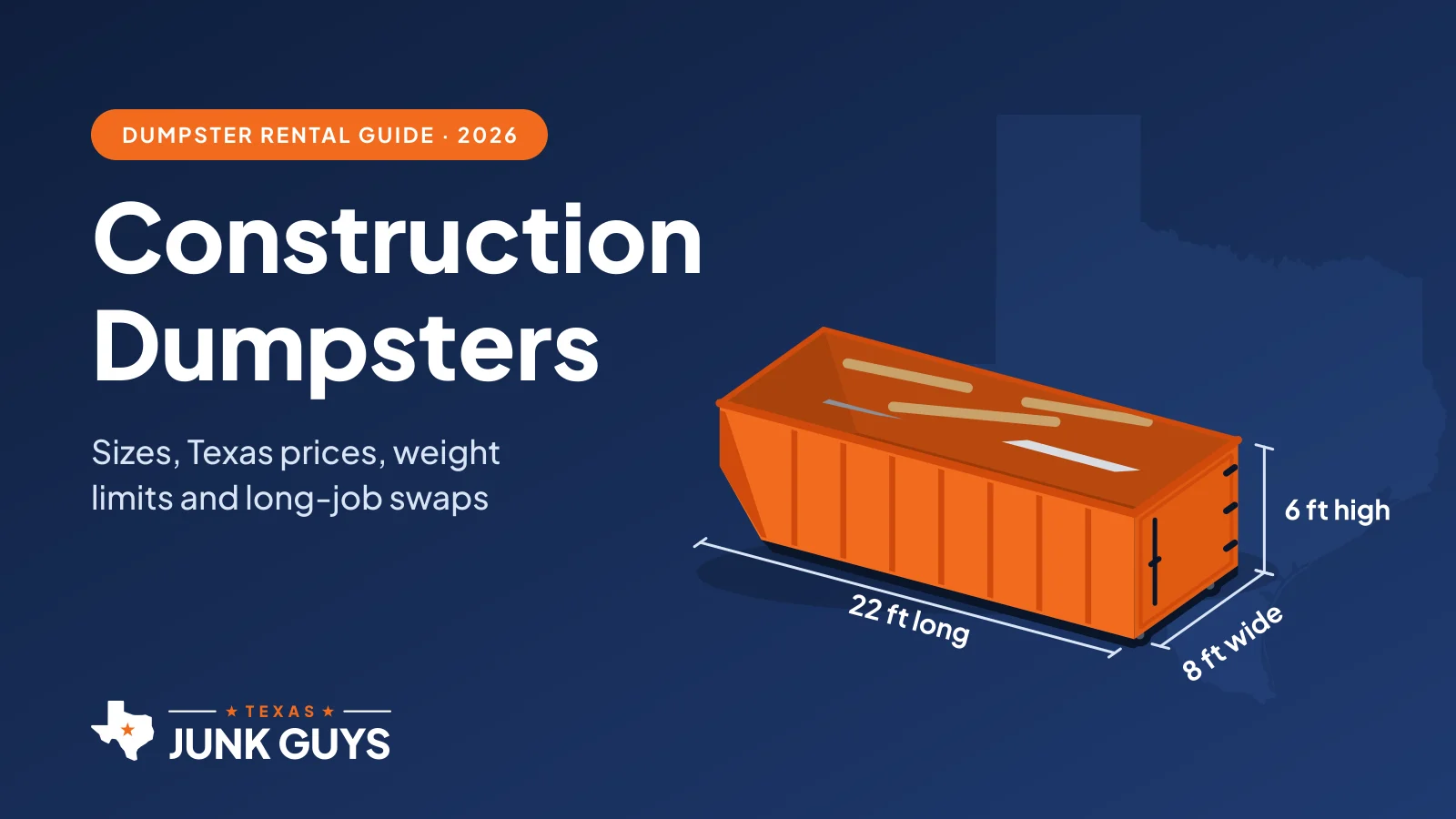
A construction dumpster is a roll-off container from 10 to 40 cubic yards that's dropped at the job site, filled with debris and hauled away. In Houston, Dallas, Austin, San Antonio and Fort Worth, a standard 7-day rental runs about $225 to $375 for a 10-yard, $300 to $550 for a 20-yard, $375 to $650 for a 30-yard and $475 to $825 for a 40-yard, according to Dumpster Rental Finder's April 2026 city price guides.
On a building or remodeling job, size is only half the decision. Construction debris is heavy, and the weight allowance often runs out before the container is full. This guide covers which size suits which job, what it costs in each big Texas metro, how weight limits work with concrete, shingles and drywall, and how to handle a project that runs for weeks.
Quick answer: Most construction jobs use a 20-, 30- or 40-yard roll-off: a 20-yard for a single-layer roof or a large remodel, a 30-yard for a whole-house renovation or new construction waste, a 40-yard for commercial demolition or a major buildout. Concrete, dirt and brick usually go in a separate heavy-debris container, often a 10-yard filled part way. A week costs roughly $300 to $825 in the big Texas metros depending on size, and long jobs are handled with swaps or a monthly rate. These are typical ranges from third-party guides, not quotes.
This post is part of our complete guide to dumpster rental in Texas, which covers how renting works from start to finish.
What is a construction dumpster?
It's the same open-top roll-off container homeowners rent for a cleanout. The name describes the job, not a different kind of container. A roll-off truck slides it off at the site, you fill it, and the truck pulls it back on and takes it to a landfill or transfer station.
What makes a construction rental different is how it's used:
- The debris is heavier. Concrete, tile, shingles, drywall and lumber weigh far more per cubic yard than household junk, so the weight allowance matters more.
- The job runs longer. A remodel or new build can take weeks or months, so containers are swapped when full instead of rented once.
- Materials are often sorted. Many companies want concrete, dirt and brick in their own container, apart from mixed debris.
- The site is busier. Crews, deliveries and parked trucks all compete for the space where the container sits.
Two other options come up on small jobs. A dumpster bag holds about 3 cubic yards, roughly one pickup load, and HomeGuide puts collection at about $140 per bag. A front-load container, the kind emptied on a schedule behind a business, suits ongoing waste rather than a single project. For most construction work, a roll-off is the right tool.
What size construction dumpster do you need?
Dumpster Rental Finder's Houston guide matches each standard size to typical jobs. Its figures for the other four big Texas metros use the same sizes.
| Size | Dimensions (L × W × H) | Pickup loads | Typical construction job |
|---|---|---|---|
| 10-yard | 12 × 8 × 3.5 ft | about 3 | Small bathroom remodel, heavy debris like concrete or dirt |
| 15-yard | 14 × 8 × 4 ft | 4.5–5 | Kitchen remodel, flooring removal |
| 20-yard | 22 × 8 × 4.5 ft | 6–8 | Single-layer roof tear-off, large remodel |
| 30-yard | 22 × 8 × 6 ft | 9–12 | Whole-house renovation, new construction debris |
| 40-yard | 22 × 8 × 8 ft | 12–16 | Commercial demolition, major buildout, large-scale cleanup |
Sources: Dumpster Rental Finder Texas city guides, April 2026 (dimensions, jobs, upper pickup-load figures). HomeGuide's dumpster rental price guide (lower pickup-load figures). Container sizes vary by manufacturer, so ask for the exact dimensions if space is tight.
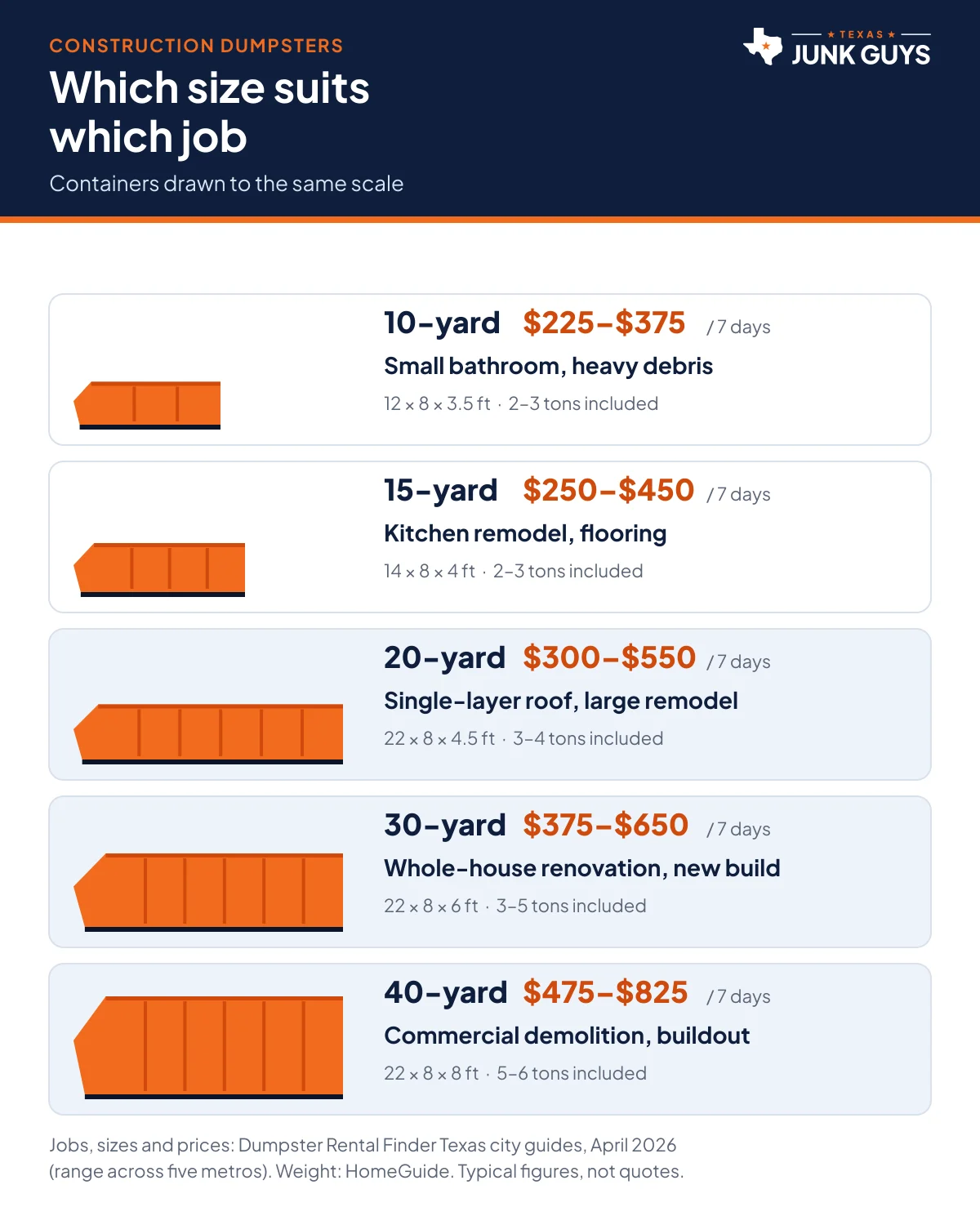
A few rules of thumb:
- Size up for light, bulky debris. Framing lumber, cabinets, trim and packaging fill space fast. Dumpster Rental Finder advises going bigger when unsure, because overage from overloading a smaller container can cost more than the price difference.
- Size down for heavy debris. For concrete, brick, tile or dirt, a bigger container doesn't help, because you hit the weight limit long before you fill it (more on that below).
- The three big sizes share a footprint. The 20-, 30- and 40-yard are all about 22 by 8 feet in Dumpster Rental Finder's figures. The bigger ones are taller, which makes them harder to load by hand but no harder to place.
For a full walk-through of every size with drawings to scale, see our guide to what size dumpster you need. If a 20-yard looks like your size, our 20-yard dumpster guide goes into it in detail.
How much does a construction dumpster cost in Texas?
There's no separate price list for "construction" dumpsters. You pay the standard roll-off rate for the size, plus whatever the job adds in weight, days and swaps. Here are the typical 7-day prices in the five largest Texas metros:
| Size | Houston | Dallas | Austin | San Antonio | Fort Worth |
|---|---|---|---|---|---|
| 10-yard | $250–$350 | $275–$375 | $275–$375 | $250–$350 | $225–$300 |
| 15-yard | $300–$400 | $325–$450 | $325–$450 | $300–$400 | $250–$350 |
| 20-yard | $350–$500 | $375–$550 | $375–$550 | $350–$500 | $300–$425 |
| 30-yard | $450–$600 | $500–$650 | $500–$650 | $450–$600 | $375–$500 |
| 40-yard | $550–$750 | $600–$825 | $600–$825 | $550–$750 | $475–$650 |
Source: Dumpster Rental Finder city price guides, last updated April 2026. The guides describe these as typical ranges based on market data, not quotes. Each covers delivery, pickup, 7 days and a base weight allowance.
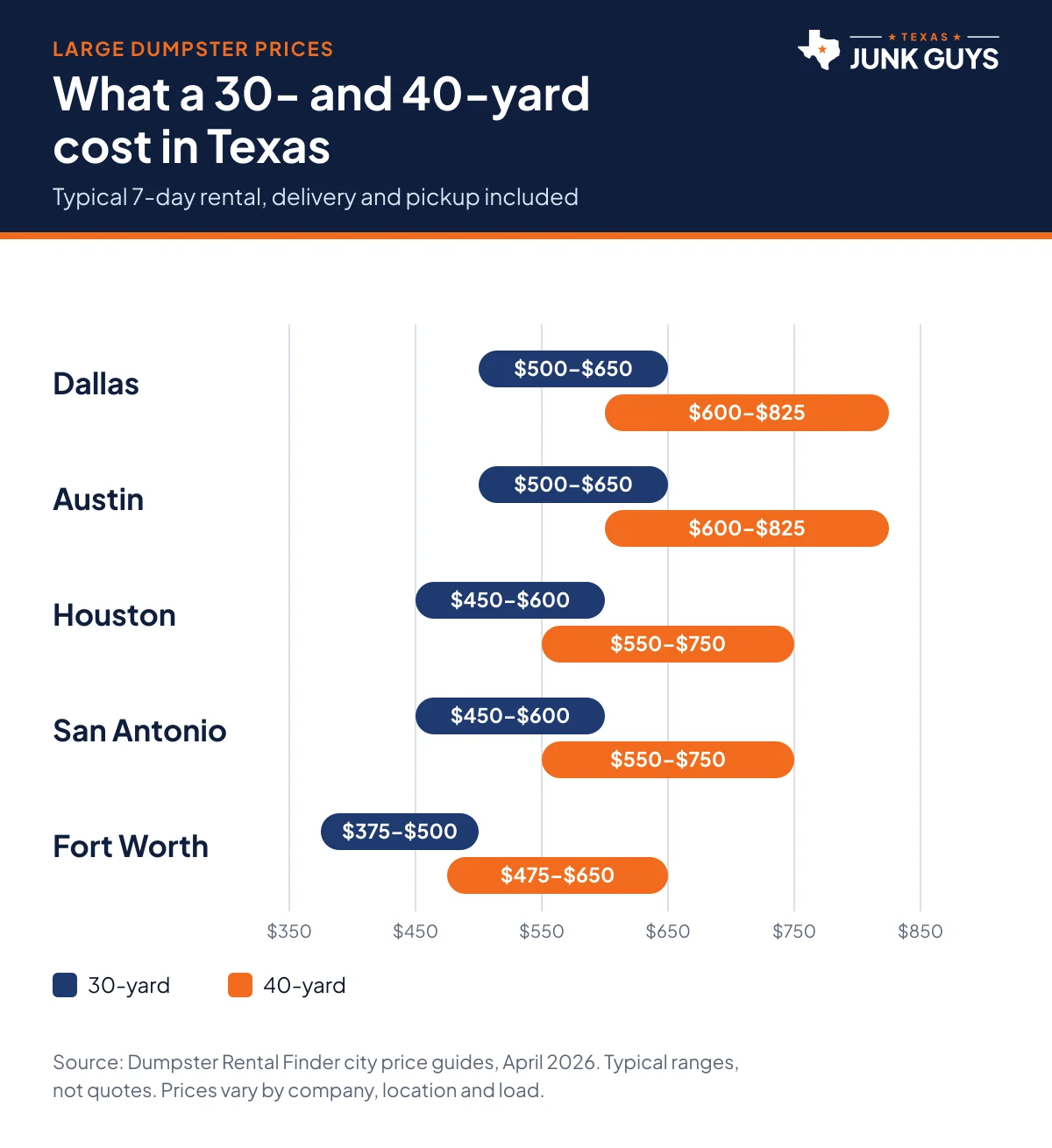
Dallas and Austin are the priciest of the five, and Fort Worth the cheapest, even though it shares a metro area with Dallas. A 40-yard in Fort Worth is listed at $475–$650, against $600–$825 in Dallas. On a job near the county line, it can pay to get quotes from companies on both sides.
The fees that matter on a construction job
The weekly price is a starting point. On a construction project, these are the costs that move the final bill:
| Fee | Typical figure | Source |
|---|---|---|
| Overage | $40–$75 per ton over the allowance | Dumpster Rental Finder, Texas |
| Extra days | $5–$15 per day after the first 7 | Dumpster Rental Finder, Texas |
| Heavy-debris container | 10–20% more than a standard one | Dumpster Rental Finder, Texas |
| Monthly rental | $500–$1,200 a month | HomeGuide, national |
| Deposit | $200–$400, credited to the final bill | HomeGuide, national |
| Street permit | $10–$75 where required | HomeGuide, national |
| Swap (empty for full) | Billed as another haul; ask when booking | HomeGuide |
Dumpster Rental Finder figures are from its April 2026 Texas city guides. HomeGuide figures are national, from its dumpster rental price guide.
For every size and city, plus how flat-rate and weight-based pricing compare, see our guide to dumpster rental prices in Texas.
How much weight can a construction dumpster hold?
Every rental includes a weight allowance, and you pay for each ton over it. HomeGuide's typical allowances are 2 to 3 tons for a 10- or 15-yard, 3 to 4 tons for a 20-yard, 3 to 5 tons for a 30-yard and 5 to 6 tons for a 40-yard. Dumpster Rental Finder's Texas guides put base allowances at 2 to 4 tons, with overage at $40 to $75 a ton.
Construction debris is where those limits bite. The U.S. Environmental Protection Agency publishes average weights per cubic yard for common materials. Using those figures, here's how full a 30-yard gets before it reaches a 3-ton and a 5-ton allowance:
| Material | Weight per cubic yard (EPA) | How full at 3 tons | How full at 5 tons |
|---|---|---|---|
| Rock or gravel | 999 lb | about 20% | about 33% |
| Dirt and sand | 929 lb | about 22% | about 36% |
| Concrete | 860 lb | about 23% | about 39% |
| Asphalt roofing (shingles) | 731 lb | about 27% | about 46% |
| Drywall | 467 lb | about 43% | about 71% |
| Mixed construction debris | 417 lb | about 48% | about 80% |
| Lumber | 169 lb | full | full |
Source: EPA, Volume-to-Weight Conversion Factors, April 2016. The "how full" columns are our arithmetic: 6,000 or 10,000 pounds divided by the EPA weight per cubic yard, compared with the container's 30 cubic yards. Real loads vary with moisture, how tightly they're packed and the size of the pieces.
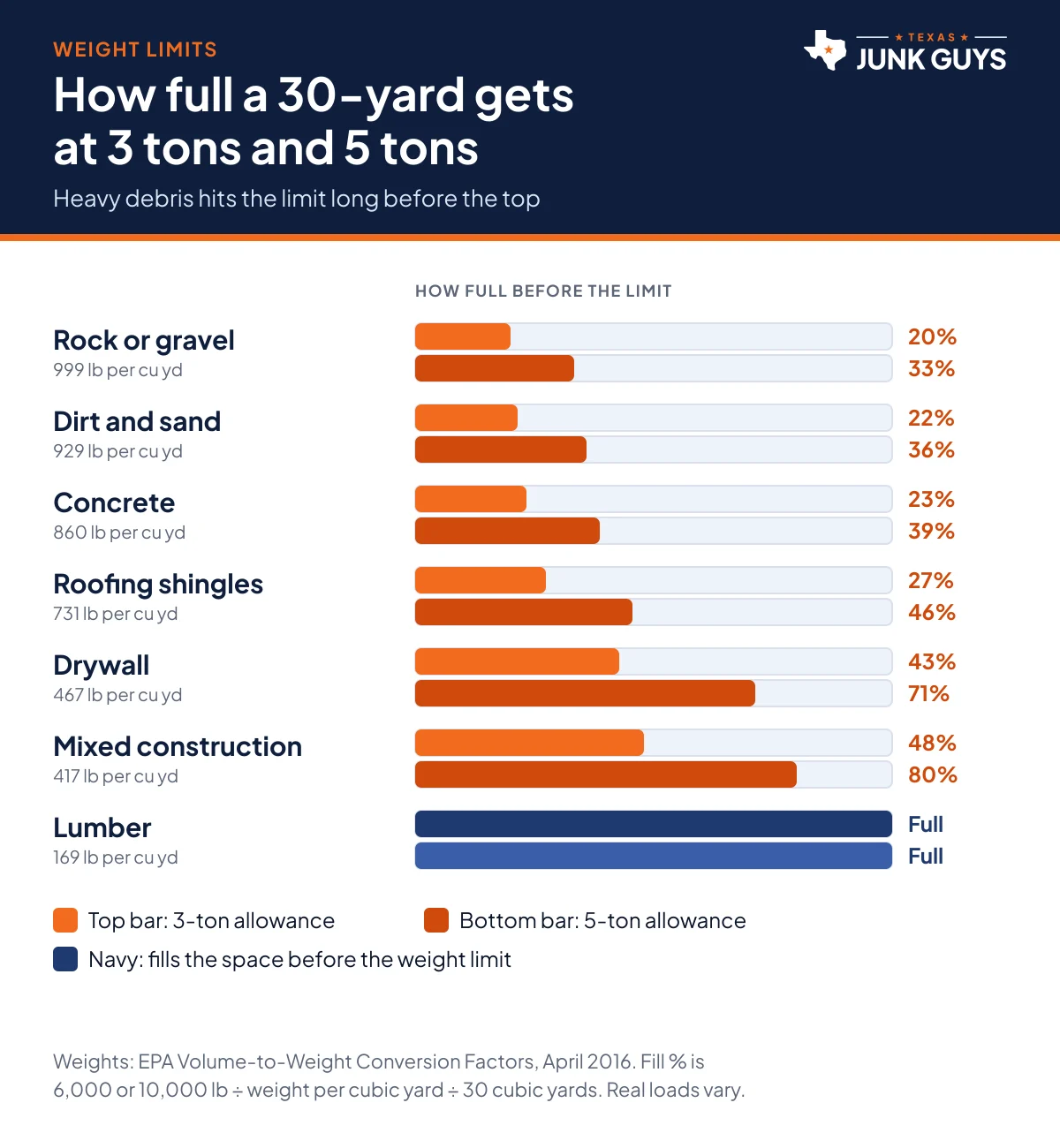
What that means on site:
- Lumber and framing waste fill the space long before the weight limit. A big container is good value for them.
- Mixed remodeling debris and drywall can approach the limit in a full 30-yard, especially at the low end of the allowance. Ask whether the company offers a higher tonnage option.
- Concrete, dirt, rock and brick hit the limit with a 30-yard only a quarter to a third full. A large container is the wrong tool for them.
- Shingles are the trap on roofing jobs. A 30-yard at a 3-ton allowance reaches its limit with only about 8 cubic yards of shingles on board.
Heavy debris needs its own container
Because of those numbers, many companies require concrete, dirt, brick and rock to go in a separate heavy-debris container, usually a 10-yard filled only part way. Dumpster Rental Finder's Texas guides say these typically cost 10 to 20 percent more than a standard container of the same size, and HomeGuide warns that a container filled entirely with concrete, brick, block or dirt can be too heavy for the truck to lift.
On a job with both kinds of debris, such as a remodel that includes tearing out a patio or a tile floor, ask whether one standard container plus one heavy-debris container costs less than the overage you'd risk by mixing them. Ask too whether the company takes clean concrete or clean dirt at a different rate, since some loads can go somewhere other than a landfill.
Texas weather adds weight
Water is heavy, and you pay for it by the ton. The EPA's table shows the effect on one construction material: wet sawdust weighs about 530 pounds per cubic yard against 275 pounds dry, almost double. Soaked drywall, insulation and lumber behave the same way. During Texas spring storms and hurricane season, keep debris covered where the company allows it, and after flooding, plan for a heavier load than the dry figures suggest.
How do construction dumpster rentals work on a long job?
A one-week rental fits a roof or a single-room remodel. A whole-house renovation or a new build can run for months, and there are three ways to handle that.
- Extra days. Keep the container past the first 7 days and pay $5 to $15 a day in the big Texas metros. That works when you're a few days over.
- Swaps. When the container is full, the company hauls it away and drops an empty one in the same trip. HomeGuide notes many companies will swap daily or weekly on big jobs. Each swap is billed as another haul, so get the swap price in writing when you book.
- A monthly or long-term rate. HomeGuide puts typical monthly rentals at $500 to $1,200 nationally, and suggests looking for better deals on six- to twelve-month commercial rentals. On a long job, ask for a monthly price and a swap price rather than a weekly rate.
Plan the container around the phases of the job:
- Demolition and tear-out produce heavy debris and lots of it. This is usually when you're most likely to need a heavy-debris container alongside a large one, and the most swaps.
- Framing and rough-in produce lumber offcuts, packaging and wire, which are bulky but light.
- Drywall and finishing produce drywall scraps, which are heavier than they look, plus cardboard and trim.
- Final cleanup is usually small enough for one last container or a smaller size.
Dumpster Rental Finder's Houston guide notes that popular sizes can book up quickly in peak renovation season, which it puts at spring and fall in Houston. If the job has a fixed start date, book ahead, and line up the first swap before the container is full.
Who rents the dumpster: you or your contractor?
On a hired job, either can. Many contractors arrange the container as part of their price. Others leave it to the homeowner. Neither is wrong, but settle it before work starts.
- Read the bid. Check whether it says debris removal is included, and if so, what that covers: the container, swaps, overage and permits.
- If the contractor rents it, ask who pays any overage or extra days, and who's responsible if something that isn't allowed ends up in it.
- If you rent it, tell the contractor the weight allowance and the banned-items list, and agree on who calls for swaps.
Renting it yourself gives you control over the price and the company. Leaving it to the contractor saves you the coordination. The important thing is that someone owns it, so you don't end up with two containers, or none, on day one.
Where will the dumpster go, and do you need a permit?
A construction site is crowded. Plan where the container goes before delivery day.
- Measure the spot. A 20-, 30- or 40-yard needs about 22 by 8 feet, plus straight-line room for the truck to line up and set it down. Ask the company how much its truck needs.
- Look up. Power lines, low branches and roof eaves can block the truck's lift.
- Check the surface. A loaded container weighs several tons. Ask about boards under it to protect a driveway, and avoid soft ground after rain.
- Leave room to work. Keep the container close enough that crews aren't carrying debris across the site, but clear of material deliveries, the driveway the crew parks on and any concrete pour.
Permits. A container on private property, such as a driveway or the lot itself, usually needs no permit, according to HomeGuide and Dumpster Rental Finder's Houston guide. One in the street, on a sidewalk or in an alley often does, from your city. HomeGuide puts typical permit costs at $10 to $75, with approval taking up to three days, and Dumpster Rental Finder's Houston guide says most Houston rental companies handle the permit for you. Each Texas city sets its own rules, so ask the company and check your city's right-of-way or street-use permit page.
HOAs. Many Texas neighborhoods have deed restrictions covering how long a dumpster can stay, where it can sit and whether it needs approval first. A long construction rental is exactly what those rules are written for, so ask your HOA before delivery, not after a violation notice.
What can't go in a construction dumpster in Texas?
Texas rules keep some wastes out of landfills altogether. Under the Texas Commission on Environmental Quality's landfill rule (30 Texas Administrative Code §330.15), that includes lead-acid batteries, used motor oil, used oil filters, whole tires and hazardous waste. None of those can go in a dumpster bound for a Texas landfill.
Beyond that, each company has its own list. HomeGuide's list of items typically not allowed includes paint, solvents and other chemicals, propane tanks and appliances with refrigerant. Dumpster Rental Finder's Houston guide says most providers there prohibit hazardous waste, tires, appliances with refrigerant and medical waste, and some also restrict mattresses and electronics.
On a construction job, watch for:
- Leftover paint, stains, sealants and adhesives. Most companies won't take them as liquids. Ask how they want them handled.
- Equipment with fuel or batteries, such as old generators or tools.
- Material you suspect contains asbestos, which can turn up in older buildings in flooring, insulation and siding. Stop and get advice before tearing it out or loading it.
Get the company's list in writing before the crew starts loading, and put it where they'll see it.
How to load a construction dumpster
- Sort as you go. Keep concrete, dirt and brick out of the main container if the company asked for that. One load of the wrong material can turn a flat price into an overage bill.
- Load heavy and flat items first, spread evenly across the floor, then lighter and bulkier items on top. A container loaded heavily at one end is harder to lift.
- Break things down. Cut long lumber, flatten packaging and stack drywall flat. It can save a swap.
- Use the door. Many roll-offs have a swing door at the back for walking in heavy items. Close and latch it before pickup.
- Don't fill above the rim. Most companies won't haul a container with debris sticking out of the top, and you'll have to unload it.
- Keep it covered in rain, where the company allows it, so you're not paying to haul water.
Questions to ask before you book
Tell the company what the job is, roughly how much debris it will produce and what it's made of. Then ask:
- What sizes do you recommend for this job, and what are the exact dimensions?
- How many tons are included, and what does each extra ton cost?
- Do you require a separate container for concrete, dirt, brick or roofing, and what does it cost?
- How many days are included, what does each extra day cost, and is there a monthly rate?
- What does a swap cost, and how much notice do you need?
- Is there a deposit, and when is it refunded?
- Do I need a permit at this address, and do you pull it?
- What items aren't allowed, and are there fees for any of them?
- Is the price all-in, or are fuel, delivery or disposal fees added?
Get at least three written quotes and compare the totals for the whole job, not the weekly headline price. To find companies that serve your area, pick your city on our dumpster rental page. You can call one directly or send one free quote request.
Sources
All figures in this guide come from third-party cost guides, a federal data table and a Texas state rule. They are typical figures, not quotes from any company.
- Dumpster Rental Finder, Dumpster Rental Prices in Houston, TX (2026), plus its matching price guides for Dallas, Austin, San Antonio and Fort Worth on the same site, all last updated April 2026. Houston checked November 8, 2026; the others October 29, 2026. Prices, dimensions, jobs by size, weight allowances, overage and extra-day rates, heavy-debris premium, permits, prohibited items and booking seasons.
- HomeGuide, Dumpster Rental Prices, April 2023, checked October 21, 2026. Weight allowances by size, pickup loads, monthly and long-term rentals, swaps, deposits, permit costs, dumpster bags, prohibited items and the heavy-debris warning.
- U.S. Environmental Protection Agency, Volume-to-Weight Conversion Factors, April 2016, checked October 29, 2026. Weights per cubic yard by material.
- Texas Commission on Environmental Quality, 30 Texas Administrative Code §330.15, General Prohibitions. Wastes banned from Texas landfills.
Frequently asked questions
- How much does a construction dumpster cost in Texas?
- In Houston, Dallas, Austin, San Antonio and Fort Worth, a standard 7-day rental typically runs $225 to $375 for a 10-yard, $300 to $550 for a 20-yard, $375 to $650 for a 30-yard and $475 to $825 for a 40-yard (Dumpster Rental Finder, April 2026). Overage, extra days, swaps and permits add to that. Get written quotes for the whole job.
- What size dumpster do I need for construction debris?
- Most construction jobs use a 20-, 30- or 40-yard. Dumpster Rental Finder's Texas guides suggest a 20-yard for a single-layer roof tear-off, a 30-yard for a whole-house renovation or new construction debris, and a 40-yard for commercial demolition or a major buildout. Concrete, dirt and brick usually go in a smaller heavy-debris container.
- How much weight can a construction dumpster hold?
- Typical allowances are 2 to 3 tons for a 10- or 15-yard, 3 to 4 tons for a 20-yard, 3 to 5 tons for a 30-yard and 5 to 6 tons for a 40-yard (HomeGuide). Overage in the big Texas metros is about $40 to $75 per extra ton. Concrete weighs about 860 pounds per cubic yard (EPA), so heavy debris reaches the limit long before the container is full.
- Can I put concrete in a construction dumpster?
- Usually, but many companies require it in a separate heavy-debris container, often a 10-yard filled part way. Dumpster Rental Finder's Texas guides say these cost 10 to 20 percent more than a standard container, and a container filled entirely with concrete can be too heavy for the truck to lift. Ask before you load it.
- How long can I keep a construction dumpster?
- A standard rental includes 7 days. Extra days usually cost $5 to $15 each in the big Texas metros. For longer jobs, ask for swaps when the container fills and a monthly rate, which HomeGuide puts at $500 to $1,200 a month nationally.
- Do I need a permit for a construction dumpster in Texas?
- Usually not if it sits on private property such as the driveway or the lot. A container in the street, on a sidewalk or in an alley often needs a city permit, which HomeGuide puts at $10 to $75. Each Texas city sets its own rules, and many rental companies pull the permit for you, so ask when you book.
- Should my contractor or I rent the dumpster?
- Either works. Many contractors include debris removal in their bid, while others leave it to the homeowner. Check the bid, and agree in advance who books the container, who calls for swaps and who pays any overage or extra days.
- What can't go in a construction dumpster in Texas?
- Texas landfill rules ban lead-acid batteries, used motor oil, oil filters, whole tires and hazardous waste. Most companies also refuse paint, solvents and other chemicals, propane tanks and appliances with refrigerant. Get the company's list in writing before loading.
This guide is general information, not advice about any particular company. Prices, sizes and rules vary by company and city, so confirm the details with the company you hire. How we list companies.